


After the so-called “12 day war” in June, when Israel executed a sneak attack on Iran, Israeli Prime Minister Benjamin Netanyahu crowed that the nation - with U.S. support - had achieved a stunning and enduring victory. “[T]his victory will stand for generations,” Netanyahu declared. “We removed two immediate existential threats, the threat of annihilation by nuclear bombs and the threat of annihilation by 20,000 ballistic missiles.”
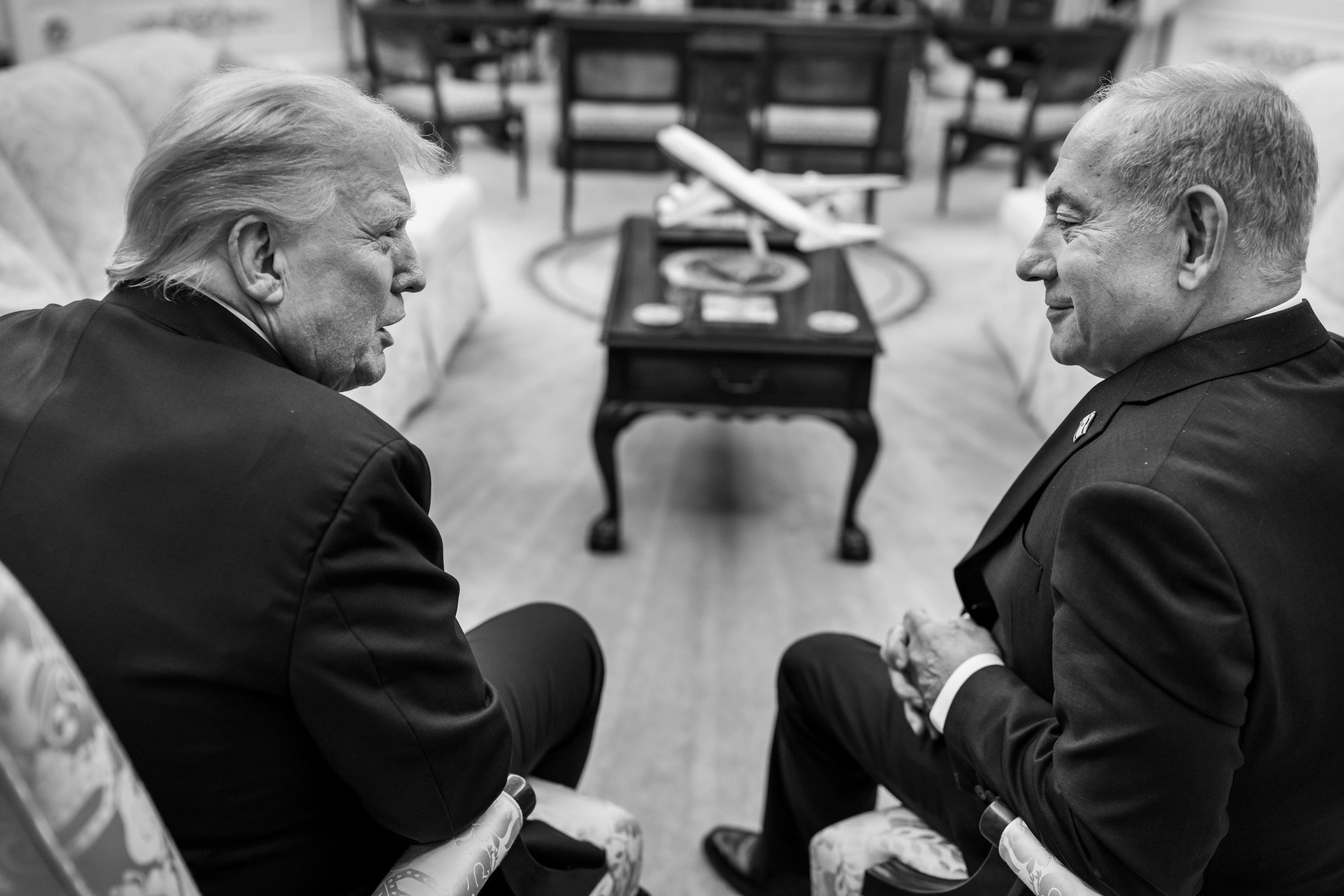
Now, not six months later, multiple news reports have indicated that Netanyahu is coming to the U.S. in around a week to ask President Trump to join in a reopening of the war on Iran. As reported by NBC, “Trump and Israeli Prime Minister Benjamin Netanyahu are expected to meet later this month in Florida at the president’s Mar-a-Lago estate. At that meeting, the sources said, Netanyahu is expected to make the case to Trump that Iran’s expansion of its ballistic missile program poses a threat that could necessitate swift action.”
Quite the Christmas present for President Trump and the American people: we get to wage a new, open-ended round of war for Netanyahu that may be much bloodier than the prelude in June, all because Netanyahu’s first war didn’t deliver lasting security gains.

Netanyahu has been previewing this push to reopen the war for months, vowing that this is the year to wipe out the Iranian axis and declaring that Iran’s enriched uranium stockpile - which survived, but may have been buried by the June strikes - must be eliminated. While the risk of another Iran war has not been discussed much in the American press, it has been a major topic of conversation for Israeli commentators, and the question is less “if” but “when.” Iranian leaders, caught flat-footed in the June war, have likewise prioritized readiness and vowed a punishing response.
The shift in focus from the nuclear program to missiles is worthy of note. The potential weaponization of Iran’s nuclear program has been a focus of American Presidents for decades, and has been treated as a major threat to American security. Yet, with Iran’s declared nuclear facilities lying in rubble, it’s hard to sell a new war designed to make the rubble bounce. So, Netanyahu is shifting from a potential threat to American security to one that is much less potent. Iran’s conventional missiles can, indeed, do damage to American soldiers, bases and infrastructure in the region. Yet Iran can’t come close to striking the American homeland with its current missile inventory. The missiles are primarily a deterrent, and one aimed at aggressors in the region who might do Iran harm, like Israel.
If Netanyahu gets his wish and brings the United States into the war over not a nuclear threat, but a conventional one largely deterring Israel, he will have rewritten the American baseline for Iran policy in fundamental ways. There is no reason to expect Netanyahu to stop demanding more hits of war, subsidized and led by the Americans, unless and until he receives a hard no or faces consequences for his reckless warmongering. This is a path that leads directly to a full American invasion and occupation of Iran to eliminate the current Iranian government, paid for with American blood and treasure.
President Trump can still put American interests first. Iran was careful to calibrate its response in June to try to avoid a full U.S. entry into the war. That would be extremely unlikely to be repeated if Iran watches Netanyahu once again maneuver the U.S. into a new round of war with Iran. The missiles that pounded Israeli cities throughout the war, some of which were shot down by vital American interceptors, could instead be targeted at U.S. bases, naval vessels or oil ships transiting the Persian Gulf. In Washington, Netanyahu will undoubtedly paper over these risks and present an image of a war that will be quick, easy and cost free - as all wars are sold. Trump would be making a major mistake to believe him.