

Three days ago, Iran Unfiltered argued that after nearly six months of war, neither Washington nor Tehran had succeeded in breaking the other side’s principal sources of leverage. Iran had retained enough military capacity to impose costs on U.S. forces and enough control over the Strait of Hormuz to keep shipping far below normal levels. The United States had inflicted enormous damage on Iran and absorbed much of the global energy shock, but it had failed to force Tehran to accept its terms.
Washington’s response to that stalemate is now becoming clearer: if overwhelming military power has not forced Iran to capitulate, the Trump administration intends to see if a pivot back to intense economic pressure can. President Donald Trump this week announced what he described as an unprecedented campaign of economic warfare and isolation against Iran. Vice President JD Vance described the conflict as entering a new phase in which economic pressure would become a central American instrument. Treasury Secretary Scott Bessent said Washington intends to combine the naval blockade with what he described as the toughest sanctions campaign ever imposed on a country.
This doesn’t mean the war is over. The naval blockade remains in place, which is widely viewed as an act of war and has involved U.S. naval vessels firing on ships seeking to pass the blockade lines, along with Iranian fire on commercial vessels transiting the Omani corridor. But moving the center of gravity from military operations toward economic warfare is also an implicit acknowledgment that nearly six months of military pressure have failed to achieve Washington’s central objective: forcing Iran to submit to U.S. terms.
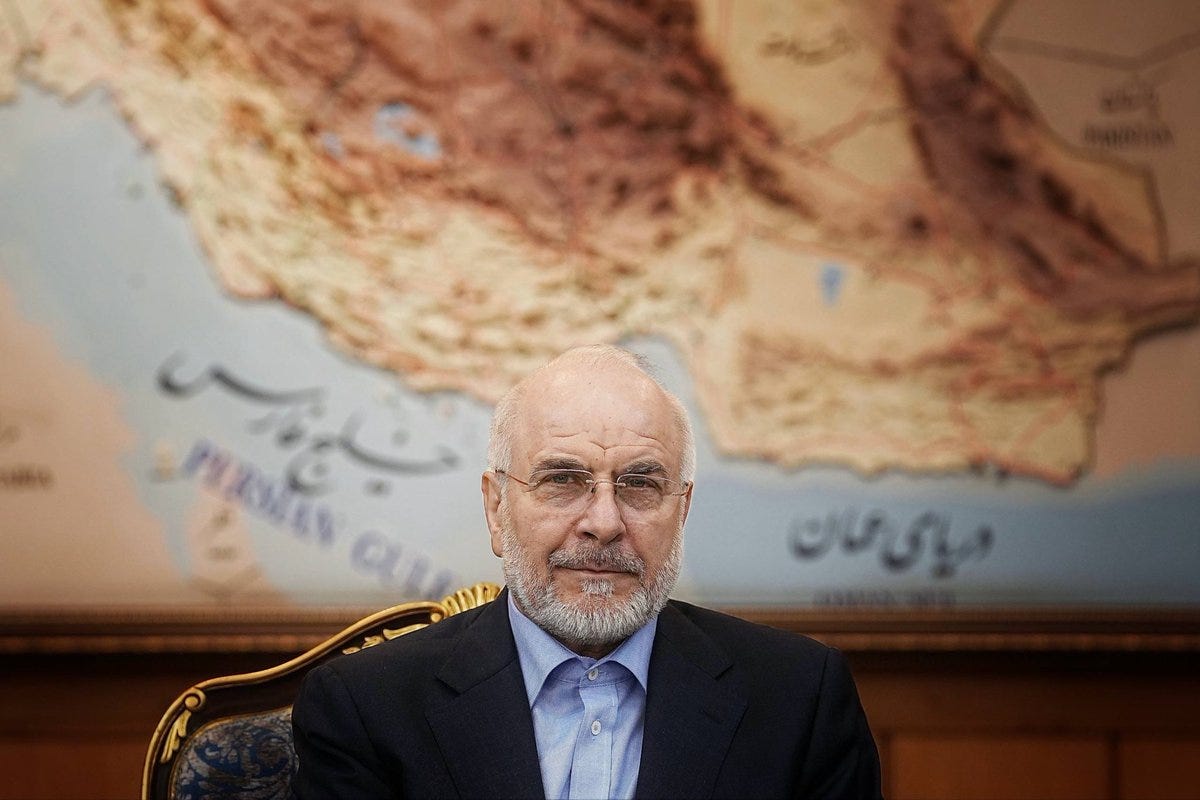
Now Washington is betting that Iran’s economy will prove easier to break. Senior Iranian officials, for their part, have acknowledged just how serious that vulnerability could be. Speaking to Iranian and Iraqi business leaders during his visit to Baghdad, Parliament Speaker Mohammad Bagher Ghalibaf offered an unusually direct assessment: “No matter how much military power we have, if the people are hungry and we do not have financial circulation, economic growth and national production, we cannot endure.” Ghalibaf’s trip has attracted attention largely because of Iran’s changing regional position, the future of Iran-aligned armed groups in Iraq and his talk of a “new regional order.” But the economic dimension of the visit may now be just as important.
Iraq is one of Iran’s most important economic partners and one of the places where Washington’s new strategy will be tested. Iran’s regional neighbors have been an important part of weathering sanctions pressures in the past, and sanctions do not inhibit many traditional trade flows. As Iran Unfiltered reported earlier this week, the United Arab Emirates remains a crucial hub for Iranian imports, re-exports, logistics and financial transactions. How far Abu Dhabi actually goes in enforcing its new publicly stated restrictions on Iranian trade could have a significant impact on Iran’s ability to withstand the new pressure campaign.
In Baghdad, Ghalibaf called for greater use of the Iranian rial and Iraqi dinar in bilateral commerce and less reliance on the U.S. dollar. Iraq, however, faces its own balancing act. It remains deeply intertwined economically with Iran while Washington retains substantial leverage over its financial system. Tehran will need to preserve those regional economic channels just as the United States tries to close them.
President Masoud Pezeshkian went further on Friday, making perhaps his clearest public argument yet for ending the war. “It is better to end the war today, when we are in a position of power and dignity,” Pezeshkian said. He described the Islamabad memorandum reached with the United States as a major achievement approved through consensus in the Supreme National Security Council, while stressing that advocating an end to the war did not mean accepting future coercion.
Pezeshkian is not publicly arguing that Iran should seek peace because it has lost the war. He is arguing that Iran should end the conflict while it can still present the outcome as successful resistance rather than capitulation.
That argument looks more urgent when set against conditions inside Iran. Officials now say gasoline consumption has reached approximately 135 million liters per day, while the restoration of war-damaged refining capacity, increased refinery output and the use of some petrochemical capacity have brought production to roughly 130 million liters per day. The government is debating politically sensitive changes to gasoline distribution, ranging from limiting supply once daily production is exhausted to restructuring subsidies around a per-person allocation.
Pezeshkian himself connected the gasoline problem to the government’s broader fiscal constraints. Iran, he argued, cannot indefinitely purchase expensive gasoline abroad and sell it domestically at heavily subsidized prices while also paying for food subsidies, wheat purchases, insurance obligations, salaries and other expenditures.
There are signs of similar pressure in healthcare. Reports this week showed sharp price increases for a number of medicines following changes affecting preferential foreign-exchange allocations. One pharmaceutical company reported average increases of roughly 120 percent across 82 products, with much larger increases for some individual drugs. Iran’s Food and Drug Administration disputes claims that this amounts to the sudden elimination of preferential currency across the pharmaceutical sector or a new across-the-board price shock. Officials say the latest changes apply only to certain intermediate materials and pharmaceutical precursors and insist that essential medicines continue to receive support. Regardless, the dispute points to a much larger problem: maintaining heavy subsidies for fuel, food and medicine becomes harder as access to foreign currency tightens and government finances come under pressure.
This is the weakness Washington now hopes to exploit. Maximum-pressure sanctions after the United States withdrew from the nuclear agreement in 2018 substantially reduced Iranian oil exports, weakened the rial, increased inflation and imposed enormous costs on the economy. However, they did not produce the political capitulation Washington sought.
The current campaign could inflict considerably greater damage. Iran is already operating under wartime conditions, maritime trade is constrained, and Washington is trying to pressure third countries and financial centers that provide Tehran with access to international commerce.
The consequences for ordinary Iranians could be severe: higher inflation, declining purchasing power, more expensive medicine and essential goods, and potentially deeper shortages.
But there is a basic strategic problem that greater pressure alone does not solve. The shift toward economic warfare may be an acknowledgment that the military campaign failed to compel Iran, but changing the instrument without changing the objective risks producing the same result. If Washington continues to define success as forcing Iran to capitulate rather than negotiating an agreement in which both sides can claim meaningful gains, there is little reason to assume another maximum-pressure campaign will succeed where previous sanctions and nearly six months of military operations have failed.
Tehran is already trying to find ways around the pressure. Ghalibaf’s emphasis on bilateral trade and national currencies is one example. Pezeshkian has emphasized commerce with neighboring states and greater use of Eurasian organizations and economic arrangements. The government has also pointed to increased rail trade with China as evidence that alternative land routes can partially compensate for maritime restrictions.
These measures cannot replace access to the global financial system or erase the consequences of a prolonged blockade. But they mean the outcome will depend not only on how much pressure Washington can impose, but also on how quickly Iran can adapt. The Strait of Hormuz gives Tehran leverage of its own. Traffic remains far below prewar levels, and reports that Chinese shipping companies have suspended some passages because of continuing security risks - and that Chinese-linked supertankers have turned around near the Strait - show that Washington has still not restored normal commercial navigation.
But Hormuz is a double-edged weapon for Iran. Restricting shipping imposes costs on the United States and its partners, while also complicating Tehran’s relations with neighbors and disrupting the trade connections Iran itself needs. Iraq, which depends heavily on oil exports through the Gulf, is a particularly clear example of that tension.
This is also why Pezeshkian’s call to end the war “while we are in a position of power and dignity” matters. It is not just another appeal for diplomacy. It is an argument about timing. If Tehran believes it has already demonstrated that the United States cannot easily defeat it militarily, it may have an opportunity to negotiate while it can still portray the outcome as successful resistance. Waiting until the economic consequences become much more severe could leave it negotiating from a weaker position.
Washington’s new strategy therefore creates a paradox. Economic pressure could strengthen the argument inside Iran for reaching an agreement sooner. But if Washington uses that opening to pursue capitulation rather than compromise, it could instead convince Tehran that the real objective is economic collapse and make an agreement harder to reach.
With a six month military campaign failing to produce a decisive outcome, Washington is now preparing to test whether economic power can accomplish what military superiority could not. The more consequential change, however, may not be switching from bombs to sanctions. It would be shifting the objective from compelling Iran’s surrender to reaching a sustainable agreement in which both sides can secure meaningful gains. Without that change, Washington risks repeating a familiar cycle: inflicting enormous costs on Iran and ordinary Iranians without achieving the political outcome it seeks.
Alas, it’s Israel, AIPAC, and other nefarious interest that influence the course of events.