

The Trump administration’s new “Economic D-Day” campaign is built around a sweeping objective: cut the economic connections that have allowed Iran to withstand six months of war and decades of sanctions. Announcing “Operation Economic Outcast” this week, Treasury Secretary Scott Bessent said Washington intends to sever “every economic lifeline” sustaining Tehran and warned governments, banks and companies that they could be forced to choose between economic ties with Iran and access to the United States.
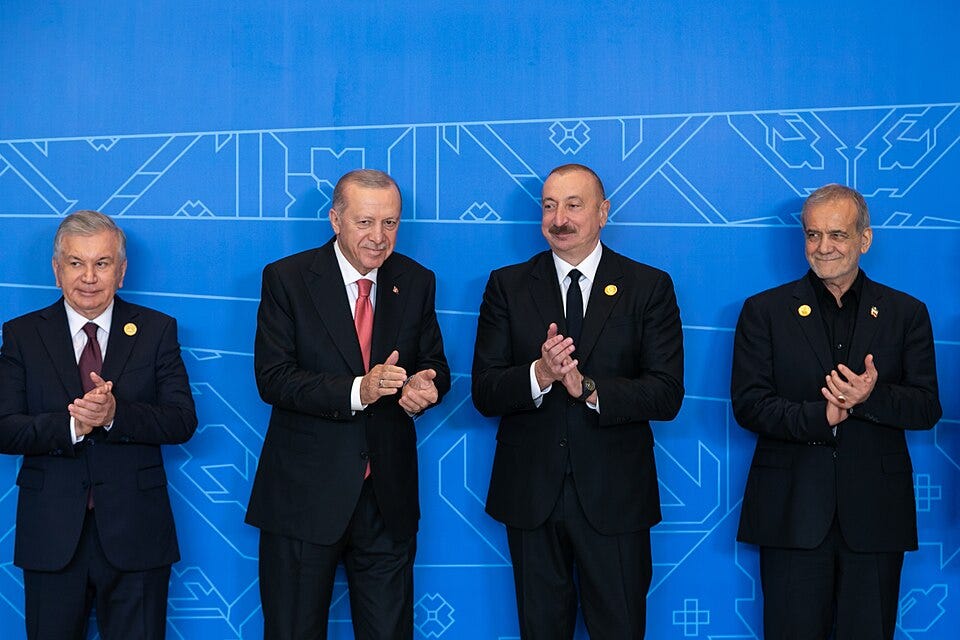

Iran is already under severe economic pressure, and Washington retains enormous leverage over international finance. Yet the experience of the war has exposed a potential obstacle to Washington’s strategy: Iran is surrounded by countries that have their own reasons to oppose cutting off a neighboring economy of 93 million people. Geography grants Iran a structural advantage against intense economic pressure. Iran has land or maritime boundaries with 15 countries, placing it among the states with the largest number of neighbors in the world. Its borders stretch from Turkey and Iraq in the west to Pakistan and Afghanistan in the east, the Caucasus and Central Asia in the north, and the Arab states across the Persian Gulf to the south.
That geography has often created security vulnerabilities for Iran, but in a campaign built around economic isolation it can also become an asset. A country connected to so many different markets, transportation corridors and political systems has more potential routes through which trade, humanitarian supplies and financial relationships can be redirected when one channel is closed. None can fully replace access to the global financial system or major commercial hubs such as the UAE, but closing all of them simultaneously requires Washington to secure cooperation from a remarkably diverse group of governments with very different interests.
The war has begun to demonstrate what that advantage can look like in practice. When maritime routes became more difficult, Iran turned more heavily toward rail and overland connections; when one commercial partner pulled back, other neighbors kept borders open, provided alternative transit routes or expanded cooperation.
Pakistan offers perhaps the clearest example. Even as Washington threatens countries maintaining economic ties with Tehran, Pakistan and Iran have been discussing how to expand them. The two governments have reiterated a target of raising bilateral trade to $10 billion, while working on barter arrangements, border markets, transportation and customs cooperation. More consequentially, Iranian and Pakistani officials have discussed using Karachi and Gwadar as alternative ports for Iranian trade with third countries, giving Tehran another potential route at a time when maritime access through the Persian Gulf remains constrained.
The discussions have continued through the current crisis. Iran and Pakistan held another meeting of their joint maritime and ports committee this week, while Islamabad has simultaneously emerged as one of the most important diplomatic intermediaries between Tehran and Washington. Field Marshal Asim Munir, Pakistan’s army chief, traveled to Tehran this week as part of those efforts. Pakistani officials said afterward that significant progress had been made toward finding a path back to negotiations. That creates an unusual contradiction at the heart of Washington’s new strategy: one of the countries the United States would need to help economically isolate Iran is simultaneously helping Tehran preserve alternative trade routes and trying to bring Iran and the United States back to the negotiating table.
Pakistan also demonstrates why the challenge is not purely economic. During the war, demonstrations expressing solidarity with Iranians and opposition to U.S. and Israeli attacks were held in several Pakistani cities. Dawn reported that hundreds gathered in Dera Ismail Khan in one such demonstration, joined by political and social groups. Jamaat-e-Islami, a major Sunni Islamist political movement, also organized protests against the attacks and in solidarity with Iran.
These demonstrations should not be interpreted as evidence that Pakistani society uniformly supports the Iranian government. It does not. But sympathy for Iranians, opposition to another regional war and hostility toward policies perceived as collectively punishing Iran can raise the domestic political cost of fully joining an American campaign to isolate the country. That distinction may become increasingly important as Washington attempts to turn financial pressure into regional policy.
Azerbaijan provides an even more striking example because its relationship with Iran before the war was anything but easy. For years, Tehran and Baku clashed over Azerbaijan’s close security relationship with Israel, regional transportation routes and mutual accusations of interference and security threats. At several points, the relationship deteriorated sharply enough to generate open warnings from both sides. Yet during the recent phases of war, that relationship moved in a different direction.
Azerbaijan sent humanitarian assistance to Iran. President Ilham Aliyev subsequently told Iranian President Masoud Pezeshkian that assistance would continue, while Pezeshkian publicly thanked Azerbaijan for its support during the conflict. Iranian officials have also said Azerbaijan helped keep transportation routes functioning and facilitated the movement of assistance from Russia into Iran.
Baku, for its part, publicly emphasized that Azerbaijani territory would not be used by another country to threaten Iran. The disagreements between Tehran and Baku have not disappeared, and it would be premature to describe the two countries as strategic partners. But the contrast is significant: a neighbor that had one of Iran’s most contentious regional relationships before the war became a source of humanitarian and logistical cooperation during it.
That experience was not unique to Azerbaijan. Turkmenistan sent medicines, medical equipment and other humanitarian supplies to Iran and kept its border crossings functioning. Iranian officials later credited Ashgabat with facilitating a humanitarian corridor that also allowed assistance from other countries to reach Iran. Armenia likewise sent medicines to Iran. Armenian Foreign Minister Ararat Mirzoyan described providing assistance to a neighboring country under such circumstances as natural, while Prime Minister Nikol Pashinyan had earlier said Tehran would not need to formally request assistance if Armenia saw a need it could meet.
This points toward a larger geographic reality: Iran’s northern borders connect it to countries that have their own economic and strategic interest in keeping trade routes open. While it cannot offset the entirety of Iran’s wartime losses, it is a considerable factor allowing Iran to weather intense military and economic pressure.
For the landlocked economies of Central Asia, the calculation can be even more concrete. Iran offers one of the region’s shortest routes toward the Persian Gulf and Indian Ocean. Central Asian governments have therefore continued pursuing transportation projects involving Iran even during the conflict.
One of the most striking examples came from Kazakhstan. In late June, Kazakhstan signed a 27-year agreement to develop and operate a logistics terminal at Iran’s Shahid Rajaee port, expanding a transportation corridor that would give Kazakh trade greater access to southern maritime routes. The significance for Washington’s strategy runs in both directions. Iran needs Central Asia as it searches for alternatives to traditional commercial routes. But Central Asian countries can also need Iran.
That makes economic isolation more complicated for Washington. In some cases, Washington is asking them to reconsider infrastructure, trade routes and investments designed around their own national interests.
Iraq presents another version of the same problem. The Iraqi economy is deeply connected to both Iran and the United States. Iran remains an important supplier and trading partner, while a post-invasion arrangement ensures that Iraq’s oil revenues are deposited in the Federal Reserve Bank of New York, providing Washington with enormous continuing leverage over Baghdad. Successive Iraqi governments have therefore spent years trying to maintain relations with both sides.
The war has made that interdependence even more visible. Iraqi officials have sought arrangements with Tehran to ensure Iraqi oil tankers can move safely through the Strait of Hormuz, with Iran granting special passage to Iraqi vessels following requests from Baghdad. For an economy overwhelmingly dependent on oil exports, Iraq now has a direct economic interest in maintaining a functioning relationship with Iran regardless of Washington’s broader strategy toward Tehran.
Domestic politics make the equation more difficult still. Iran remains deeply controversial inside Iraq, and years of Iranian political influence - including its longstanding relationships with Iraqi armed groups and political factions - have generated substantial resentment. But powerful Iraqi political and social constituencies also oppose the U.S. war and would resist seeing Baghdad transformed into an instrument for economically strangling its neighbor.
Opposition to economically isolating Iran should not automatically be interpreted as support for the Iranian government. Türkiye illustrates the same distinction from yet another direction. Ankara has substantial disagreements with Tehran and has worked to diversify some of its economic and energy relationships away from Iran. Yet when the war disrupted normal movement across the border, Turkish authorities kept commercial cargo moving through the three principal border crossings even while restricting ordinary passenger traffic.
For Türkiye, the question is not simply whether it agrees with Tehran. Iran is a large neighboring country connected to Turkish calculations involving trade, energy, border security, migration and regional stability. Economic collapse or prolonged warfare next door would create costs for Turkey that Washington does not have to bear directly.
This helps explain why the regional response to Iran’s isolation cannot be reduced to a binary choice between supporting Tehran and supporting Washington. Some of Iran’s neighbors may sympathize with Iranians suffering through the war. Others may oppose U.S. military action while strongly disagreeing with the Islamic Republic. Still others may simply conclude that cutting trade, transportation or energy connections with Iran would damage their own economies.
Often, all three calculations coexist. None of this means Economic D-Day cannot impose considerable harm. Nations may downgrade their levels of trade and cooperation under pressure, and workarounds may not be able to deliver the level of trade Iran needs to stay afloat.
But six months of war have demonstrated that Iran’s regional connections are not sustained only by ideology or support for the Islamic Republic. Iran cannot simply be removed from the map. That reality creates a choice for Washington. Economic pressure may provide additional leverage for diplomacy, particularly if Tehran concludes that the costs of continued confrontation are becoming unsustainable. But if the objective becomes the complete economic isolation of Iran, the United States will find itself asking neighboring governments to absorb significant economic and political costs of their own.
There is also a longer-term risk. The more difficult Washington makes Iran’s traditional economic relationships, the stronger Tehran’s incentive becomes to build alternative routes through Pakistan, the Caucasus, Central Asia, Russia and China and to develop financial arrangements less exposed to U.S. pressure. Economic isolation can weaken Iran in the short term while simultaneously accelerating its search for economic networks outside Washington’s reach, undermining the efficacy of pressure over the long term.
Whether Iran’s alternatives are significant enough to compensate for lost access to major financial centers remains an open question. Iran’s economic difficulties suggest they are not a 1-for-1 replacement, at least for now. But while Washington may be able to make Iran’s relationships with its neighbors more costly, making those relationships disappear is a much harder proposition. A country with 15 land and maritime neighbors has many doors to the outside world, and Washington will have to close far more than one of them to achieve genuine isolation.