

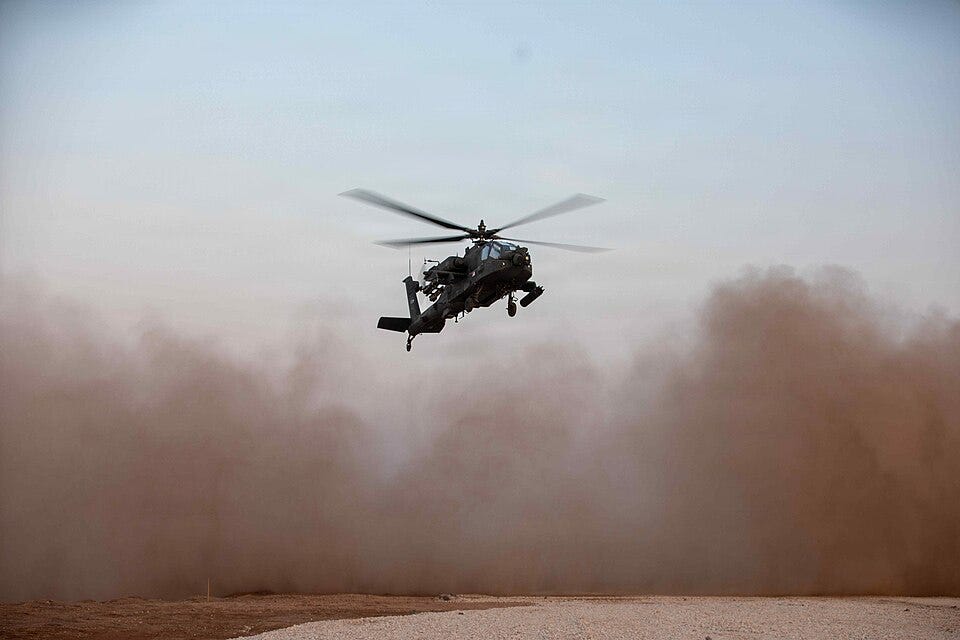
Another cycle of U.S.-Iran retaliatory strikes appears imminent as President Trump has asserted that yesterday Iran “shot down one of our highly sophisticated Apache Helicopters while patrolling over the Strait of Hormuz. There were two pilots involved, both are safe and uninjured.” He continued, “the United States must, of necessity, respond to this attack.”
Additional details, including what precipitated the apparent shooting down of an Apache helicopter, were not immediately available. The U.S. has tried at various points to militarily escort tankers through the narrow Strait of Hormuz, which has often triggered significant exchanges of fire as Iran seeks to continue its own restrictions on commercial and military traffic through the vital energy chokepoint. Coming on the heels of major Iran-Israel strikes, the tempo of violations of the ceasefire brokered on April 7 appears to be increasing, dampening possibilities of a diplomatic breakthrough while heightening risks of a return to full-scale war.
.jpg)
Additionally, Iranian media have reported that two members of the Iranian Army’s Air Defense Force were killed during Israeli strikes carried out on Monday, marking the first publicly acknowledged fatalities linked to the latest round of Israeli attacks on Iran. According to Iran’s Tasnim News Agency, the two servicemen, Bahman Hosseini and Alireza Abiri, were killed while carrying out operational duties during the recent limited military exchanges between Iran and Israel. Their funeral ceremonies were reportedly held on Tuesday.
The announcement is significant because Iranian authorities had previously reported no fatalities from the Israeli attacks conducted on Monday and Tuesday, stating only that 15 people had been injured. The confirmation of the deaths therefore represents the first officially-reported fatalities associated with the latest escalation.
The Israeli military stated on Tuesday that it had conducted a “comprehensive” operation against strategic Iranian air defense systems. According to the Israeli military, Iran’s air defense capabilities were significantly degraded during the 12-day war earlier this year, but Iranian forces subsequently attempted to rebuild those capabilities by deploying and repositioning air defense systems across different parts of the country.
Israeli officials claimed that the latest operation specifically targeted these reconstruction efforts and that multiple air defense systems deployed to restore Iran’s defensive network were destroyed. The strikes were described as part of an effort to prevent Iran from reestablishing the air defense coverage that had been weakened during the previous conflict.
Recent developments, however, suggest a more complicated picture. While Iran’s air defense network has not proven capable of preventing Israeli aircraft and missiles from operating inside Iranian airspace, it has demonstrated that it retains at least some operational capability and can do damage - even to advanced American fighter jets. During the 39-day war, Iranian air defenses reportedly engaged a number of Israeli and U.S. aircraft, and damaged one F-35 fighter jet and hit or downed several other aircraft. Others appear to have avoided damage or destruction following near misses. Reports from the conflict also indicated that two downed pilots landed inside Iran and were later rescued, though this remains unconfirmed. Regardless, along with the apparent shoot down of the Apache helicopter, numerous incidents suggest that Iran’s air defense network retains the ability to challenge hostile air operations.
A second notable development concerns Iran’s missile force. During the 39-day war, Israeli and U.S. forces repeatedly targeted Iranian missile bases, launch sites, and underground missile tunnel complexes in an effort to reduce Tehran’s ability to launch retaliatory strikes. However, the missile launches carried out by Iran in recent days appear to have originated from some of the same facilities that were reportedly attacked during the conflict.
This underscores that the strikes do not appear to have caused lasting damage as sometimes claimed. In some cases, the attacks only temporarily disrupted operations or damaged tunnel entrances and supporting infrastructure, rather than destroying the underground facilities themselves. The continued use of these bases both before and after the ceasefire indicates that significant portions of Iran’s missile infrastructure either survived the attacks or were restored to operational status relatively quickly, allowing Tehran to maintain missile-launch capabilities despite an extensive bombing campaign against its strategic missile network.
Overall, the recent conflict demonstrated that while Israel and the United States were able to inflict significant damage on Iran’s military infrastructure, the campaign did not fully eliminate either Iran’s air defense network or its missile-launch capabilities. The continued operation of both systems suggests that military action alone may be insufficient to permanently resolve the underlying security concerns, reinforcing the importance of diplomatic negotiations as a more sustainable path toward addressing the dispute.