

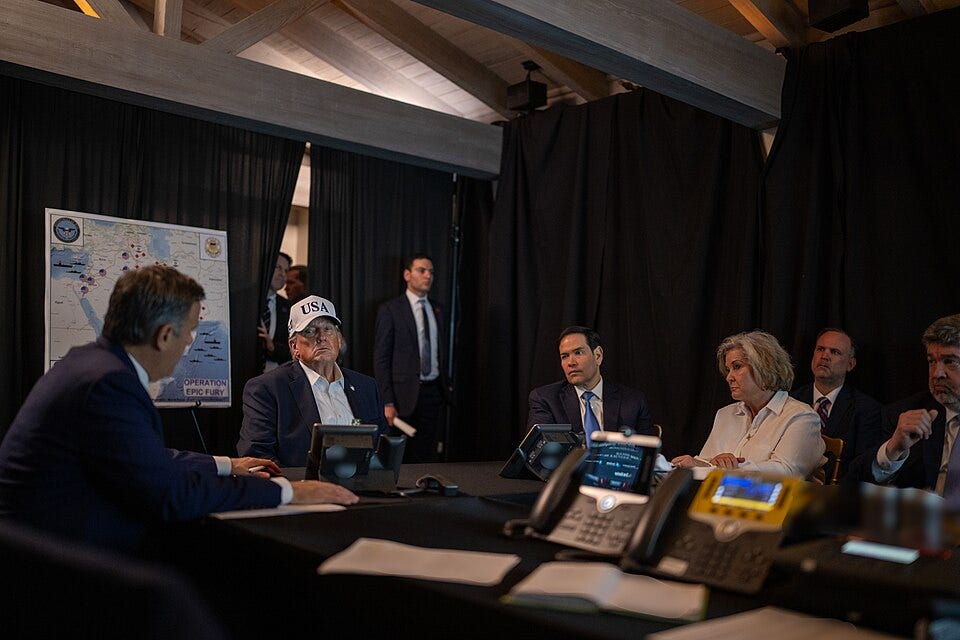
Posting on Truth Social Monday, President Trump claims to have called off a renewed military assault on Iran at the request of the leaders of Qatar, Saudi Arabia and the United Arab Emirates. He also claimed significant progress toward a new nuclear deal. According to President Trump:
“I have been asked by the Emir of Qatar, Tamim bin Hamad Al Thani, the Crown Prince of Saudi Arabia, Mohammed bin Salman Al Saud, and the President of the United Arab Emirates, Mohamed bin Zayed Al Nahyan, to hold off on our planned Military attack of the Islamic Republic of Iran, which was scheduled for tomorrow, in that serious negotiations are now taking place, and that, in their opinion, as Great Leaders and Allies, a Deal will be made, which will be very acceptable to the United States of America, as well as all Countries in the Middle East, and beyond. This Deal will include, importantly, NO NUCLEAR WEAPONS FOR IRAN! Based on my respect for the above mentioned Leaders, I have instructed Secretary of War, Pete Hegseth, The Chairman of The Joint Chiefs of Staff, General Daniel Caine, and The United States Military, that we will NOT be doing the scheduled attack of Iran tomorrow, but have further instructed them to be prepared to go forward with a full, large scale assault of Iran, on a moment’s notice, in the event that an acceptable Deal is not reached. Thank you for your attention to this matter! President DONALD J. TRUMP.”
_(55121599389).jpg)
It remains unclear at the time of publication whether Trump had truly ordered a renewed assault on Iran, or if the claim is part of the back and forth issuance of threats between the U.S. and Iran that has transpired amid backchannel negotiations and exchanges of diplomatic proposals. Three months after the United States and Israel launched a war on Iran, and six weeks into a ceasefire that neither side has formally abandoned but both have repeatedly violated, both sides are signaling their readiness for the possibility of renewed confrontation. The result is a dangerous pattern in which every diplomatic opening is matched by new military signaling, strategic threats, and demonstrations of technological vulnerability.
Signs of new diplomatic movement came after Donald Trump’s return from Beijing. After months of demanding the permanent dismantlement of Iran’s nuclear program, Trump publicly stated that he could accept a “20-year suspension” of Iranian uranium enrichment if it were “a real 20 years.” Reports now suggest negotiators are discussing a possible 12–15 year compromise framework, with Pakistan continuing to serve as a key mediation channel between Tehran and Washington.
Washington also appears to have softened parts of its earlier position regarding Iran’s frozen assets and nuclear restrictions. According to Reuters and regional reporting, negotiations reportedly include a partial release of frozen Iranian funds, with discussions involving the possible unfreezing of up to 25 percent of Iranian assets restricted in line with U.S. sanctions during an initial phase. Discussions have also shifted away from demands for the total dismantlement of Iran’s nuclear infrastructure toward tighter limits and long-term restrictions under international monitoring. Iran’s Foreign Ministry confirmed that indirect exchanges with Washington continue through Islamabad, while Foreign Minister Abbas Araghchi stated that Tehran would return to negotiations once convinced the United States is “serious.”
Yet while diplomacy continues, the rhetoric from both sides has grown noticeably more alarming. Along with Trump’s claim that he canceled plans for a new military assault, Iranian state television, IRGC-linked media, and military analysts are increasingly discussing forms of escalation that extend far beyond conventional missile exchanges. A growing focus has emerged around the vulnerability of the infrastructure that supports globalization itself: orbital satellite networks, undersea internet cables, cloud data centers, energy corridors, and civilian nuclear infrastructure.
In recent days, Iranian state media analyses have openly explored the fragility of the rapidly expanding Low Earth Orbit (LEO) environment. Analysts on Iranian television argued that modern space infrastructure has become increasingly vulnerable due to the explosive growth of commercial and military satellite constellations. They warned that in any major geopolitical crisis, even a limited disruption in orbit - whether caused by collision, sabotage, electronic warfare, or kinetic attack - could trigger a cascading chain reaction of debris and system failures.
The concern reflects a broader global fear often described by aerospace analysts as the Kessler Syndrome: a scenario in which one major orbital collision creates thousands of fragments that then strike other satellites, producing further collisions in a self-sustaining chain reaction. Because LEO is now densely populated with communication, reconnaissance, navigation, and commercial satellites, even a relatively limited incident could rapidly spread across interconnected systems, disrupting telecommunications, GPS navigation, banking systems, aviation coordination, military communications, and large parts of the global digital economy.
Iranian analysts argued that creating disruption in orbit may, in some circumstances, be easier and cheaper than penetrating multiple advanced air-defense systems to strike heavily protected terrestrial targets. Rather than sending missiles through layers of regional defenses, they suggested that a destabilizing event involving satellites in a crowded orbital corridor could create disproportionate consequences for global infrastructure. The discussion reflects a broader Iranian emphasis on asymmetric pressure points and technologically interconnected vulnerabilities.
This rhetoric has emerged alongside growing Iranian discussion of other strategic chokepoints. IRGC-linked Tasnim News published detailed mapping of the undersea fiber-optic cable systems running beneath the Strait of Hormuz, framing them as potential pressure points for the global economy. Iranian state television also highlighted the cloud infrastructure and data centers of the UAE, Bahrain, and Qatar as vulnerabilities that could become relevant in any future escalation. Analysts warned that disruption to submarine cable systems could damage financial transactions, internet traffic, cloud services, and military communications across multiple continents. While experts note that any attempt to physically disrupt these networks could be technically difficult and legally risky, the discussion itself reflects a growing focus on digital and economic coercion as part of Iran’s deterrence strategy.
Notably, on May 17, a drone strike caused a fire near the Barakah nuclear power plant in the UAE, marking one of the most sensitive incidents since the ceasefire began. According to Emirati authorities and the IAEA, one of three drones struck an electrical generator outside the plant’s inner perimeter, while two others were intercepted. The incident caused no casualties or radiation leak, though one reactor reportedly temporarily switched to emergency diesel power. During the war’s more active phase, energy infrastructure in Saudi Arabia, Qatar, Kuwait, and the UAE came under repeated attack.
The UAE stated that investigations into the source of the drones were ongoing. While some Emirati, Israeli, and regional sources suggested possible involvement by Iran or Iran-linked actors, no group officially claimed responsibility and the UAE stopped short of publicly and definitively accusing Tehran. The IAEA nevertheless described the incident as a matter of “grave concern,” warning that military activity near civilian nuclear infrastructure risks dangerous escalation and potential regional catastrophe.
Meanwhile, according to a Financial Times report later cited by Reuters, Iran used Chinese satellite intelligence during the war to help monitor U.S. military activity in the Gulf - a claim that Beijing has denied. If accurate, such capabilities could complicate future American force positioning and military planning in the region. Senior Iranian military figures have also warned that targets previously avoided during the first phase of the war may now fall within the “operational priority list” if hostilities resume.
At the same time, events inside Israel have added another layer of uncertainty and tension. On May 17, a large late-night explosion and fireball were reported near Beit Shemesh at a testing area connected to Israel’s state-owned Tomer rocket propulsion company, which develops and tests missile and rocket engines for Israel’s defense industry. Initial reports described the event as a “controlled explosion,” but the scale of the blast, the late-night timing, the temporary restrictions around the site, and conflicting local statements quickly fueled speculation and public concern.
Israel’s Tomer company later stated that the incident was part of a pre-planned experiment coordinated with emergency services. However, local reporting indicated that municipal authorities themselves had not been fully informed beforehand. The visual characteristics of the explosion - including a large mushroom-shaped fireball - also led some Israeli analysts and commentators to question whether the event resembled a routine engine test.
The United States and Israel are meanwhile signaling their own readiness for renewed conflict. U.S. cargo aircraft have continued transporting military equipment to Israel, while Israeli media report that the IDF remains on elevated war readiness. According to multiple reports, Washington and Tel Aviv are reviewing options ranging from expanded air campaigns to operations targeting Iran’s underground nuclear infrastructure. Senator Lindsey Graham publicly called for placing Iran’s energy infrastructure “at the top of the list” of potential targets in any future confrontation.
The broader picture is one of a conflict whose potential battlefield is rapidly expanding. What began as a confrontation centered on nuclear facilities, missile strikes, and maritime pressure is increasingly evolving into a competition over the infrastructure of modern interconnected civilization itself: energy corridors, cloud computing systems, submarine internet cables, financial networks, civilian nuclear facilities, and orbital satellite infrastructure.
This is what makes the current phase especially dangerous. Both sides appear intent on signaling their readiness for full-scale war, while simultaneously raising the potential costs of that war if diplomacy fails. Every negotiation proposal is accompanied by demonstrations of new vulnerabilities, new targets, and new escalation pathways. In such an environment, even accidents, technical failures, or misunderstood events - whether in the Strait of Hormuz, a Gulf energy facility, a missile testing site in Israel, or in orbital space itself - can quickly become catalysts for a much broader crisis.