

Before the first strike fell, Iran was already carrying a wound that had never fully healed. Decades of layered sanctions had not simply constrained the economy, they had reshaped it from the inside. Sanctions forced workarounds where open trade once flowed, pushing a generation of entrepreneurs into informality, and eroding the institutional capacity of a state that might otherwise have managed its resources with greater effect. National income per capita had fallen from roughly $8,000 in 2012 to around $5,000 by the mid-2020s. Inflation was chronic. The rial had lost so much of its value that ordinary citizens had long since learned to denominate their savings in dollars, gold, or anything harder than the national currency. By early 2026, Iran’s economy was a structure held together by ingenuity and habit more than by institutional strength. The war did not create this fragility. It detonated it.
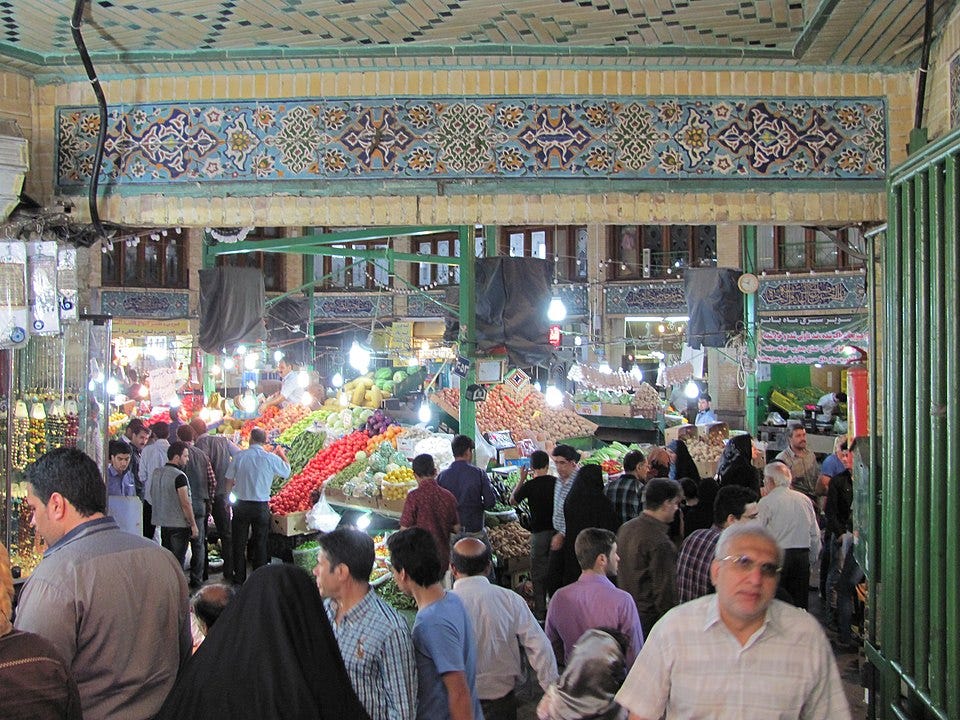
And yet what followed, during the first 40 days of war, was something that surprised many observers: a degree of economic endurance that defied the most pessimistic expectations. The bombing campaign targeted military installations along with civilian infrastructure like steel plants, petrochemical complexes, and oil depots, yet there were no significant reported signs of extreme duress, such as shortages of fuel at the pump, bread lines or collapsing medicine supply chains. The electrical grid was largely maintained. For a country absorbing that level of sustained aerial punishment, this was not a trivial achievement. Iran’s decades of living under sanctions had, paradoxically, built a set of muscles that a more open economy might never have developed.
Parallel supply systems, informal import networks, state-managed distribution of essentials, and a population accustomed to scarcity as a baseline condition created a distributed shock absorption. The resilience was not only military. It was logistical, social, and in its own imperfect way, economic. The government managed rationing and prioritization in ways that prevented the most acute humanitarian emergencies from materializing during active combat. People endured. Businesses improvised. The fabric held. This survival itself was a form of resistance. This resistance was not loud or dramatic, but structural and stubborn, woven into the daily decisions of a population that had been dealing with scarcity for thirty years.
But wars do not end when the shooting stops, and pressure on the Iranian economy is significantly growing amid stalemated nuclear negotiations, with pressure being felt by ordinary citizens. The electricity grid, which held during the war, is now showing strain. The Vice President has acknowledged serious energy imbalances and warned conditions will deteriorate further. The same industrial infrastructure that was sustained amid bombardment is now operating under cumulative damage that is becoming more visible. Mobarakeh Steel Isfahan and Khuzestan Steel, the backbone of Iranian manufacturing, are operating at sharply reduced capacity or not at all, with ripple effects across auto parts, textiles, construction, and packaging.
The inflationary picture is severe. The national currency has broken through 1.84 million rials to the US dollar. Inflation has reached 53.7%, rising to 58.2% for low-income households. Food inflation has crossed 115% year-on-year. Bread and cereals are up 140%, red meat and poultry 135%, oils and fats 219%, and dairy nearly 117%. A single egg costs around 20,000 tomans. Red meat exceeds 2.2 million tomans per kilogram. Meanwhile, the monthly minimum wage, even after a 60% increase, is under $92, the lowest in the region. The IMF projects a 6.1% contraction in 2026, while the World Bank notes a 2.7% contraction before the war’s peak impact.
.jpg)
The scale of job destruction is staggering. One million jobs were lost directly, with another one million lost via indirect effects. More than 150,000 new unemployment insurance registrations were recorded in weeks. A single day saw 318,000 job applications, a 50% surge. Unemployment may rise from 7.6% to around 15%, or closer to 20% including informal workers. The UNDP warns that 4.1 million more people could fall into poverty.
The internet blackout, now extending past sixty days, has hit one of the most dynamic sectors. E-commerce, freelancing, and digital work have been paralyzed. Digikala - a major online marketplace - has conducted mass layoffs. Tech startups have cut 40–60% of staff. A major AI venture with 800 billion tomans of investment has been suspended. ILNA has laid off most of its staff. More than 23,000 industrial and commercial units have been damaged or shut down.
Externally, pressure compounds everything. The closure of the Strait of Hormuz - responsible for over 90% of Iran’s trade - has cut off more than $30 billion in annual oil revenue. Energy previously made up roughly 25% of government revenue. The state now faces the near-impossible task of funding reconstruction, sustaining military operations, subsidizing 90 million people, and paying wages without its main income source. Officials warn that recovery may take more than a decade, meaning an entire generation will grow up in a constrained economy.
And yet Iran has built parallel economic systems over decades: barter trade, gold-based transactions, and regional trade networks bypassing the dollar. Some analysts suggest sanctions relief could enable faster recovery, though this depends on uncertain political outcomes.
What is not uncertain is the direction: pressure is intensifying. Poverty is rising. Purchasing power is eroding. Infrastructure is under strain. The labor market is under severe stress. Ordinary people are carrying the burden, with many workers earning less than $100 per month, business owners losing savings and many professions shedding jobs.
Yet historically, Iran has endured. It survived eight years of war with Iraq and decades of sanctions. Whether this moment becomes another chapter of endurance or a breaking point remains uncertain.
All of this feeds into strategic calculations in Washington, where the Trump administration appears to have embraced the theory that maximalist pressure on Iran will become unbearable and force collapse or surrender. But this theory has a poor historical track record. The Iranian system is structurally insulated from public economic pressure, demonstrated by long-term internet shutdowns, suppression of protests, and control over essential goods. Instead, this strategy creates a bilateral cost on civilians: Iranians pay through collapsing wages and rising prices, while Americans face higher fuel and food costs. Meanwhile, hardliners on both sides remain insulated, leaving ordinary people to bear the consequences.
Thanks for this very informative piece. Sad and slightly hopeful at the same time, thanks to the resourcefulness and resilience of ordinary Iranians. It was entirely predictable to me, and many others, that bombing from the air, conducted by two genocidal global superpowers, US and Israel, and supported by another old colonial power, the UK (who in its own time inflicted misery and death around the world) would not bring freedom and prosperity to the peoples of Iran, or democracy, or anything resembling justice. Those goals were not even in the designs of those who planned and perpetrated this criminal war.