

The NIAC Capitol Insider is a newly launched digest tracking the latest from Congress on Iran-related policy developments, legislation, votes and more. This resource is designed to give our community a clearer, more comprehensive understanding of how Congress is approaching Iran policy by breaking down votes, providing policy analysis, and updating on key congressional actions.
First Republican Flip in the Senate
The 60 Day Deadline has Passed - Now What?
Republicans Begin Drafting War Authorization
Secretary of Defense Pete Hegseth Faces Congress
Looking Ahead — More War Powers Votes Incoming
Bicameral Push for Temporary Protected Status for Iranians
Last week we saw movement but no breakthroughs in Congressional efforts to pass an Iran War Powers resolution to terminate the President’s war in Iran. With the war crossing the 60-day mark – a critical legal deadline for the President to secure Congressional authorization for unauthorized hostilities under the War Powers Act – scrutiny of the administration’s actions on Capitol Hill is intensifying. The moment is exposing divisions within the Republican Party and raising new questions about whether the Trump administration will proceed with seeking a formal authorization for war or continue operating illegally without it.
Perhaps relatedly, President Trump is now suggesting that the U.S. and Iran are close to reaching a memorandum of understanding to end the war (and avoid any need for Congressional authorization). See NIAC’s official statement on those latest reports. Nonetheless, the massive humanitarian and fiscal impact of this war, along with its significant illegality, will still demand accountability and oversight from Congress.
First Republican Flip in the Senate
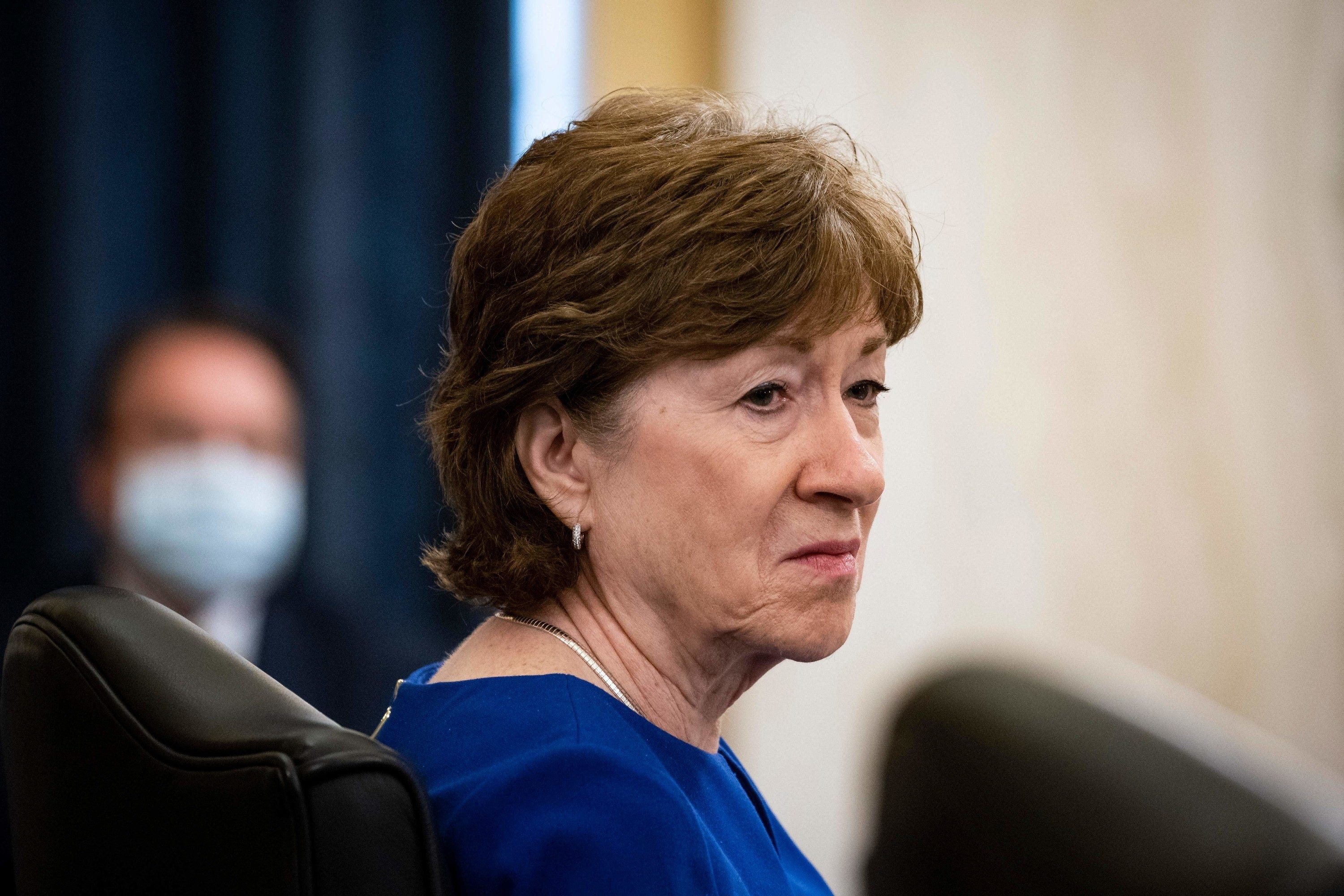
Last week, the Senate voted on S.J.Res. 184, the latest Iran War Powers Resolution led by Senator Adam Schiff (D-CA). While all five previous war powers votes had retained the same vote outcome, Senator Susan Collins (R-ME) became the first Republican besides Senator Rand Paul (R-KY) to break with her party and vote in favor of the Iran war powers resolution after voting against it previously.
Senator Collins’ shift is significant. Up until now, Republican leadership has largely held the line against war powers resolutions, even as concerns about escalation and lack of authorization have grown. Collins’ reversal signals potential cracks in that unified front, particularly as the legal and political pressure surrounding the war intensifies.
This development comes as Congress moves closer to another round of votes that could determine whether Congress will meaningfully reassert its authority over war-making by finally passing a war powers resolution.
The 60 Day Deadline has Passed - Now What?
Under the War Powers Resolution of 1973, the “60-day clock” refers to the period after U.S. forces are introduced into hostilities, without prior authorization, during which the president must either obtain congressional authorization or end military involvement.
The War Powers Resolution’s 60-day clock has officially expired, triggering a legal requirement for the administration to either seek congressional authorization for continued military engagement, or certify that additional time (up to 30 days) is needed to safely withdraw U.S. forces. So far, the administration has done neither.
The absence of either action underscores what critics have argued from the start, that this conflict has been unlawful since day one. As correctly outlined in a recent piece in Just Security, President Trump’s Iran war was already “doubly illegal” as a direct violation of both the U.S. Constitution and the UN Charter. And now, with the 60 day deadline having passed, the war is “triply illegal.”
Right now, the war’s growing illegality does not appear to be shifting lawmakers’ stances in a major way. This provides the President a de facto pass to continue prosecuting hostilities against Iran. If diplomacy fails and military escalation spikes, however, dynamics could shift once again.
Republicans Begin Drafting War Authorization
At the same time, a group of Senate Republicans continue work on a draft Authorization for Use of Military Force (AUMF) related to Iran, which is a measure passed by Congress and signed by the President that would provide specific, statutory authorization to engage in military hostilities.
Efforts to draft a new war authorization carry significant risks, as they could effectively provide permission for continuing a conflict that has already proven destabilizing, while further entrenching a broader precedent of expanded executive war authority.
While the effort poses some risk, Republican Senate Majority Leader John Thune has suggested an authorization would not be necessary “at this point.” This suggests there would be trepidation among some members of his caucus of tying themselves closer to a war that is unpopular and backfiring.
While Murkowski and some of her colleagues argue that military action should be formally authorized, that position must be weighed against the realities and consequences of the ongoing war. After more than 60 days, the question is not whether the administration should be given the opportunity to obtain a legal authorization for the war, but how this already illegal war should be brought to an end.
An alternative for Senate Republicans to pursue is rallying to advance war powers resolutions aimed at ending the unauthorized war, full stop. With Sen. Susan Collins’ break last week with the party, momentum is beginning to build in favor of renewed war powers efforts.
Secretary of Defense Pete Hegseth Faces Congress
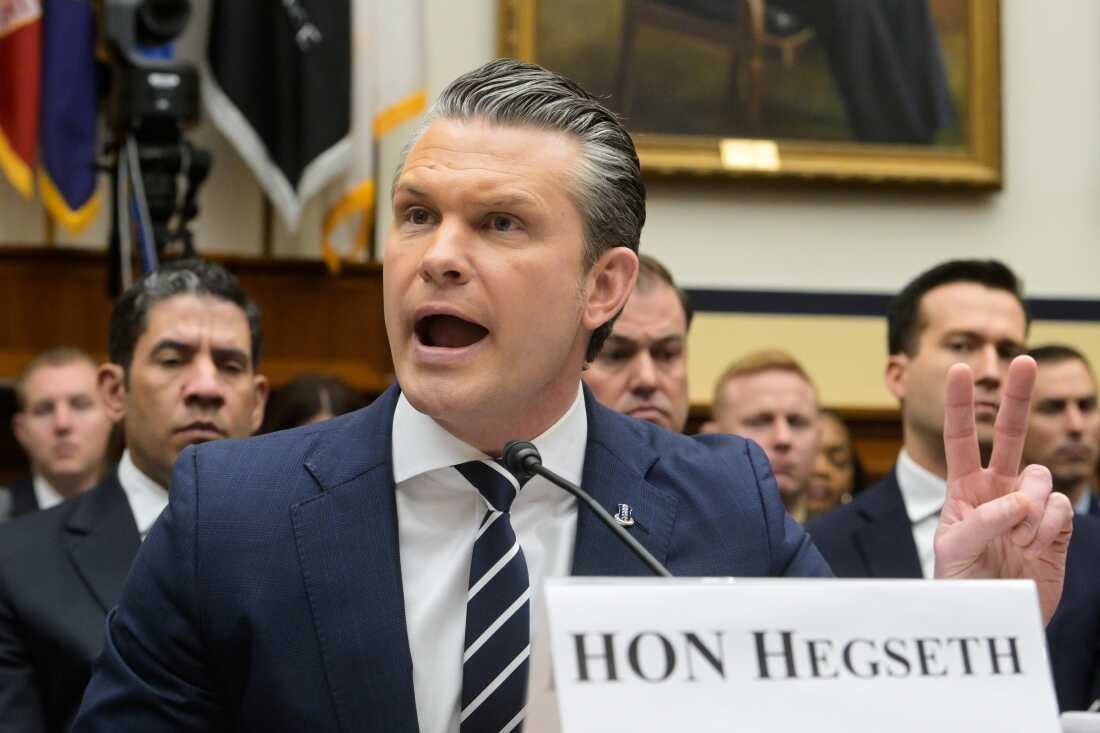
Defense Secretary Pete Hegseth faced tough questioning on Capitol Hill last week, with lawmakers pressing him on the administration’s strategy, legal justifications, and endgame in Iran.
In his first appearance before Congress since the war began, Hegseth was met with sharp skepticism from Democrats over the war being waged without congressional authorization and with mounting costs, which Pentagon officials said had reached roughly $25 billion (the actual costs are likely at least double that total). Lawmakers also raised concerns about the lack of a clear strategy, the strain on U.S. military resources, and civilian harm, including scrutiny of the use of AI in targeting decisions, an approach tied to the bombing of the school in Minab early on in the war.
Hegseth defended the Trump administration’s approach, bombastically at times, asserting that the campaign was both effective and necessary, even as members of Congress challenged what they described as an overly optimistic portrayal of the war and its outcomes.
When pressed on the expiration of the 60-day deadline under the War Powers Resolution of 1973, Hegseth argued that the ongoing ceasefire effectively “pauses” the clock. That claim is not supported by the statute, a point emphasized during questioning by Sen. Tim Kaine. This kind of interpretation is further called into question given the ongoing U.S. naval blockade in the Strait of Hormuz, which is widely regarded as an act of war.
The hearing underscored the continued and growing disconnect between the administration’s framing of the war and congressional concerns about its costs, legality, and trajectory, further fueling calls for greater oversight and renewed efforts to reassert Congress’s role in decisions of war and peace.
Looking Ahead — More War Powers Votes Incoming
Momentum is building for additional war powers votes in both chambers. In the House, at least half a dozen resolutions have already been filed and are expected to come up for a vote once they ripen, including measures introduced by Reps. Gregory Meeks (D-NY), Pramila Jayapal (D-WA), Maxine Dexter (D-OR), Jared Huffman (D-CA), John Garamendi (D-CA), and Ro Khanna (D-CA).
While earlier war powers votes in the House were decided by narrow margins, making passage plausible, the outcome will ultimately hinge on a small group of swing votes, which include Reps. Nancy Mace (R-SC), Warren Davidson (R-OH), Lauren Boebert (R-CO), and Jared Golden (D-ME).
The positions of these swing votes are likely to be shaped by both attendance dynamics and the evolving situation on the ground. If the current ceasefire holds, even amid reports of continued hostilities and isolated acts of war, support for war powers may be more limited. However, if hostilities fully resume and the ceasefire formally collapses, backing for the resolutions is expected to grow, particularly in the context of mounting legal pressure following the expiration of the 60-day war powers deadline.
As a result, while passage remains very much in play, the trajectory of events in the coming weeks will be decisive in determining whether these resolutions ultimately succeed.
Bicameral Push for Temporary Protected Status for Iranians
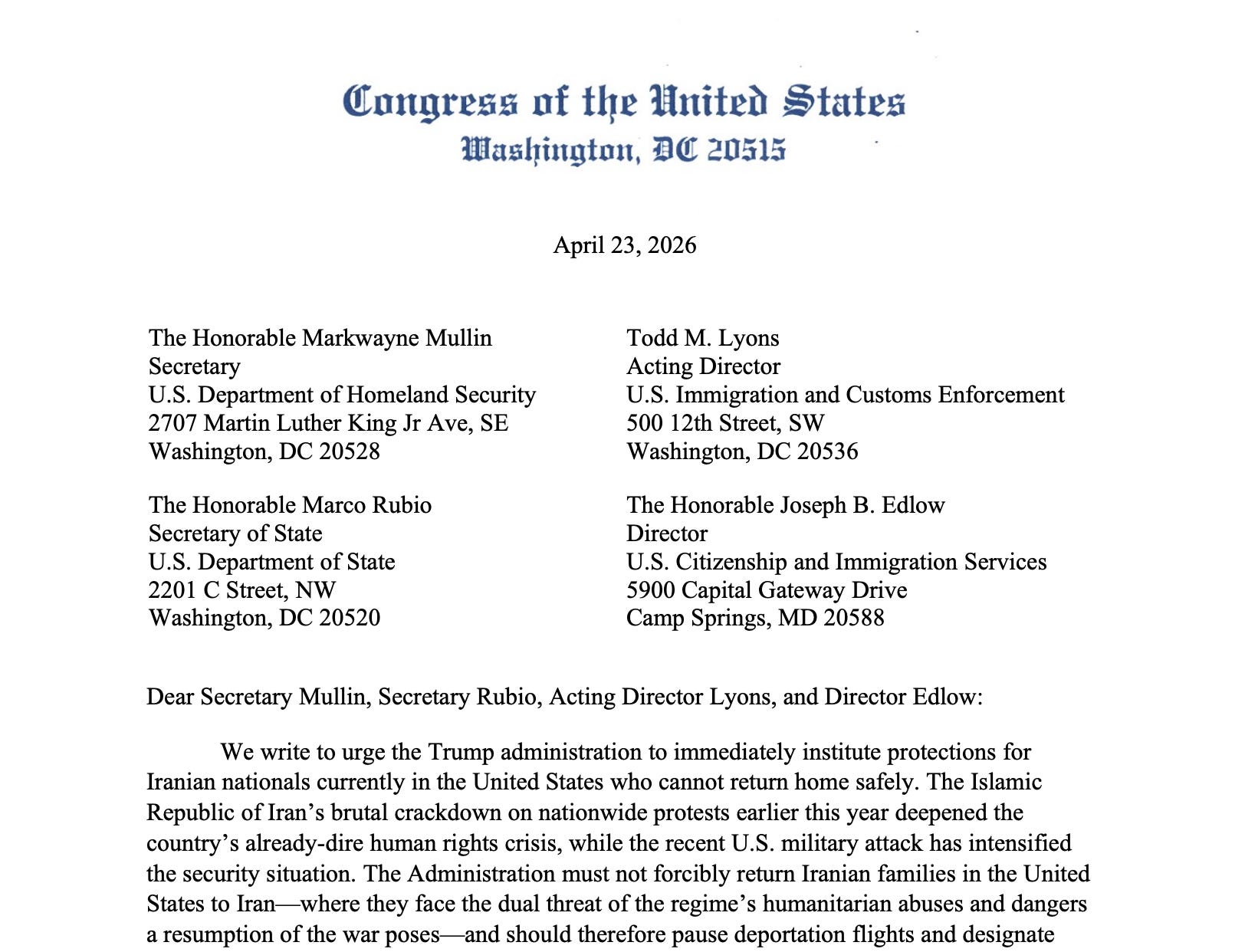
In a separate but related development, a recent letter sent by Rep. Yassamin Ansari (D-AZ) and Senator Ed Markey (D-MA) on April 23 calls on the Trump administration to designate Temporary Protected Status (TPS) or Deferred Enforced Departure (DED) for Iranian nationals currently in the United States. In the months leading up to the war, the Trump administration chartered three deportation flights to Iran, which have included religious and ethnic minorities, political dissidents, and individuals who faced credible fears of persecution upon return to Iran. Since the start of the war the administration has not proceeded with deporting any more planeloads of Iranians, but the risk nonetheless remains and may resurface if the war formally concludes.
In the letter, the Members emphasize the dangers facing Iranian civilians and argue that deporting individuals back to an unstable and potentially dangerous environment would be inhumane.
This effort reflects growing concern about the humanitarian consequences of the war, not just abroad, but for Iranian communities here in the U.S.