



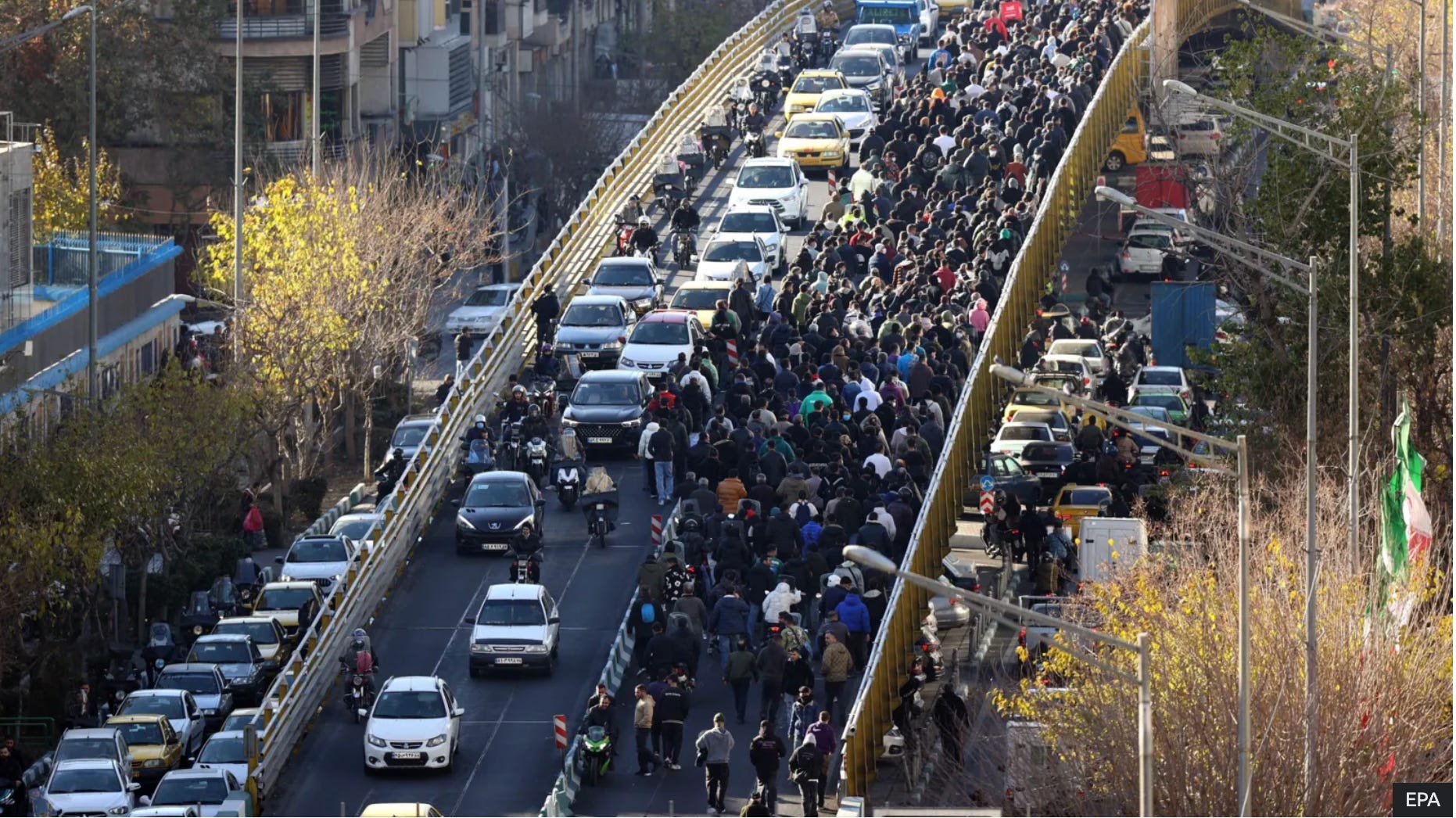
As protests erupt across Iran in response to economic collapse and broken promises of reform, a familiar playbook is unfolding: Israeli government officials and their allies are cynically co-opting the legitimate grievances of ordinary Iranians to advance their own agenda of militarism and outside-led regime change. Their agenda is to bring more war, more suffering, and more instability to the very people they claim to champion.
This post will explore key factors fueling the current protests inside Iran, then expose how some of the war lobby forces are carrying forward the playbook by cynically exploiting Iranian suffering in this moment for personal gain.
As Iranian Americans with family and loved ones in Iran, we stand in solidarity with the Iranian people peacefully asserting their fundamental rights in the face of repression, and condemn security forces’ violent crackdown on peaceful public assembly. The Iranian government is guilty of extensive human rights abuses against the Iranian people. As a diaspora of Iranians in the United States, it is also increasingly documented that the majority of Iranian Americans also oppose decades of sanctions by our own U.S. government that have worsened economic conditions for ordinary Iranians—and Iranian activists have unequivocally rejected attempts by Israel or any other outside actors to exploit the Iranian people’s legitimate grievances as justification for more war and civilian suffering.
We’ve seen the war lobby playbook co-opt everyday people’s suffering before to justify war in the name of “human rights”, “liberation”, and “regional security”. President George W. Bush’s invasions of Iraq and Afghanistan that have bogged America down in over a generation of wars in the region. Israel’s ongoing genocidal campaign against the people of Gaza, which they hope to expand outward into a new arena by waging war on Iran.
Above all, the people of Iran deserve a free, fair and effective government on their terms. Bombs falling on Tehran promising change will only result in decades more of instability and bloodshed. We stand with the people of Iran fighting for change, and reject imperialism and violence in their name.
So What’s Actually Happening?
To understand the current moment, we need to look beyond sensational headlines and examine the timeline of recent events inside Iran. Five interconnected factors, among others, seem to have driven Iranians into the streets:
Post-War Disappointment:
Following the 12 day Israel-U.S.-Iran War in June. There was a brief sense of national unity and widespread expectation that the government might respond with meaningful domestic reforms: releasing political prisoners, easing social restrictions, reopening civic space, or offering broader amnesty to members of the diaspora. Instead, the regime reverted to “factory settings” by arresting activists like Narges Mohammadi and the organizers of a peaceful women-led running event. This perceived return to business as usual generated deep disappointment and disillusionment among a population that had rallied during external threat.
The Gasoline Price Increase:
On December 13, Iran raised fuel prices for the first time since 2019—a highly sensitive move given the traumatic memory of the 2019 “Bloody November” protests. For many Iranians, the price hike wasn’t just an economic shock but an emotional reminder of that earlier period of brutal repression.
The Draft National Budget:
On December 23, President Pezeshkian submitted the draft budget for Iranian fiscal year 1405 (beginning March 2026). The proposed 20% public-sector wage increase has drawn criticism from economists and ordinary people alike, as it falls far below inflation levels widely estimated around 50% —reinforcing expectations of further economic hardship in the coming year.
The Taraneh Alidoosti Documentary:
On December 24, BBC Persian aired a documentary on actress Taraneh Alidoosti, highlighting her support for the “Women, Life, Freedom” movement and her defiance of compulsory hijab laws. The film circulated widely across Persian-language social platforms and revived collective memory of the 2022-2023 protest movement, reinforcing the sense that the social and political grievances behind it remain unresolved.
Currency Collapse:
On December 26, the rial hit a record low trading at roughly 1.45 million rials to the U.S. dollar in Tehran. The sharp depreciation fueled trader demonstrations in Tehran and intensified public anxiety about economic stability in multiple cities including Hamedan, Malard, Qeshm, and Tabriz.
Cue the Israeli Co-Opting

Into this complex domestic crisis steps the Israeli government and its echo chamber—not to support Iranian people, but to weaponize their suffering. Let’s examine some of the most egregious, shameless co-opting of these legitimate protests.
Former Israeli Prime Minister and current Israeli President Naftali Bennett released a video urging Iranians to “rise up,” claiming “the free world stands with you.” This is the same government that was happy to bomb Iranian civilians with impunity during the 12-day war.
Israeli Minister of Innovation, Science and Technology Gila Gamliel, an ally of monarchist figure Reza Pahlavi, weighed in with her own messages of “support.”
Even more dystopian: Mossad tweeting in Persian to Iranian protesters—Israel’s intelligence agency trying to position itself as champion of Iranian freedom.
The war lobby in Washington
Here in the United States, the pro-war agenda is being advanced through familiar channels. Congressman Brad Sherman, Chair of the House Foreign Affairs Subcommittee on the Middle East, has promoted resolutions supporting outside-led regime change efforts, echoing monarchist and MEK (Mujahedin-e Khalq) talking points. AIPAC has amplified these messages retweeting support for external intervention masked as solidarity.
Let’s be clear about what this is: Israel and its allies are not concerned with Iranian welfare. They have actively championed the “maximum pressure” sanctions policy that has devastated Iran’s economy—sanctions that have hurt ordinary Iranians far more than the government they’re supposedly designed to pressure. They supported and participated in illegal and unprovoked military strikes on Iran. Now they want to use Iranian suffering as justification for more of the same.
Two Hands Around Iranian Necks
The Iranian people are being strangled by two hands: their own government’s mismanagement, repression, and economic incompetence on one side—and decades of crippling U.S. sanctions and Israeli military aggression on the other. Both share responsibility for the current crisis. Both deserve condemnation.
What Iranians need is not more outside interference from governments with their own geopolitical axes to grind. They need relief from sanctions that make medicine and basic goods scarce. They need a government that prioritizes their wellbeing over militarism and ideological rigidity. They need space to organize, protest, and demand change without tear gas and arrests—and without foreign powers using their struggle as a pretext for intervention.
As Iranian Americans, we know our community and our families deserve better than this false choice between domestic repression and foreign-backed regime change. True solidarity with the Iranian people means supporting their right to determine their own future—free from both internal authoritarianism and external manipulation.
Ultimately, people of all backgrounds who claim to stand with Iranians must speak up against the Israeli government and its allies’ plans for war. Rather than help Iranians, Israeli co-option of these legitimate protests validates the Islamic Republic’s foreign-plot narratives, makes repression easier, and discourages, instead of encouraging, broader participation.
If they truly cared about Iranian lives, they wouldn’t have bombed Iranian civilians, and they wouldn’t continue pushing for policies that immiserate ordinary Iranians.
The Iranian people’s struggle for dignity, economic justice, and freedom is their own. It deserves self-aware solidarity from the diaspora that asserts their self-determination—not Western “salvation” in the form of more bombs on Tehran
.
Great piece! Thanks for helping many of us to navigate between the intricacy of support for true democratic reform and our condemnation of US and Israeli manipulation and meddling (never forget 1950s CIA overthrow of Iran’s democratically elected president & installation of the brutal Shah — whose secret police were trained by Israel). We are seeing this all around the world - & must keep our eyes on the true prize of People Power!