

The ongoing war between Iran and the United States and Israel is increasingly evolving beyond a conventional military confrontation into what many actors across the region perceive as an existential struggle for Shi’a communities in the Middle East. A combination of military escalation, the symbolic killing of key leadership figures, religious mobilization by senior clerics, and deep historical memory of sectarian violence has transformed the conflict into something far more dangerous than a traditional geopolitical dispute.
At the center of this transformation is the killing of Iran’s Supreme Leader Ayatollah Ali Khamenei during the opening phase of the war, an event that has had profound political, religious, and psychological consequences across Shi’a networks in the region. Ayatollah Khamenei was not only the political leader of Iran, but also a marja (source of emulation) for many Shi’a Muslims, meaning that millions of believers across the Middle East and beyond followed his religious guidance. In Shi’a Islam, senior clerics known as maraji’ hold extraordinary authority over their followers in matters of law, faith, and political conduct. Because of this unique position, Khamenei’s death was perceived not merely as the elimination of a state leader but as the killing of a major Shi’a religious authority during a foreign military campaign.
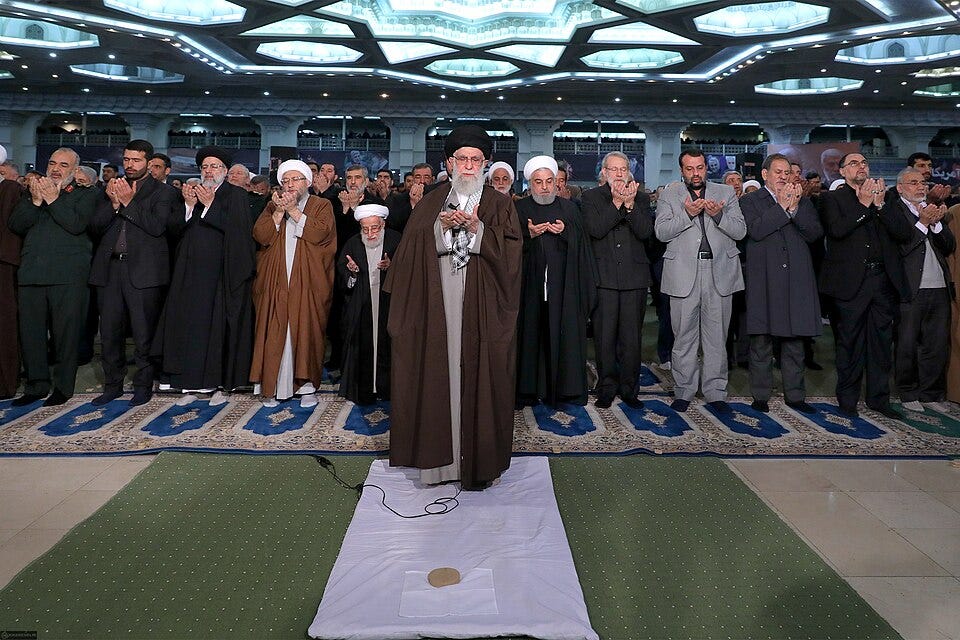

For many Shi’a communities, this event reinforced the belief that the war is not simply about Iran’s nuclear program or regional influence but about the future security and political survival of Shi’a power in the Middle East. Following Khamenei’s death, Grand Ayatollah Ali al-Sistani of Iraq has become the single most influential Shi’a religious authority in the world. Sistani has long been one of the most respected and widely followed maraji’ among Shi’a Muslims, particularly in Iraq and across many Shi’a communities in the Middle East and the global diaspora.
For decades, Sistani and Khamenei together represented two of the most important religious authorities in the Shi’a world, each exercising influence through different religious and political networks. However, after the killing of Khamenei, Sistani’s position has become even more central, effectively leaving him as the most authoritative marja for millions of Shi’a believers at a critical moment in the region. Because of this role, Sistani’s statements and potential religious rulings now carry even greater weight than before, and any call from him regarding the defense of Shi’a communities or Iran could have major political and military consequences across the Middle East.
In response to the war, Sistani issued a strong condemnation of the attacks on Iran and called on Muslims and the international community to oppose the war and show solidarity with the Iranian people. Within Shi’a religious and political networks, discussions have also emerged about the possibility of religious mobilization to defend Iran, including references to the concept of communal jihad in defense of the Islamic community.
The significance of such a religious ruling is demonstrated by history. In 2014, when ISIS captured the Iraqi city of Mosul and threatened Baghdad, Sistani issued a historic fatwa calling for defensive jihad. That ruling mobilized tens of thousands of volunteers and led to the creation of the Popular Mobilization Forces (Hashd al-Shaabi), which became a central force in defeating ISIS. This precedent illustrates the extraordinary capacity of a single fatwa from a senior Shi’a cleric to mobilize large numbers of fighters across national borders.
Another crucial factor shaping the perception of the war is the role Iran plays in the broader Shi’a political landscape. For decades, Iran has functioned as the strategic backbone of Shi’a movements across the Middle East, providing political, financial, and military support to several key actors. These include Hezbollah in Lebanon, Shi’a militias in Iraq, and the Houthi movement in Yemen. Together, these actors form what is often described as a transnational Shi’a alliance, sometimes referred to as the “axis of resistance.”
For many of these movements, the survival of Iran’s political system is directly connected to their own security and influence. If Iran were weakened or replaced by a government hostile to Shi’a movements, many groups believe they would become highly vulnerable to regional rivals and extremist organizations. This perception contributes to the growing view that defending Iran is essential for protecting Shi’a communities across the region.
The interpretation of the current conflict is also deeply shaped by recent historical trauma, particularly the atrocities committed by ISIS against Shi’a communities in Iraq. One of the most defining events occurred in June 2014 with the massacre at Camp Speicher near the Iraqi city of Tikrit. During this attack, ISIS militants captured thousands of unarmed Iraqi military cadets, most of whom were Shi’a. Between 1,100 and 1,700 young cadets were systematically executed, with their bodies thrown into the Tigris River or buried in mass graves. Many of the victims were barely twenty years old. ISIS deliberately filmed the executions and circulated the videos to terrorize Shi’a communities. The massacre became one of the largest terrorist killings of the modern era and left a profound psychological scar across the Shi’a world.
The trauma of Speicher was one of the primary factors behind the mass mobilization that followed Sistani’s 2014 fatwa, ultimately contributing to the defeat of ISIS. Because of this history, many Shi’a communities interpret the current war through the lens of collective survival and the need to prevent another wave of sectarian violence.
At the same time, the conflict is escalating militarily inside Iran itself. Iranian authorities announced that funeral ceremonies for several senior military commanders killed in the war will take place in Tehran, reflecting significant leadership losses. Among those reported killed are Abdolrahim Mousavi (Chief of Staff of Iran’s Armed Forces), Mohammad Pakpour (Commander of the Islamic Revolutionary Guard Corps), Ali Shamkhani (Secretary of the Defense Council), Aziz Nasirzadeh (Minister of Defense), and Mohammad Shirazi (Head of the Office of the Supreme Leader).
Missile strikes have also affected civilian areas. Iranian media reported that a missile struck Bagheri Highway in Tehran, killing civilians and burning multiple vehicles. Another strike reportedly targeted a traffic police building in eastern Tehran, causing additional fatalities. In the city of Khomein, authorities reported damage to at least 265 civilian buildings, including homes and commercial units. Israel has also stated that it targeted an underground ballistic missile development complex at Imam Hussein University in Tehran, which Israeli officials described as a facility involved in missile research and development.
Meanwhile, Iranian officials have made clear that Tehran is not seeking a ceasefire under current conditions. Speaker of Parliament Mohammad Bagher Ghalibaf stated that Iran must continue fighting until the aggressor is punished so that such attacks are never repeated. Similarly, Iran’s central military command declared that the war will not end unless the United States and Israel express regret for their actions, emphasizing retaliation for the killing of Iran’s leadership. Iranian officials have also warned that continued attacks could lead to disruptions in oil exports from the region, potentially affecting global energy markets further.
Beyond Iran itself, the conflict risks drawing in multiple Shi’a armed movements across the region. Hezbollah in Lebanon, for example, already views its confrontation with Israel as an existential struggle. Despite ceasefire arrangements in recent years, Israel has continued targeted strikes against individuals suspected of Hezbollah membership, reinforcing the organization’s belief that the conflict with Israel remains ongoing. Hezbollah has also struck back amid the Iran war, landing blows in Israeli territory and adding to the difficulty of Israel’s defense against Iranian retaliation.
Similarly, Iraqi Shi’a militias and the Houthi movement in Yemen maintain strong ideological and military ties with Iran. If Iran were perceived to face an existential threat, these groups could feel compelled to enter the conflict more directly, expanding the battlefield from the Persian Gulf to the eastern Mediterranean.
Taken together, these developments suggest that the war is gradually shifting from a conventional interstate conflict into a confrontation shaped by religious authority, sectarian identity, and historical trauma. Three dynamics are particularly significant: the killing of Ali Khamenei, a figure who held both political leadership and religious authority; the potentially decisive role of Grand Ayatollah Sistani, whose religious rulings have previously triggered mass mobilization; and the widespread perception that Iran represents the backbone of Shi’a political security in the Middle East.
When conflicts become framed as struggles for communal survival rather than strategic disputes, they become far more difficult to contain or resolve. For this reason, the current war risks evolving into a much wider regional confrontation involving Iran, Israel, the United States, and multiple Shi’a armed movements across the Middle East. If this transformation continues, the conflict could become one of the most destabilizing sectarian crises in the region since the rise of ISIS, with consequences extending far beyond Iran itself.
Ayatollah Sistani became a major Marjaʿ al-Taqlid after the death of Abu al‑Qasim al‑Khoei. Both clerics were born in Iran. Ali al‑Sistani was born in 1930 in Mashhad, in Iran’s northeastern province of Khorasan Razavi. At a relatively young age he left Iran and eventually settled permanently in Najaf, Iraq.
Sistani is a leading Shiʿa cleric known for supporting the separation of religion and the state—what in this context can be described as the separation of mosque and state. He played an important role in Iraq during the sectarian violence that followed the fall of Saddam Hussein after the 2003 invasion of Iraq. During that turbulent period, Sistani repeatedly called for reconciliation between Shiʿa and Sunni Muslims. He promoted restraint and peace, issuing religious guidance that condemned sectarian violence and urged Iraqis to avoid retaliation.
If Sistani today speaks out against war with Iran, it is largely because he fears such a conflict would bring wider chaos to the entire Middle East. From this perspective, many Americans who value peace and freedom may see his stance as consistent with a broader moral tradition that emphasizes reconciliation and nonviolence—principles also associated with the teachings of Jesus Christ.
Thank you so much for this--very informative. And I was impressed with the Zoom meeting earlier today: glad you are uniting with other peace groups and alerting members of Congress about the important changes so many of us see as needed.