

The current phase of Iran–U.S. tensions suggests a notable shift in Washington’s strategic approach, from the risk of direct military confrontation toward a combination of maritime pressure and continued diplomatic engagement. Rather than pursuing immediate escalation, the United States appears to be recalibrating its strategy to maximize economic leverage while pressing for advantage in ongoing negotiations.
At the core of this approach is a de facto maritime containment strategy, aimed at restricting Iran’s ability to export oil and conduct international trade. This represents a return to elements of the earlier “maximum pressure” framework, but with a critical distinction: instead of relying primarily on sanctions enforcement, the strategy now seeks to physically constrain Iran’s access to global energy markets, including limiting pathways for sanctions evasion and illicit oil shipments. Reports indicate that U.S. forces have already begun enforcing restrictions on maritime traffic linked to Iran, with disruptions observed in shipping routes and vessels being turned back.
_Supports_Operation_Epic_Fury_(9550780).jpg)
This shift could significantly increase pressure on Iran’s economy, which was already in a period of crisis before the war. The cost of basic commodities has continued to rise and the war has disrupted or ended many jobs within the country, causing significant strain on the civilian population.
By targeting the country’s most vital revenue stream in energy exports, the strategy is designed to narrow Tehran’s economic options and strengthen Washington’s negotiating position. At the same time, maintaining diplomatic engagement allows the United States to present the pressure as part of a broader effort to achieve a negotiated outcome, rather than an interlude between war. Recent signals suggest that negotiations may resume soon, potentially mediated by Pakistan again, with indirect messages already being exchanged and both sides acknowledging limited progress despite persistent gaps, particularly over the scope and duration of nuclear restrictions.
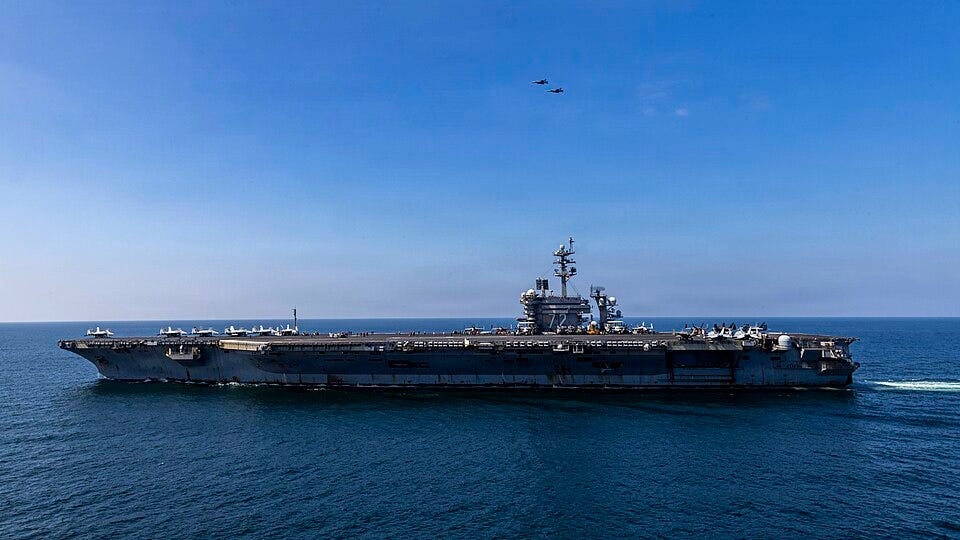
However, this strategy is not purely economic or diplomatic. In parallel, the United States is continuing to expand its military posture in the region, reinforcing the coercive dimension of its approach. Reports indicate that additional U.S. forces are being deployed to the Middle East, including the USS George H.W. Bush carrier group, which is en route to the region and expected to arrive in the coming weeks. Two separate aircraft carrier groups in the USS Gerald R. Ford and USS Abraham Lincoln were heavily involved in wartime operations against Iran, with the Ford hobbled under unclear circumstances and the Lincoln still operating in or around the Arabian Sea. The Amphibious assault ships previously deployed to the Middle East remain in place as well. This buildup underscores that while Washington is emphasizing maritime pressure and negotiation, it is simultaneously maintaining credible military deterrence and escalation capacity.
From a U.S. perspective, this dual-track strategy - economic pressure combined with visible military readiness - offers a lower-risk alternative to direct confrontation. As some analysts have noted, maritime enforcement operations can be conducted from relative distance, reducing exposure to Iranian missiles, drones, fast-attack craft, and naval mines compared to more aggressive options such as escorting convoys or seizing strategic assets.
However, this approach carries substantial risks beyond Iran itself. Unlike earlier phases of maximum pressure, the current strategy unfolds in a fragile global economic environment, where energy markets remain highly sensitive to disruption. Any sustained interference with Iranian exports - particularly in conjunction with broader maritime insecurity - has the potential to tighten global supply, increase volatility in oil prices, and disrupt shipping routes.
These risks are further amplified by the possibility of spillover into other strategic chokepoints. Instability in the Bab al-Mandeb Strait, particularly if exacerbated by non-state actors such as Ansarallah, could significantly disrupt one of the world’s most critical maritime corridors. Combined with tensions in the Strait of Hormuz, this would create a scenario in which multiple energy and trade arteries are simultaneously under pressure, placing additional strain on global markets.
Iran, for its part, has signaled both openness to continued diplomacy and readiness to respond to pressure. Iranian officials have emphasized that negotiations remain possible, while warning that efforts to force capitulation will fail. At the same time, Tehran has issued explicit warnings that continued disruption of its maritime trade could be interpreted as a violation of the ceasefire, with senior military authorities stating that Iran could respond by restricting broader regional shipping flows across the Persian Gulf, the Sea of Oman, and even the Red Sea.
Iran retains significant leverage within this dynamic. While avoiding full-scale escalation, it has the capacity to apply calibrated pressure in the Strait of Hormuz, including restricting or complicating maritime transit. Even limited disruption—or the credible threat of it—can have outsized effects on global energy flows, shipping insurance costs, and market stability, thereby raising the economic and political costs of the U.S. strategy.
The international dimension further complicates the picture. China has already criticized maritime restrictions as destabilizing, while broader diplomatic activity suggests that regional and global actors are actively seeking to prevent escalation while preserving space for negotiations. At the same time, U.S. officials have indicated that economic pressure, including stricter enforcement of oil sanctions and the removal of temporary waivers, will continue, reinforcing the overall strategy.
From a timing perspective, the effectiveness of this approach is also shaped by sequencing. A maritime containment strategy might have yielded stronger results prior to the current period of heightened geopolitical and economic sensitivity. In today’s environment - marked by inflationary pressures, supply chain vulnerabilities, and market uncertainty - the tolerance for sustained disruption is significantly lower. As a result, measures intended to pressure Iran may also generate unintended feedback effects on global markets, energy prices, and U.S. allies.
In this context, the emerging U.S. strategy can be understood as an attempt to balance coercion and diplomacy: applying intensified economic pressure through maritime restrictions while preserving a pathway for negotiations, all under the umbrella of sustained military deterrence. Whether this approach succeeds will depend not only on its impact on Iran, but also on the resilience of global markets, the behavior of regional actors, and the ability of both sides to manage escalation without crossing critical thresholds. Ultimately, the current trajectory points to a managed escalation framework, where both sides seek to avoid full-scale conflict while leveraging economic, military, and strategic pressure to shape the outcome of future negotiations.
A strategy of losers like you kuni tanbul, as us in Artesh have helped make Iran self succicent and done much to strengthen Iranians Worldwide, and those who betrayed and attacked Iran will suffer