


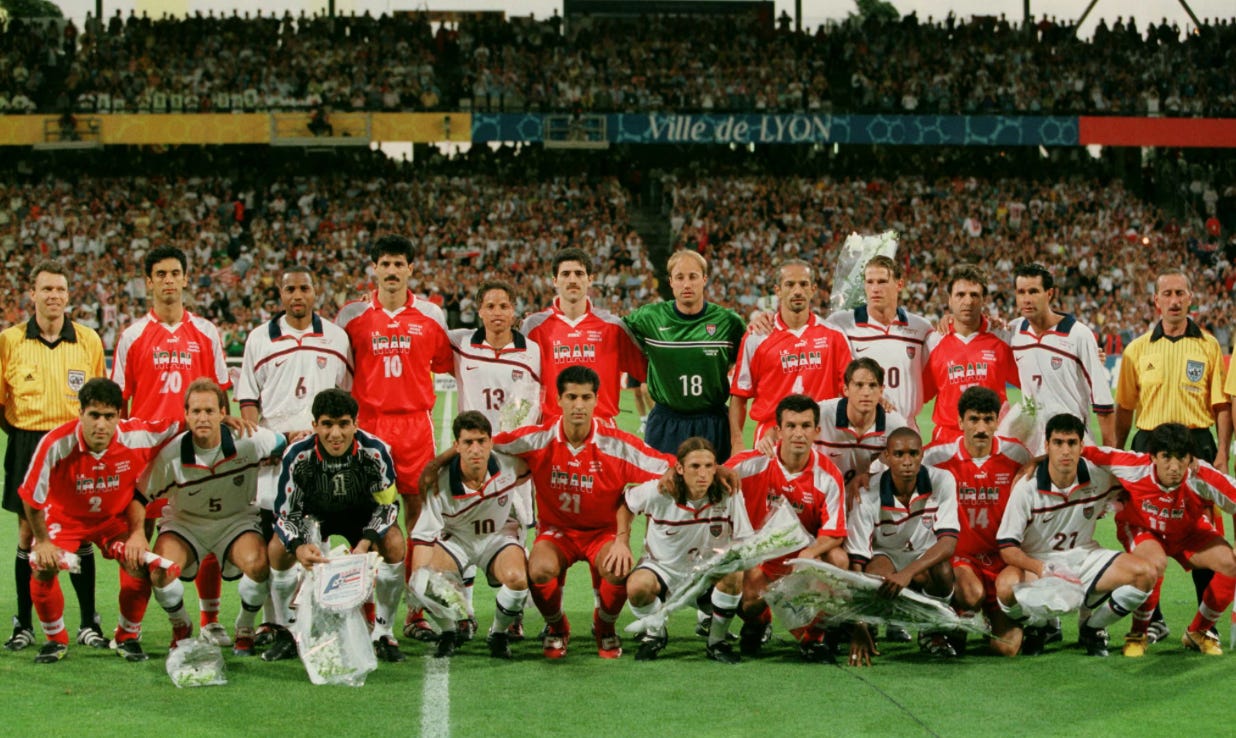
This author once played and coached Division I soccer and on lower‑level professional teams, but at any level one truth stands out: the beautiful game is most spectacular at the World Cup. Its beauty lies in groups of players working in unison, attackers creating space for each other, quick decisions and quick relinquishing of the ball, and the trust that you will get it back later. There’s no shortage of individual talent, but that’s not what defines a game built on speed of thought, trust, and running for others.
One brilliant attacker might change a match, but no one player can carry a team the way American sports mythology teaches us to imagine sports. The best soccer teams understand that the ball moves faster than any individual, and that collective intelligence is its own power. Most fans have a special appreciation for this, but it is striking that our leaders do not.
The 2026 World Cup should be a celebration of global connection, but the way it is being staged is different. Ticket prices are soaring, with resale marketplace and secondary platforms listing in the six‑ and seven‑figure range. For many fans from travel‑banned countries, the price of admission is not the only obstacle as a World Cup as a ticket does not guarantee a visa, and the U.S. blocks or restricts entry for travelers, including for players and staff whose national teams are participating.
There is no better illustration of this than Iran, whose Football Federation announced just days before the World Cup kicks off, that its entire ticket allocation for group‑stage matches in the United States has been revoked, leaving thousands of supporters who booked flights and hotels suddenly unable to enter the stadiums where their own team will play. FIFA’s rules entitle each participating federations to distribute a share of seats—roughly 8 percent of a stadium’s capacity—to fans, but now that allocation to Iran has been rescinded. It is a slap in the face to the most basic kind of diplomacy—letting people show up, cheer, and share a game together.
The “World Cup” is effectively telling a segment of that world that they are not allowed in the seats set aside for them. Whatever the bureaucratic justifications, the message lands as collective punishment. It turns a symbol of global connection into another instrument of exclusion and shows how fragile the norms of neutrality and equal treatment really are.
The United States loves to call itself a great sports nation, but it often confuses greatness with individual domination. That mindset helps explain why we keep struggling with soccer on the world stage, why we are already mishandling the 2026 World Cup, and why our Iran policy keeps defaulting to war instead of diplomacy. For a country obsessed with the star quarterback, the unstoppable scorer, and the singular highlight reel, soccer’s demand for mutual collaboration is an uncomfortable mirror.
That same philosophical failure shows up even more dangerously in our foreign policy on Iran. War hawks have spent years pretending that Iran’s nuclear issue can be solved by pressure, threats, and eventual war, when the world already demonstrated a better path. The 2015 JCPOA, negotiated by the United States, Iran, and the international community, constrained Iran’s nuclear program and kept it peaceful through verification and limits. Donald Trump tore that agreement up, and ever since, too many officials have acted as if “might makes right” is a strategy rather than a dead end.
A chorus of hawkish voices insists that concessions are weakness and that only escalating pressure can bend Iran to our will. From think tanks that treat sanctions and strikes as default tools of statecraft to commentators who openly float “surgical” attacks or regime change, the story line remains that cooperation is naïve and coordination is for suckers. That story line sells in a media environment that rewards tough talk and simple villains, just as highlight reels reward the most spectacular dunk or solo run.
This is the same logic that distorts our sports culture: we privilege the biggest names and the most “dominant” individual, then act surprised when we fail at the things that require coordination. Just as soccer is not won by the most spectacular solo act, the same is true of diplomacy, of governing a diverse country, and of hosting a global tournament with any seriousness about access and fairness.
The Iran World Cup ticket debacle should be a warning about how quickly “rules” can be bent when those in power decide certain people do not belong. A host country that can find a way to block an entire national fan base from accessing its allocated tickets days before a tournament sends a signal not only to Iranians but to other marginalized and politically disfavored communities: your ability to participate is contingent, your presence is a privilege, and that privilege can be revoked at any time. That is the opposite of the ethos that international sport is supposed to embody.
Sports, at their best, are a low‑stakes rehearsal for coexistence. When fans from rival countries sit in the same stadium, ride the same trains, or wait in the same concession lines, they are living out a small, tangible version of the world we claim to want: one in which political boundaries and ideological battles do not dictate who gets to show up. Denying that experience to Iranian supporters does not make anyone safer or resolve any of the underlying disputes between Washington and Tehran. It simply narrows the space where ordinary people might otherwise build familiarity and empathy.
America keeps reaching for the wrong kind of greatness. We are at our best when we build systems, coalitions, and institutions that let people do hard things together. We are at our worst when we mistake domination for strength and spectacle for strategy. In soccer, that means an endless cycle of disappointment as we try to brute‑force our way through a game that rewards pattern recognition and shared movement. In foreign policy, it means tearing up working agreements because they do not offer enough opportunities for chest‑thumping, then feigning surprise when the situation deteriorates.
If we want to understand American lag in soccer, our World Cup skewing toward exclusion, and an Iran policy stumbling toward disaster, we should start with the basic question of might versus cooperation. The real test of power is not whether one person can take over the field. It is whether a society can move as a unit—and resist the temptation to use something as simple as a ticket allocation as another arena for discrimination.

well said, Etan 👏🏼👏🏼👏🏼
Goes to show another instance of the pettiness of the Epstein class. When they can't accomplish anything in the battle field they aim for the soccer field.