

Iran, Saudi Arabia, Pakistan and Turkey agreed on October 26 to continue security discussions after a high-level meeting in Tehran, as renewed threats from Washington and Israeli reports of proposed military operations heightened concerns about another major escalation. The talks addressed regional security while offering a potential channel for finding a way forward between Iran and the United States and containing the fighting involving Saudi Arabia and Yemen’s Houthis.
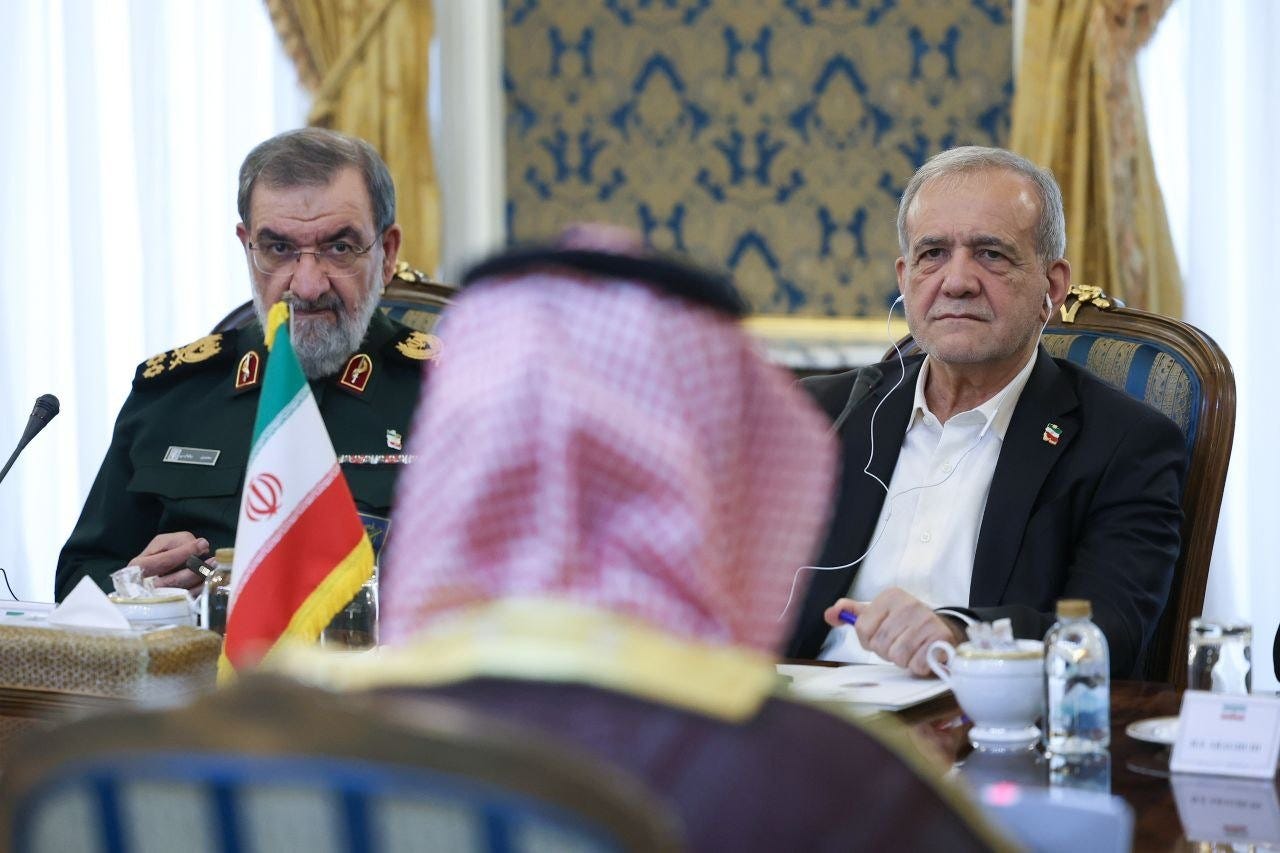
The meeting brought Saudi Defense Minister Prince Khalid bin Salman, Pakistan’s military chief Field Marshal Asim Munir and Turkish intelligence chief Ibrahim Kalin together with Mohsen Rezaei, secretary of Iran’s Supreme National Security Council. The visiting officials also met President Masoud Pezeshkian, with Foreign Minister Abbas Araghchi participating in the discussions.
The closing statement committed the four countries to further dialogue on cooperation, peace and security. It announced no ceasefire, detailed settlement or timetable for another meeting. Reporting about the discussions, however, suggested that the initiative went beyond a general exchange of views.
Reuters, citing a Pakistani official, reported that Munir presented a possible compromise intended to offer gains to both Washington and Tehran. Saudi Arabia, Pakistan, Turkey and Qatar could potentially act as guarantors if it were accepted. Its terms were not disclosed, and no government publicly confirmed acceptance. Another Pakistani official described a regional nonaggression network as a focus of the talks.
The diplomatic effort came amid increasingly explicit discussion of renewed military action. In his latest endorsement of Netanyahu ahead of Israel’s October 27 election, President Donald Trump said the two leaders needed to “finish the job.” Netanyahu, highlighting their partnership, suggested that further action against Iran could follow and said he had instructed Israel’s military and Mossad to work toward overthrowing Iran’s government. The White House nevertheless said the United States would not attack Iran before the November 3 midterm elections, while maintaining its blockade. That statement left Washington’s intentions after the election unresolved.
Reports of military preparations added urgency to the diplomacy, though it remains unclear whether and when there would be a renewed attack. CNN reported, citing U.S. officials, that American forces could launch substantial operations within 96 hours of a presidential order. The reported readiness window described the military’s ability to act after order from the President, not a confirmed countdown to a renewed hostilities. Other reporting suggested that some officials expected renewed action after the U.S. elections, while acknowledging that Trump had not made a final decision.
In Israel, reports of disagreements within the security establishment raised further questions about the timing and purpose of possible operations. Haaretz reported that senior Mossad officials opposed an operation backed by agency chief Roman Gofman and Netanyahu, expressing concern that political considerations could influence its timing before the election. Mossad declined to discuss operational activities or internal deliberations.
Separately, Channel 12 reported a confrontation between Netanyahu and military chief Eyal Zamir over an instruction that could trigger renewed conflict with Iran. According to the report, Zamir sought further discussion and written authorization from the political leadership before considering implementing the plan. The operation’s details were not disclosed.
Netanyahu rejected the report, and Defense Minister Israel Katz denied a rift between the government and military. Katz also said Israel had not intended to initiate an attack before the election. The competing accounts leave unresolved what action was contemplated and whether it had received authorization.
Against this backdrop, Saudi Arabia described the Tehran visit as an effort to prevent escalation, keep negotiating channels open and support mediation by Qatar and Pakistan. Iranian officials emphasized both the immediate confrontation and the possibility of developing broader regional security arrangements.
The Yemen conflict gives the initiative another urgent dimension and connects it to an earlier Iranian offer to mediate. On October 12, Iranian reporting described Araghchi offering to facilitate talks during a telephone conversation with Saudi Foreign Minister Faisal bin Farhan. Araghchi warned that reliance on military measures without a political solution would make the conflict more difficult to resolve.
On October 20, Araghchi said neither Saudi Arabia nor the Houthis had responded to Iran’s mediation offer. The Tehran meeting therefore followed an existing Iranian proposal to help end their fighting. Its closing statement did not say whether that offer had now been accepted or whether a separate Saudi-Houthi negotiating process would begin.
Iran’s relationship with the Houthis does not, by itself, establish that Tehran can negotiate or enforce commitments on their behalf. Any account of a broader settlement must distinguish Iran’s potential role in facilitating negotiations from decisions that the Yemeni movement would have to make itself.
The fighting continued as the delegations gathered. The Houthis claimed attacks on pumping stations along Saudi Arabia’s East-West oil pipeline and Riyadh’s airport; Saudi authorities did not immediately confirm those particular claims. The pipeline carries oil to the Red Sea port of Yanbu, providing an export route that bypasses the Strait of Hormuz.
Saudi Arabia’s engagement with Tehran also accompanies military coordination with Pakistan and Turkey. The three countries signed the Mecca defense agreement in August. At an October 5 emergency meeting, they approved steps to implement collective defense commitments, including arrangements for rapidly deploying agreed military capabilities in Saudi Arabia. Their visit to Iran added direct diplomacy to those preparations.
Iranian Foreign Ministry spokesperson Esmail Baghaei described the Tehran meeting as a practical step toward regional cooperation based on shared interests. According to Ali Baqeri-Kani, deputy secretary of the Supreme National Security Council, Munir proposed the gathering during his visit the previous week.
Pezeshkian expressed support for understandings that would resolve differences and strengthen security and development. He also urged participants to move beyond written commitments toward practical results, advocating better transport connections, easier travel and stronger links among businesses, universities and scientific institutions.
Former Foreign Minister Mohammad Javad Zarif offered a more specific proposal: a “West Asian Security Network,” known by the Persian acronym Vasl, based on nonaggression, mutual confidence-building and shared prosperity. His suggestion contributed to the domestic discussion about regional cooperation but was not adopted in the communiqué.
Qatar remained active on a parallel diplomatic track. Baghaei confirmed that a Qatari delegation’s preceding visit to Tehran included mediation related to Iran-U.S. negotiations. Pezeshkian subsequently departed for Moscow for the Gas Exporting Countries Forum, with the Kremlin announcing separate meetings between President Vladimir Putin and the Iranian president and Qatar’s emir on October 27. No joint negotiating format was announced.
Taken together, the reported agenda suggests an effort to address interconnected conflicts through coordinated diplomacy: seeking a compromise between Iran and the United States, reducing threats to Saudi Arabia and exploring arrangements for regional nonaggression. Progress on one track could improve conditions on another, but the public record does not establish that the parties have made substantive progress toward a comprehensive bargain.
For now, the four governments have committed to continued talks. Whether that channel can produce reciprocal steps on military escalation, maritime access and the Yemen conflict remains unresolved. Yet the need for progress becomes increasingly urgent as diplomatic proposals compete with preparations for another round of war.