

Renowned Iranian sociologist and recent political prisoner Saeed Madani sharply criticized monarchist politics, calls for foreign military intervention and what he describes as unrealistic expectations surrounding the overthrow of the Islamic Republic. While reiterating that the Islamic Republic bears full responsibility for the violent suppression and killing of protesters, Madani argued in an open letter to fellow sociologist Asef Bayat that opposition to the government alone does not make every alternative democratic or legitimate.
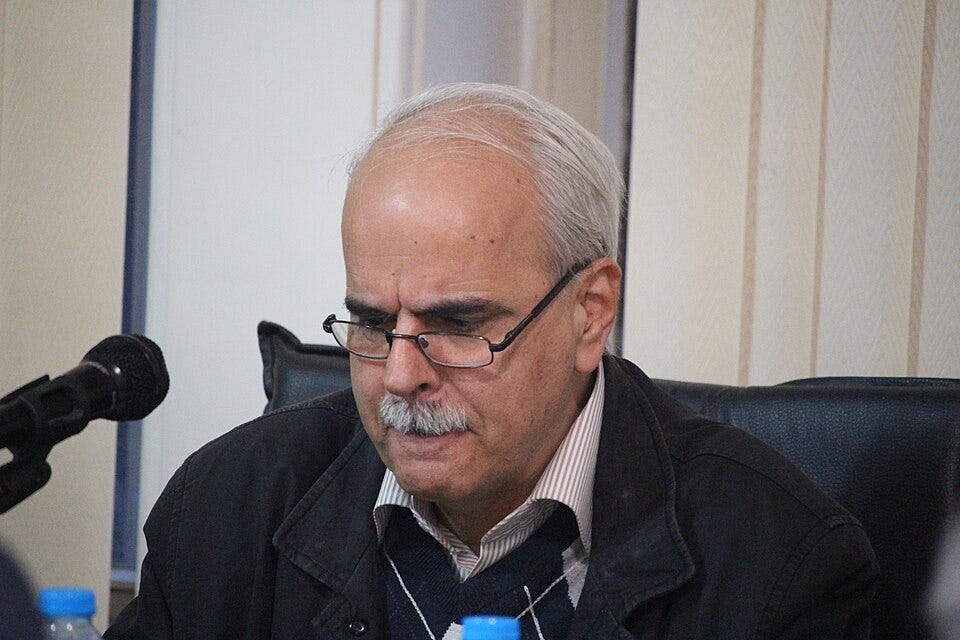

The letter is the latest installment in an ongoing exchange between Madani and Bayat that began in May 2024 after Bayat responded to an interview Madani gave from prison about Iran following the “Woman, Life, Freedom” movement. Since then, the two scholars have exchanged several lengthy letters debating Iran’s protest movements, democratic transition, revolution, civil society, and the role of violence in political change. Madani’s newest response focuses extensively on the future of Iran’s opposition and the risks he associates with monarchist strategies and reliance on foreign powers.
Madani, a sociologist and longtime researcher on poverty, inequality, social movements, and civil society, argues that Iran’s democratic future cannot be built either through the continuation of the Islamic Republic or through foreign-backed regime change. Instead, he advocates what he calls a nonviolent democratic transition based on organized civil society, sustained domestic pressure, negotiations, a referendum, and a constituent assembly.
A central part of Madani’s argument is his distinction between two phases of the January protests. He argues that the demonstrations before January 8 were fundamentally different from those that followed Reza Pahlavi’s public call for nationwide mobilization on January 8 and 9.
According to Madani, the protests that began in early January emerged organically from Iran’s worsening economic and social conditions. He writes that demonstrations initially spread from Tehran’s commercial districts, including the Alaeddin market, where currency depreciation, inflation, economic instability, and declining purchasing power had placed enormous pressure on merchants, shop employees, delivery workers, informal laborers, and members of Iran’s shrinking middle class.
Madani argues that these early demonstrations were not organized by monarchists or any single opposition leader abroad. Rather, they reflected accumulated public frustration over inflation, corruption, unemployment, inequality, political repression, and the absence of economic prospects. Similar to previous nationwide protests, including those of 2017, 2019, and the “Woman, Life, Freedom” movement, the demonstrations combined economic grievances with broader political demands and spread through decentralized social networks rather than centralized leadership.
Madani argues that Reza Pahlavi’s attempts on January 8-9 to direct the protest movement via calls for mobilization and action fundamentally altered the political atmosphere surrounding the protests. Rather than remaining a decentralized social movement, the demonstrations increasingly became associated with a final confrontation aimed at immediate regime change under a specific political alternative.
Madani emphasizes that the the Islamic Republic bears direct responsibility for the deaths and repression that followed, arguing that the government likely would have suppressed the protests violently regardless of Reza Pahlavi’s intervention.
Still, Madani sharply criticizes Pahlavi’s call as “irresponsible” and “opportunistic,” arguing that people were encouraged to confront one of the region’s most heavily armed security apparatuses without organized domestic leadership, protective structures, or any realistic mechanism to reduce the risks facing protesters. His criticism is not directed at encouraging protest itself. Instead, he argues that political leaders who call on citizens to risk their lives have an ethical responsibility to accurately assess the risks, avoid unrealistic promises, and accept responsibility for the consequences of their appeals.
One of Madani’s strongest criticisms concerns what he describes as the expectation that foreign assistance would arrive if demonstrations intensified. According to him, many opposition media outlets and activists created the impression that if protesters remained in the streets long enough, the United States or Israel would intervene militarily, weaken the Islamic Republic, and pave the way for Reza Pahlavi’s return to power.
Madani argues that those making such claims had no authority to guarantee foreign intervention, yet many protesters came to believe that regime collapse was imminent. Drawing on conversations with detainees following the protests, Madani writes that many had embraced three central assumptions: that pre-revolutionary Iran had been a period of comprehensive prosperity and freedom; that the monarchy represented the only viable alternative to the Islamic Republic; and that Donald Trump would ultimately help install Reza Pahlavi in Tehran after the government’s rapid collapse. Madani notes that some detainees even referred to Trump as “Uncle Trump,” which he interprets as evidence that parts of the opposition had come to view the United States not as a foreign state pursuing its own strategic interests, but as a benevolent actor committed to liberating Iran.
He rejects all three assumptions as historically inaccurate and politically misleading. In his view, pre-1979 Iran should neither be portrayed as an ideal democracy nor reduced to a simple narrative of prosperity. Likewise, he argues that Iran’s future should not be presented as a binary choice between the Islamic Republic and the restoration of the monarchy.
Madani devotes considerable attention to what he calls the monarchist reconstruction of history. He argues that parts of the opposition have created an idealized and selective image of the Pahlavi era, emphasizing stability and economic development while minimizing political repression, inequality, corruption, and the absence of democratic institutions.
According to Madani, distorting history for political purposes undermines democratic legitimacy. A political movement that relies on selective historical narratives, he argues, cannot simply assume that it will respect democratic principles once in power.
His criticism extends beyond evaluations of Mohammad Reza Shah himself. Instead, Madani questions the principle of hereditary political legitimacy, arguing that political authority in a democratic society must derive exclusively from the free choice of citizens, rather than family lineage, historical nostalgia, or foreign sponsorship. Madani also criticizes the revival of symbols such as the Imperial Guard (”Javidan Guard”), arguing that such symbolism allowed the government to portray a broad social protest movement as an organized attempt to restore the monarchy.
Madani stresses that none of these criticisms diminish the Islamic Republic’s responsibility for the violence. Regardless of the political orientation of protesters or opposition groups, the government remains fully responsible for the killings, arrests, and repression.
His second major criticism concerns calls for American and Israeli military intervention. Madani argues that parts of the monarchist opposition have increasingly linked regime change to foreign military action rather than domestic political mobilization. In this framework, Iranian society no longer serves as the principal engine of change; instead, foreign governments are expected to weaken or overthrow the Islamic Republic through military force before transferring power to a preferred political alternative.
He rejects this strategy on both political and ethical grounds. Politically, Madani argues that it wrongly assumes Iran’s domestic protest movements have failed simply because they have not yet overthrown the government. He maintains that social movements should not be judged solely by immediate regime change. Even when governments survive, movements can fundamentally reshape public attitudes, political culture, gender relations, and the boundaries of acceptable state authority. He cites the lasting social transformations following the “Woman, Life, Freedom” movement as evidence that profound change can occur without immediate governmental collapse.
Ethically, Madani questions how human rights advocates can support military attacks that would inevitably endanger civilians, conscript soldiers, hospital workers, and other individuals who may have no role in government decision-making. He argues that support for bombing military or government facilities cannot ignore the human costs involved.
Madani also challenges the assumption that the United States or Israel would prioritize Iran’s democratic future over their own strategic interests. Foreign governments, he argues, pursue national security and geopolitical objectives, not democratic transformation in other countries.
Even if military intervention succeeded in weakening or toppling the Islamic Republic, Madani warns that there is no guarantee such an outcome would produce democracy. Instead, it could result in institutional collapse, civil conflict, territorial fragmentation, or prolonged instability similar to experiences elsewhere in the region.
He therefore argues that welcoming foreign military attacks in the name of Iranian nationalism presents a fundamental contradiction. In his view, one cannot simultaneously claim to defend Iran while encouraging military strikes against Iranian territory and infrastructure.
Madani similarly cautions against viewing uncontrolled state collapse as a desirable outcome. Without functioning institutions and a broadly negotiated political transition, he argues, the collapse of the state could produce civil war or fragmentation rather than democracy.
As an alternative, Madani advocates a negotiated, nonviolent democratic transition rooted in Iranian civil society. He argues that labor organizations, students, women, teachers, retirees, professional associations, and other social groups remain the country’s primary agents of democratic change.
His vision closely resembles Bayat’s concept of a “negotiated revolution,” in which sustained civic mobilization ultimately creates the conditions for negotiations, a national referendum, and the election of a constituent assembly to determine Iran’s future political system. In this framework, no individual, dynasty, or foreign government has the authority to predetermine Iran’s political future. Whether Iran ultimately chooses a republic, constitutional monarchy, or another political system, Madani argues that such decisions must emerge through free public participation rather than hereditary claims or foreign military intervention.
Madani concludes that the protests before January 8 represented an authentic, internally generated social movement that did not originate with Reza Pahlavi’s call. While maintaining that the Islamic Republic bears full responsibility for the subsequent killings, he argues that the January 8-9 mobilization changed both the political framing and the risks facing protesters by promoting expectations of rapid regime collapse and possible American or Israeli intervention.
Ultimately, Madani argues that the path to power cannot be separated from the nature of the political system that follows. In his view, a democratic Iran cannot emerge through historical revisionism, hereditary political claims, or foreign military intervention, but only through a democratic process led by Iranian society itself.
Re: "According to Madani, the protests that began in early January emerged organically from Iran’s worsening economic and social conditions."
Protests may have emerged organically, but the worsening economic conditions did not. Need to factor in what extent the US played a role in crippling the economy. Which is something they’ve admitted to. Here’s a post about Scott Bessent bragging about the US economic destruction machinations - and the implications for other countries of this kind of US behavior.
https://mindtheblindspot.substack.com/p/how-the-us-treasury-engineered-a