

Iranian President Masoud Pezeshkian announced on Thursday, May 7th, that he had recently met in person with Mojtaba Khamenei, the Islamic Republic’s new Supreme Leader. Pezeshkian, speaking during an unscheduled meeting with trade union and bazaar representatives at the Ministry of Industry in Tehran, gave no details of when or where the meeting took place, but confirmed the conversation lasted nearly two and a half hours in what he described as a warm and unmediated atmosphere.
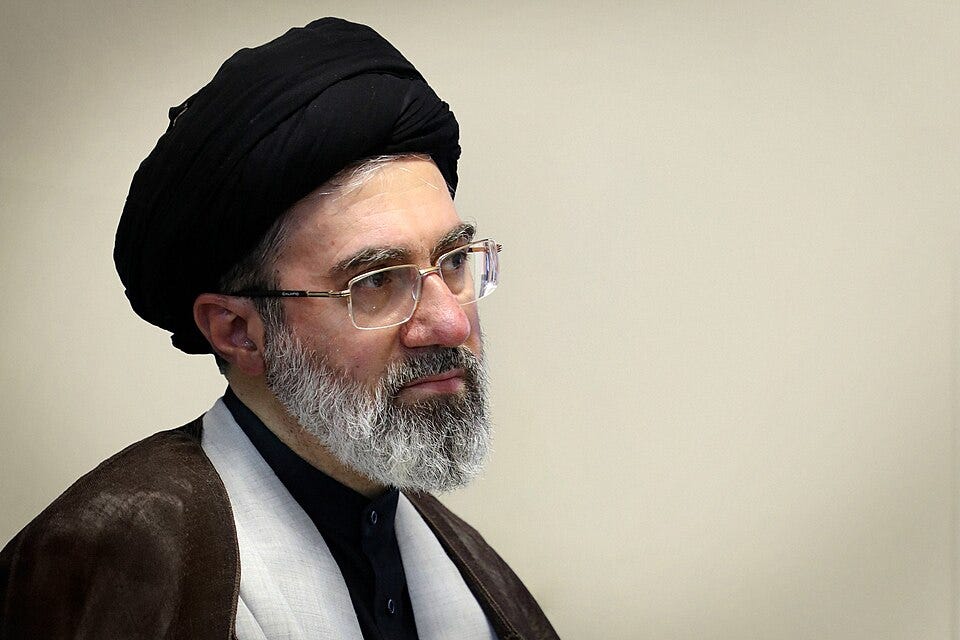

Describing the meeting, Pezeshkian said: “What stood out to me more than anything else was the manner, perspective, and deeply sincere and humble behaviour of the Supreme Leader — an approach that transformed the atmosphere into one based on trust, calmness, empathy, and direct dialogue.” He added that when the highest-ranking official in the country treats people with such moral conduct and humility, this behaviour can naturally serve as a model for the country’s entire management and administrative system — one based on accountability, closeness to the people, and genuinely listening to their problems, in the same way he suggests the previous Supreme Leader had practised throughout his life.
This is the first public confirmation by a senior Iranian official of a face-to-face meeting with the new Supreme Leader since his appointment just two months ago. Mojtaba Khamenei was appointed by Iran’s Assembly of Experts and his appointment was announced by state television on March 9 (17 Esfand 1404), just over one week after the US-Israeli strikes on February 28 that killed his father, Ali Khamenei. Since that day, no image, video, or audio of Mojtaba Khamenei has been made public, and Iranian state media have published only written statements attributed to him.
While no formal statement on the full extent of his injuries has been issued, a state television anchor referred to him as “janbaz” — a term meaning war-wounded veteran — immediately following his introduction as the new Supreme Leader, offering the first implicit official acknowledgment that he had been hurt.
Hojatoleslam Mohsen Qomi, Deputy for International Affairs of the Supreme Leader’s office, addressed the matter directly, saying that questions raised about Khamenei’s health and absence are “an enemy trick” designed to provoke a reaction. He confirmed that Khamenei was injured in the attack on the leadership compound, but said he survived because he had stepped into the courtyard for a brief errand just minutes before the explosion. Qomi went on to state that Mojtaba Khamenei is currently in full health, is actively overseeing the country’s affairs including the ongoing nuclear negotiations, and has recently issued direct guidance to the Iranian negotiating team.
Iran’s ambassador to Cyprus, Alireza Salarian, offered a more candid account, saying: “He was wounded in his legs, hand and arm…I think he may be hospitalized due to his injuries.” The gap between these two official accounts - one claiming full health and active governance, the other suggesting ongoing hospitalization - reflects the broader ambiguity that has defined Mojtaba Khamenei’s leadership from the start.
Pezeshkian’s announcement provides the clearest signal yet that Mojtaba Khamenei is alive and capable of direct, extended dialogue. Yet the deliberate silence around the circumstances of the meeting, the contradictions between official accounts of his health, and his continued physical absence from public life mean that fundamental questions - about where he is, the true extent of his injuries, and the degree to which he is actively governing - remain, for now, without a definitive public answer.