

Iranian President Masoud Pezeshkian departed for New York on Tuesday to attend the United Nations General Assembly, arriving at a consequential moment in the nearly seven-month war. His trip comes as commercial traffic through the Strait of Hormuz remains severely disrupted, both Iran and the United States face mounting economic pressure, and several diplomatic channels appear to be converging around the question of whether the conflict can be brought toward a negotiated end.
.jpg)
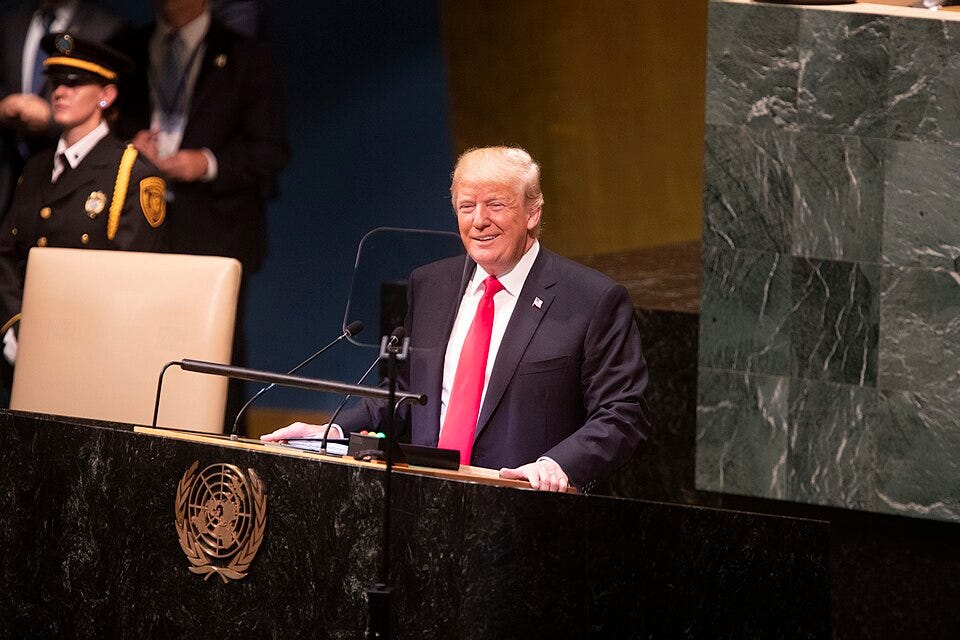
President Trump, in his remarks before the General Assembly, framed Iran as unwilling to strike a deal, a consistent terrorist threat to the U.S., and the globe and his war as justified. He repeated a recent refrain suggesting he can choose between a deal and annihilation. “I have a big decision to make: Will a deal be made with Iran that lets them rebuild and create a far greater country than it ever was before, maybe one of the greatest in the Middle East or even the world?” Trump continued, “Or do I annihilate the Islamic Republic, and do it quickly, never giving them a chance to kill and destroy people and countries again? Do I drive them into hell, with no chance of survival and no hope of future greatness or generations? But I believe we’ll make a deal right after the election…they’re waiting to see how I do in the midterm election. What they don’t realize is I did that already…I’ll be here for two and a half years.” He suggested he will give no credence to the midterms influencing his approach toward Iran, and declared the U.S. has more munitions than ever before.
Trump also suggested that Iran had killed 72,000 of its own people - roughly 10 times the figure produced by the Iran human rights group HRANA after the protests and 24 times the figure announced by the Iranian government. Moreover, without explanation, Trump suggested that 10,000 Iranians had been killed recently. While dozens of individuals who have been accused of violence in the protests have been executed, there is no indication of recent widespread protests or a crackdown on such a scale.
Trump’s frame raises a question as to whether the President might be preparing for a climb down or an escalation. Heated, genocidal rhetoric accompanied the pivot to a ceasefire in April. This rhetoric echoes a similar tone, though the President has defied easy predictions on Iran for years.
On Tuesday, Reuters reported that Iran is prepared to reopen the Strait of Hormuz within seven days if the United States eases military pressure and lifts its blockade of Iranian ports. According to a senior Iranian official who was not identified, Tehran’s proposal for ending hostilities was conveyed to Washington through intermediaries on September 16. The official said Iran’s delegation in New York has full authority to revive diplomacy and that details of an agreement could be discussed there through mediators, although a direct meeting between Pezeshkian and President Donald Trump is not planned. Iran has not publicly confirmed the seven-day proposal in these terms.
The timing is significant because Tehran has spent the past several days publicly signaling an interest in negotiations without backing away from its leverage in Hormuz. Mohsen Rezaei, secretary of Iran’s Supreme National Security Council, said on September 19 that Iran had conveyed seven conditions to Washington for the beginning of negotiations. Rezaei did not publicly enumerate all seven in his statement. In an interview with Al Jazeera, however, he identified three principal demands: an end to the war “on all fronts,” the release of Iran’s frozen assets and an end to the U.S. naval blockade. He said Qatar had transmitted Iran’s conditions to Washington and that Tehran was awaiting Trump’s response.
The complete list remains undisclosed, but the reported seven-day proposal suggests a potentially important change in sequencing. Previous Iranian statements presented reopening Hormuz as something that would follow fulfillment of Tehran’s conditions. The latest proposal, if accurately reported, appears more incremental: Washington would formally commit to diplomacy and take tangible steps to reduce military pressure and end the blockade, after which Iran could reopen the strait within seven days while negotiations over a broader settlement proceed.
That would amount to an action-for-action process rather than requiring every outstanding dispute to be resolved before Hormuz reopens. The stakes remain enormous. Preliminary shipping data showed only two large commercial vessels crossing the strait on Monday, down from ten the previous day and roughly 125 per day before the war began on February 28. The figures do not include ships that may have crossed with their tracking systems switched off. Two vessels were also attacked in separate incidents around the strait, although responsibility had not been established.
The disruption gives Tehran leverage, but sustaining the confrontation is imposing serious costs on both sides. Trump is approaching the November 3 midterm elections amid record diesel prices, stubborn inflation and growing voter dissatisfaction over the cost of living and the Iran war. His approval rating has fallen to 32 percent, the lowest of his political career in Reuters/Ipsos polling, while some Republican candidates in competitive races are openly calling for the war to end quickly.
Iran is under severe pressure of its own. The U.S. naval blockade and intensified sanctions have constrained oil exports and access to foreign currency, while sharp currency fluctuations, inflation and import pressures are further eroding household purchasing power. Iranian officials have increasingly acknowledged that the economy and people’s livelihoods have become a central challenge of the war. Those pressures do not guarantee compromise, but they give both governments powerful reasons to explore an arrangement that preserves core interests while ending an economically costly conflict.
Another important piece is a separate Iran-Oman framework for navigation through Hormuz. Iranian officials say Tehran and Muscat have developed a plan for reopening shipping through the strait. The proposal surfaced prominently during Foreign Minister Abbas Araghchi’s visit to Beijing on September 16, the same date on which Iran’s latest proposal was reportedly transmitted to Washington.
According to the Chinese Foreign Ministry’s account of Araghchi’s meeting with Foreign Minister Wang Yi, the Iranian side said Iran had reached a plan with Oman to open the Strait of Hormuz and argued that the United States should fulfill commitments it had made. Wang urged Iran and the United States to exercise restraint, return to the Islamabad Memorandum of Understanding, rebuild a negotiating mechanism and begin substantive consultations. China also explicitly called for effective measures to reopen Hormuz as soon as possible.
The Beijing meeting is significant because it shows that the Hormuz arrangement and a broader return to negotiations were already being discussed at a high diplomatic level immediately before the latest Iranian initiative became public. It also places China directly inside the diplomatic picture at a moment when Beijing is communicating with both Tehran and Washington.
Inside Iran, Parliament Speaker Mohammad Bagher Ghalibaf has also begun speaking unusually explicitly about avoiding an indefinite conflict. On September 20, he criticized two competing approaches: one that advocates continued war without offering a mechanism for ending it and, by rejecting diplomacy, risks pushing Iran toward “attrition and endless war”; and another that, in his view, underestimates Iran’s capabilities and favors accepting unilateral American demands. Ghalibaf instead argued for combining military pressure with diplomacy and converting what Iran considers its battlefield leverage into political gains. His comments provide further evidence of an increasingly public discussion within Iran’s political establishment over how the war should end, rather than a simple choice between fighting and negotiating.
China may now become particularly important to that process. Beijing wants the Strait of Hormuz reopened and international energy flows stabilized but has simultaneously called for negotiations based on reciprocal steps rather than unilateral Iranian concessions. China is also a major economic partner of Iran and has significantly more leverage than smaller regional mediators. In its official account of the September 16 meeting, Beijing said it was prepared to play a “constructive role” in resolving the conflict while supporting Iran’s legitimate rights and interests and urging both Tehran and Washington toward substantive negotiations.
What happened immediately afterward makes the Chinese channel more noteworthy. On September 17, one day after meeting Araghchi, Wang spoke by telephone with U.S. Secretary of State Marco Rubio. The Middle East was among the issues discussed, and Beijing again called for restraint, renewed negotiations and a reopening of the Strait of Hormuz. Within roughly 24 hours, China’s foreign minister had therefore been in direct communication with senior officials from both Tehran and Washington as diplomatic activity around the war intensified.
The diplomatic calendar creates another opportunity. Chinese President Xi Jinping is due to visit the United States from September 23 to 25 and meet Trump in Washington. Their agenda extends far beyond Iran, encompassing trade, artificial intelligence, Taiwan and the broader U.S.-China relationship, but the Iran war is also expected to be discussed.
This gives China a potentially distinctive role. Qatar and Oman can carry messages and develop practical arrangements; Beijing has direct access to Tehran, a major economic relationship with Iran and simultaneous high-level access to Washington. Washington could seek Chinese help in encouraging a stable reopening of Hormuz, while Tehran may see Beijing as a major-power channel supportive of reciprocal implementation rather than surrendering its principal leverage before negotiations begin.
The sequence is therefore notable: Araghchi discussed Hormuz and negotiations in Beijing; Wang spoke with Rubio the following day; Iran says its conditions have been conveyed through regional intermediaries; Pezeshkian is now heading to New York; and Xi is preparing for talks with Trump in Washington.
Major obstacles remain. Iran insists Washington must take concrete steps before Tehran relinquishes its leverage in Hormuz. The Trump administration continues to threaten renewed military action, while maritime attacks and broader regional fighting have not stopped. The full seven Iranian conditions remain undisclosed, and Washington has not publicly accepted either Tehran’s reported sequencing proposal or the Iran-Oman framework.
Pezeshkian is therefore not arriving in New York with an announced peace agreement, and a meeting with Trump is not currently expected. What makes this UN gathering different is the diplomatic activity surrounding it: Iran has transmitted conditions for negotiations, senior officials in Tehran are publicly discussing how military leverage could be converted into a political outcome, a concrete proposal for Hormuz has reportedly reached Washington, and governments with access to both sides are actively engaged.
The coming days may show whether these separate channels remain another round of indirect messaging or begin to form a workable negotiating process. Pezeshkian’s presence in New York provides an immediate venue for testing that possibility, while Xi’s talks with Trump could determine whether China assumes a larger role in the diplomacy surrounding the war.