

Iranian President Masoud Pezeshkian used his address to the United Nations General Assembly on Wednesday to deliver a message centered on two themes that have increasingly defined Tehran’s approach after seven months of war: Iran believes it must possess sufficient power to deter further attacks, but it is not closing the door to diplomacy with the United States.
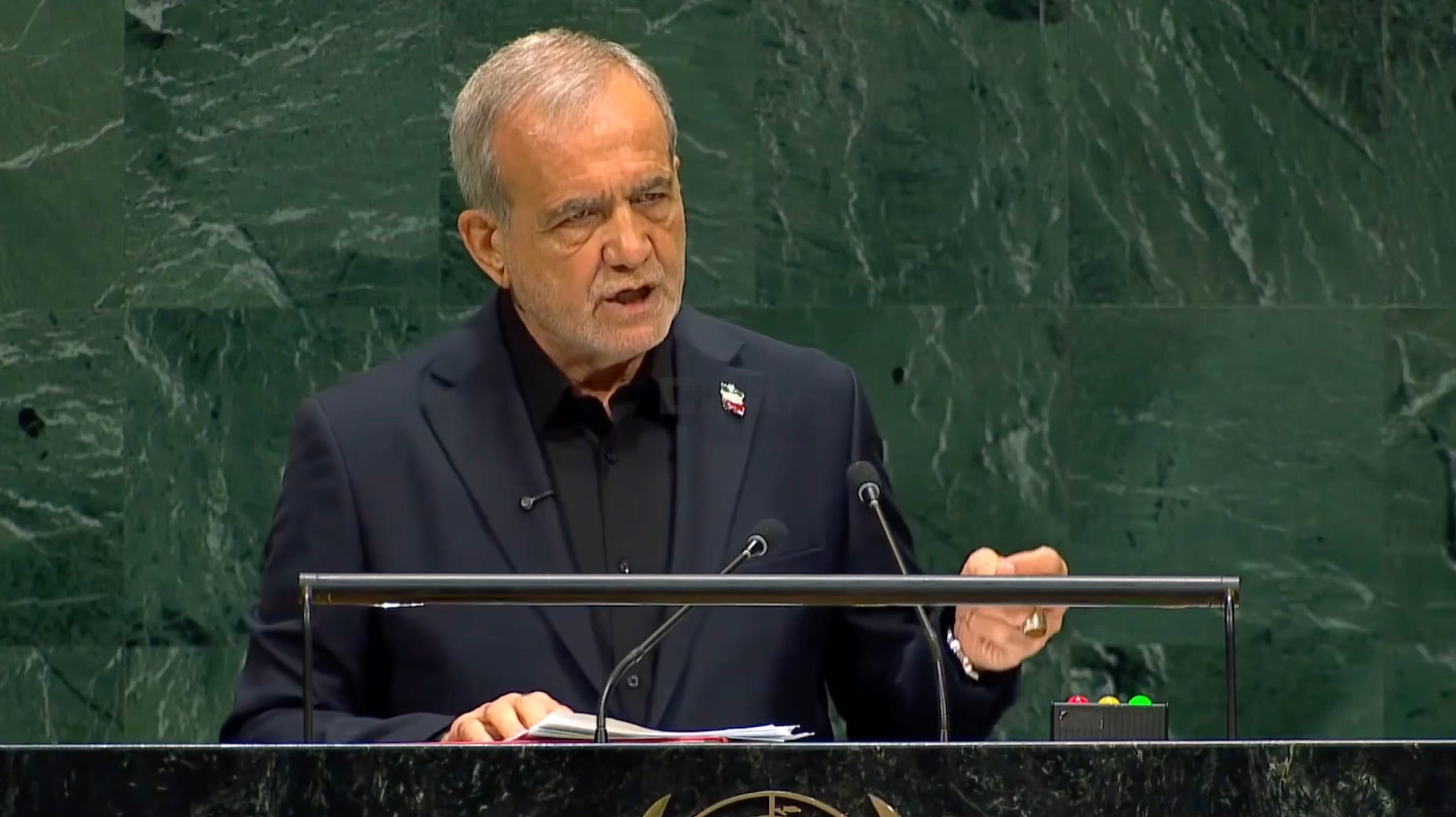
Speaking one day after President Donald Trump used the same UN podium to threaten Iran with further military escalation, Pezeshkian repeatedly returned to the question of power. He argued that Iran’s experience during the war had demonstrated the consequences for countries unable to adequately defend themselves, while distinguishing defensive strength from aggression.
“We want power to defend ourselves, not to invade other countries,” Pezeshkian said. At another point, he put the argument more starkly: in today’s international system, without power, “we will be crushed.” Pezeshkian opened his speech with a direct response to Trump’s portrayal of Iran a day earlier. Holding up photographs of Iranians killed during the conflict, including children killed in the U.S. strike on the Shajareh Tayyebeh school in Minab, victims of the bombing of a sports facility in Lamerd, and Iran’s late Supreme Leader Ali Khamenei, he rejected the characterization of Iran as a terrorist state.
“We are not terrorists. We are victims of terrorism,” Pezeshkian said, arguing that Iran had been attacked by the United States and Israel and had responded in self-defense. He said Iran had not attacked another country in roughly two centuries and questioned why Iran was accused of terrorism while Iranian civilians, political leaders and infrastructure had been targeted. Pezeshkian credited the Iranian public with preventing those efforts from succeeding.
The broader argument running through the speech was that the war had strengthened Tehran’s belief in deterrence rather than weakened it. Pezeshkian said Iran’s defensive systems exist so that “no one imagines that bombing Iranian cities will go unanswered,” adding that Iran would not seek anyone’s permission to defend itself. At the same time, he emphasized that Iran does not seek regional domination. Its objective, he said, is sufficient strength to defend the country and pursue development, not to invade its neighbors.
That distinction shaped Pezeshkian’s message to surrounding countries. He argued that Iran’s security cannot ultimately be separated from the security of its neighbors and called for cooperation, shared security and economic development. His message also carried a warning: Iran and its neighbors could build peace and security together, or ultimately share the consequences of regional insecurity. Despite his emphasis on military strength, Pezeshkian repeatedly left the door open to negotiations.
“For our defense, we do not fear war, and for peace, we do not run from negotiations,” he said. Pezeshkian said Iran had demonstrated its willingness to pursue diplomacy but would not negotiate under military coercion. “We are ready for dialogue with the world, but we will not accept the language of force.”
The remarks directly answered Trump’s speech a day earlier, in which the U.S. president paired the possibility of an agreement with threats of military “annihilation.” Pezeshkian argued that such threats violate the principles of the UN Charter and would not force Iran to surrender. The exchange highlighted a central obstacle facing renewed diplomacy: Washington is seeking to use military and economic pressure as leverage, while Tehran insists that meaningful negotiations cannot take place under the threat of additional attacks.
Pezeshkian also addressed Iran’s nuclear program, reiterating that Tehran does not seek nuclear weapons but will not surrender its nuclear knowledge or peaceful nuclear technology. Iran, he said, wants nuclear energy for development and does not accept that nuclear science should effectively remain the exclusive domain of a small number of countries. His formulation was straightforward: “No nuclear weapon, but no deprivation of Iran from nuclear knowledge.”
Pezeshkian contrasted Iran’s treatment with that of Israel, which is widely believed to possess nuclear weapons but is not a member of the Nuclear Non-Proliferation Treaty. “The atomic bomb is in Israel, but the inspectors are in Iran,” he said. He argued that Israel has not subjected its nuclear program to the inspection system applied to Iran while Tehran continues to face sanctions and scrutiny. “Israel kills, but Iran is sanctioned,” Pezeshkian said, presenting the comparison as an example of what Iran views as a double standard.
Pezeshkian also connected sanctions directly to their impact on ordinary Iranians. He argued that U.S. sanctions disproportionately harm the sick, the poor and other vulnerable people, rather than simply putting pressure on the government. He also pointed to Iran being attacked while engaged in negotiations, arguing that Tehran continues to face military pressure and sanctions even as it maintains that it is prepared for diplomacy.
Another major portion of the speech concerned the Strait of Hormuz, which has become both a military flashpoint and an important source of Iranian leverage. “We cannot allow everyone to benefit from the Strait of Hormuz while Iran is deprived of it,” Pezeshkian said. He argued that Iran could not be expected to accept restrictions on its own commerce while weapons, missiles and military supplies continued to move through the same waters. “They close the way to Iran and then move weapons, ammunition and missiles through the strait to destroy countries. This is not possible, and we will not allow it.”
The remarks came as indirect contacts between Iran and the United States continued in New York. Tehran has linked the future of navigation through the Strait of Hormuz to U.S. military pressure and restrictions on Iranian ports, while signaling that diplomacy remains possible.
The speech also came amid a broader Iranian response to Trump’s UN address. Earlier Wednesday, Supreme National Security Council Secretary Mohsen Rezaei said Foreign Minister Abbas Araghchi had been authorized to communicate Iran’s conditions through intermediaries in New York. The announcement suggested that despite escalating rhetoric, Tehran continues to authorize diplomatic engagement.
At the same time, Rezaei emphasized Iran’s military and geographic leverage. He described the Strait of Hormuz as an instrument for securing Iran’s rights in negotiations and warned that Tehran would respond to further U.S. attacks. He also warned neighboring countries against allowing their territory, airspace or infrastructure to be used for military operations against Iran.
Rezaei separately made claims about Iran’s military capabilities, including that an Iranian missile had been detonated above the aircraft carrier USS George Washington and that Iran was reverse-engineering a U.S. autonomous underwater vehicle. Those claims have not been independently verified. Iran’s military leadership delivered an even sharper response. The General Staff of the Armed Forces and the Khatam al-Anbiya Central Headquarters said Iran was prepared to answer new attacks with “more severe, more crushing and unpredictable blows.”
The military’s language was considerably more confrontational than Pezeshkian’s. The president instead sought to combine deterrence with an explicit willingness to negotiate. Taken together, however, the messages point to a two-track Iranian strategy: demonstrating military leverage while keeping diplomatic channels open.
Pezeshkian also addressed the humanitarian consequences of war in the region, particularly in Gaza. He cited the large number of Palestinians killed and displaced and argued that international institutions had failed to protect civilians. He said it was impossible to speak credibly about peace while the Palestinian conflict remained unresolved and argued that resistance could not simply be eliminated through bombing.
For Pezeshkian, the lesson of Iran’s own experience appeared similar: military pressure can impose enormous costs on civilians, but Tehran does not believe that pressure alone will produce political capitulation. His address therefore presented military strength and diplomacy not as competing approaches, but as interconnected elements of Iran’s strategy after seven months of war. Pezeshkian’s central argument was that credible defensive power is necessary for diplomacy to occur on more equal terms.
His message to Washington was that Iran remains willing to negotiate but will not accept negotiations framed as surrender. To neighboring states, he argued that their security and Iran’s are ultimately intertwined. On the nuclear issue, he rejected both nuclear weapons and demands that Iran abandon peaceful nuclear knowledge. And on Hormuz, he made clear that Tehran does not believe freedom of navigation can mean unrestricted access for others while Iran itself faces blockade and economic exclusion.
One day after Trump paired diplomacy with threats of further military force, Pezeshkian offered Iran’s response from the same UN podium: Tehran intends to strengthen its ability to defend itself while leaving a path open for negotiations. “We do not fear war,” Pezeshkian said, “and we do not run from negotiations.”