


Tragedy upon tragedy has beset the people of Iran, with yet another round of mass demonstrations this month being met with overwhelming force and thousands of protesters killed. The pain, despair and anger from this crisis is still raw, and many inside and outside Iran are desperate for some sense of justice.
Iranians have lit the flame of protest many times in recent years, but ultimately it has been smothered before becoming self-sustaining. The Iranian government’s brutality, and internal Iranian dynamics, explain most of why these demonstrations have not led to political change. Yet, for Americans, it’s critical we understand the role of U.S. policy in shaping the environment of protest movements and reinforcing and intensifying the harsh security atmosphere inside Iran.
With so much on the line, it is important to recognize a fallacy that lies at the heart of the conversation on U.S. policy toward Iran: the claim that the U.S. has erred by doing too little on Iran. While calls for the United States to “do more” may be understandable in light of the Iranian government’s increasing brutality and the continued frustrations of Iranians hoping for change, they also get the situation wrong. To the contrary, the United States has often erred by doing far too much of the wrong thing, stacking the deck against the people of Iran by crushing them with far-reaching sanctions and continually threatening war.
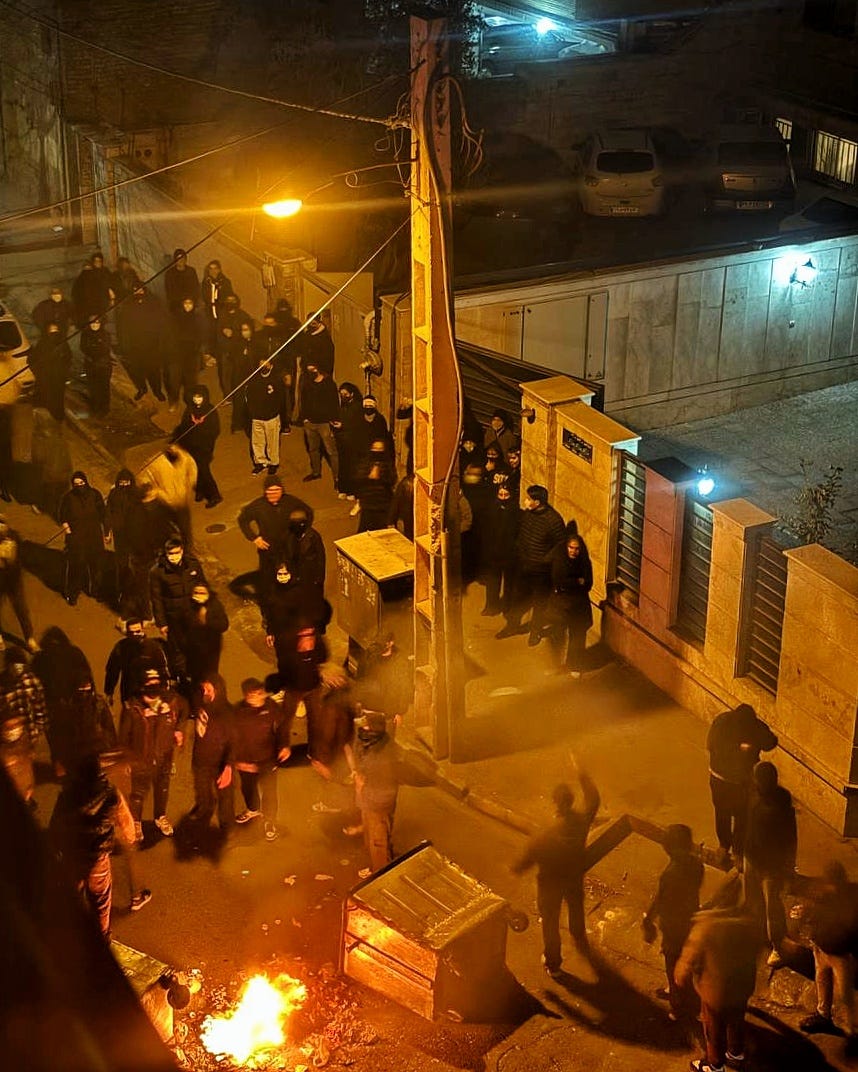

The notion the U.S. must “do more” on Iran – promoted for decades by groups like AIPAC and the Israel lobby, as well as by exile opposition groups like the Mujahideen-e-Khalq (MEK) and monarchists promoting sanctions and interventionist pressure policies – has been fixated on coercion and punitive policies, not efforts to actually support ordinary Iranians. This logic has naturally led to a situation where the American toolkit for coercing the Islamic Republic has been all but exhausted.
The U.S. has cut off Iran from American and international markets, has barred foreign companies that do business with the United States from trading with Iran, and cut off Iran’s oil revenues which are frozen in bank accounts abroad. U.S. sanctions have inadvertently aided the Islamic Republic’s repression, including in disconnecting Iranians from the internet, and efforts by policymakers to update these policies have often been too little, too late. The U.S. briefly pursued detente and relieving sanctions via a multilateral nuclear agreement, only to violate the accord and pursue “maximum pressure” on Iran which has continued for more than seven years. The U.S. enabled Israel to decimate Iran’s “axis of resistance” and launch strikes inside the country that killed much of Iran’s military leadership along with hundreds of civilians. And the U.S. itself bombed Iran’s nuclear facilities in June. Yet, the regime endures and the calls from some of the most prominent voices in the Iranian exile community for the U.S. to “do something” have begun to coalesce and demand the final, predictable option in the toolkit – U.S. military action aimed at changing the regime.
Stripped from any pretense of improving the livelihood of its people, both by external design and its own choices, the Islamic Republic now relies almost entirely on the solid core underpinning any state: a monopoly on the use of force. Now thousands of Iranians who were attempting to voice their demands and escape their desperate circumstances have been victimized by the state, whereas past cycles left dozens or hundreds dead in the state’s repression.
What comes next is an important question. Those arguing that the U.S. must now take the final step and bomb Iran appear to be mistaking the Iranian government’s isolation and lack of options for fragility. A cornered predator is not without options - it will attack viciously if it sees no other alternative.
Strikes on Iran would be highly unlikely to trigger a return of a mass movement to the streets and the precipitous collapse of a corrupt and hollow structure, as some have portrayed. Iran’s power structure is deeply embedded, and there has been no sign of defections in Iran’s military or political leadership. As a result, Iran would lash out with its missiles and other military capabilities if attacked, calculating that overwhelming force is the last card that can be played to prevent a repeat of the fate that befell similar isolated regimes like Saddam Hussein’s Iraq and Muammar Qaddafi’s Libya. As much as President Trump may hope that Iran strikes would be decisive, it is far more likely to be bloody and chaotic with significant losses on the American side — not to mention countless innocent Iranian civilians.
The deck is stacked against democracy flourishing once the smoke from bombing clears. The strongest power center in the Islamic Republic remains its military, including the Islamic Revolutionary Guard Corps, which has been loyal to the Supreme Leader. The IRGC or a splinter of it would be in the most advantageous position to take over in any power vacuum following a regime decapitation strike. In addition to the risks of one authoritarian state being replaced by another, the state itself could fracture as competing factions vie for control or seek to break away from the central state, leading to a bloody civil war.
Some, knowing all the risks of further societal degradation and destruction that war brings, may still calculate that the brutality of the Islamic Republic demands nothing else but to push forward and hope that U.S. bombs will trigger a fundamental and brighter change. But if President Trump truly wanted to do right by American interests and the Iranian people, he would cease all threats of military intervention, declaring clearly that Iran’s future must be led by Iranians themselves. Instead of pursuing crushing sanctions forcing ordinary Iranians into desperate circumstances, Trump could direct the Treasury Department to rework sanctions to target pressure squarely on Iranian officials responsible for crimes against Iran’s people while sparing the general population and economy as a whole. At the same time, he could ensure there is full support and funding for credible independent investigations recently authorized by the United Nations to pursue real accountability. Under this scenario, the Islamic Republic would be denied a boogeyman to rally its supporters against and exploit to justify its brutality. The Iranian people would have an economic reprieve and be better able to build civil society networks necessary for any democratic transition and to sustain demonstrations and activism demanding political change. Instead, the only tools that appear to be on the table are the further weakening of Iranian society relative to the government through economic immiseration, or a foreign military intervention.
In international politics, there are no guarantees. Yet a path that reduces external pressure on ordinary Iranians and creates conditions conducive for the Iranian people to sustain a movement for change is the best way to enable rather than hamstring organic efforts in Iran to be able to stand up to the anachronistic and increasingly brutal system that rules over them. It also represents a path away from the vortex of violence and chaos that is enveloping Iran and risks producing regional war, state collapse and civil war.
If we continue on the same course, either the flame of Iranian democracy will continue to be smothered, or a war will threaten everything in an explosion of violence. A different way is still possible, if we allow the Iranian people to breathe.