

Diplomatic efforts between Iran and the United States remain deadlocked as hostilities erupted again, centered on the Strait of Hormuz. Iran transmitted a 14-point peace proposal to Washington via Pakistan, acting as intermediary. Iran’s Foreign Ministry confirmed receipt of the U.S. counterproposal and said it was under review. Despite President Trump describing “very positive talks” with Tehran on Truth Social, he simultaneously told reporters he had studied Iran’s proposal carefully and found it “unacceptable.” Iran, for its part, insists it “does not negotiate under deadlines or pressure,” and has shown no sign of relaxing its control of the Strait of Hormuz. With no agreement in sight, both sides have moved aggressively to strengthen their position on the ground.
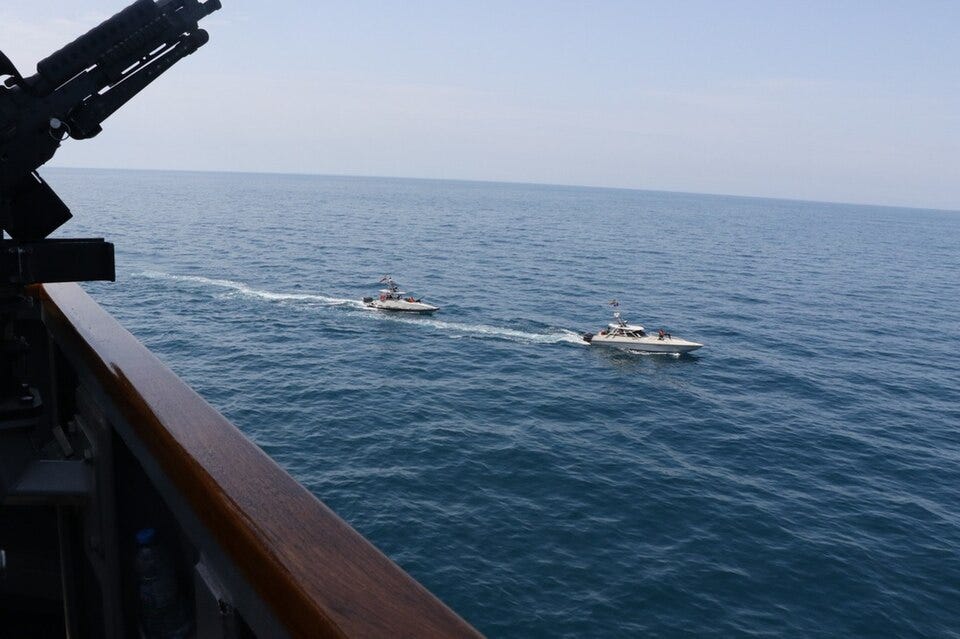

Washington has sought to remove Iran of its most powerful leverage: control over the Strait of Hormuz. Iran has used its dominance over this narrow waterway, through which roughly one quarter of the world’s seaborne oil trade passes, as its primary bargaining chip in negotiations and its primary instrument of economic retaliation. If the U.S. can demonstrate that ships can pass freely without Iranian permission, that card loses much of its value. This is the strategic logic behind the so-called “Operation Freedom,” which President Trump announced on Sunday and launched on Monday, May 4, 2026. 15,000 military personnel, more than 100 aircraft, and multiple guided-missile destroyers are reportedly available to escort commercial vessels through the Strait and shield them from retaliation. The extent that this will be acted upon remains unclear.
Iran has responded with an equally determined effort to prove the opposite: that no ship passes without its permission. The IRGC Navy formally declared a new control zone covering the entire Strait, broadcasting warnings in Farsi and English: “the Strait remains closed; passage without authorization from the Islamic Republic of Iran is forbidden.” General Ali Abdollahi, commander of the Khatam al-Anbia Central Headquarters, made Tehran’s position explicit: “any foreign armed force that attempts to approach or enter the Strait of Hormuz will be attacked.” Iran’s Foreign Ministry spokesman Ismail Baqaei reinforced the message commercially: “shipping companies know well that ensuring their safety requires coordination with Iran.”
Critically, Iran’s newly declared control zone goes far beyond the Strait itself. The IRGC defined the zone as extending from a line between Kuh-e Mubarak in Iran and southern Fujairah in the United Arab Emirates (UAE), westward to a line between the tip of Qeshm Island and Umm al-Quwain, effectively covering the entire eastern coastline of the UAE. This boundary carries direct strategic significance. The UAE had constructed an overland pipeline connecting Abu Dhabi’s oil fields to the port of Fujairah, located on its eastern coast outside the Strait of Hormuz entirely, precisely to allow oil exports to continue even if the Strait was closed. By declaring the waters off Fujairah part of its control zone, Iran is signaling that it intends to seal this bypass route as well, leaving the UAE with no path to move its oil to global markets without Iranian approval.
A series of hostilities unfolded on Monday: Iran fired warning shots at a U.S. naval vessel that reportedly sought to enter the Strait of Hormuz, with CENTCOM issuing a public denial that the warning shots hit any of its vessels. The U.S. subsequently announced two U.S.-flagged merchant ships had succeeded in passing through the Strait of Hormuz, though this could not be separately verified. The IRGC immediately and flatly denied the claim, issuing a statement declaring that no commercial ship or oil tanker had passed through the Strait without its permission. What is not in dispute is the number: even accepting the U.S. version entirely, two ships passed under the protection of a 15,000-strong military operation. Before the war, more than 130 ships regularly transited the Strait every single day. Two ships does not mean commerce is restored, if indeed they passed. If true, it would be, at best, a symbolic proof of concept.
The U.S.-led Joint Maritime Information Center also issued an advisory directing ships to cross the strait in Oman’s waters, claiming this as an “enhanced security area.” Yet there could be significant challenges to following such a route. Additionally, the South Korean vessel HHM Namu, a 180-meter cargo ship with 24 crew members, belonging to a nation with no involvement in the conflict, suffered an explosion and fire near UAE waters in the Strait, on the very eve of Operation Freedom’s launch.
Iran followed its earlier announcement of an extension of its control through Fujairah with strikes on the oil terminal there. However, the initial picture of what happened there was far from clear, and the gap between the UAE’s first statements and the reality that subsequently emerged is telling. Before images of the fires began circulating widely, the UAE government had already issued a statement claiming it had intercepted and destroyed three of the four Iranian missiles, with the fourth falling harmlessly into the sea, a narrative of near-total defensive success that left little room for significant damage on the ground.
The pattern is familiar: it closely resembles the Israeli practice of reporting military incidents in which casualties and material damage are either omitted entirely or presented at such a minimal level that they can be effectively disregarded. But once images of large fires burning across the Fujairah industrial zone spread rapidly online, the UAE was forced to revise its account. Officials acknowledged that Iranian drones had struck oil refinery facilities at the port, causing the fires visible in the footage. Three Indian workers were reportedly injured and hospitalized. The UAE then issued a formal statement holding Iran “fully responsible” for the attacks and declaring that it reserves “the legitimate right” to respond. Brent crude surpassed $115 per barrel, a single-day gain of more than 5%, as the scale of the Fujairah strikes became clear to markets.
Finally, President Trump asserted on Monday that the U.S. had fired on and sunk several Iranian fast boats that were reportedly threatening shipping in the Strait. According to CENTCOM Commander Brad Cooper, the U.S. military sunk six Iranian ships using AH-64 Apache and MH-60 Seahawk helicopters. Iran has not responded to the claims.
The clashes, taking place in the fog of war, have not tilted the balance of the Strait in any direction. For a shipowner, the arithmetic remains unforgiving: a military escort could reduce risk, ultimately cannot eliminate it. Iran has shown it will target neutral vessels; insurance premiums have surged; and no convoy compensates for a sunken ship or a lost crew. It is not yet clear how a U.S. military escort can provide genuine protection against an adversary simultaneously deploying missiles, drones, and fast boats inside the Strait, while also striking the alternative Fujairah route outside it.
The hours ahead are highly volatile, and what Washington’s response to Iran’s strikes will be remains unknown. If the United States decides to strike Iranian military positions directly, a new and far larger round of confrontation could be triggered, one whose ultimate dimensions are extremely difficult to predict.
Two scenarios may be more likely than a general war. The first is a targeted naval confrontation aimed at destroying or severely degrading Iran’s naval capacity to the point where it can no longer enforce its blockade, though how feasible that would be against an adversary with extensive coastal missile batteries and a dispersed force structure remains deeply uncertain. The second is an infrastructure war - systematic strikes on Iranian oil, energy, and economic infrastructure, with reprisal strikes targeting similar infrastructure across the Persian Gulf. Neither path is clean. Neither outcome is controlled. And the diplomatic channel that might have offered a way out is, for the moment, deeply fraught.
The Strait of Hormuz is shared by Oman and Iran. Oman’s coastal waters are relatively shallow, while Iran’s are deep enough to allow large vessels to enter and exit the Persian Gulf. When people refer to “international waters” in this context, they are often talking about areas adjacent to Iran’s maritime borders, which Iran has a right to defend.
Meanwhile, gas prices have climbed above $4 a gallon in New York—something many would have considered unthinkable not long ago—raising concerns about a broader economic downturn. Military responses such as “Operation Freedom” are unlikely to stabilize the global economy and may instead escalate tensions. Reports indicate that 15,000 military personnel, more than 100 aircraft, and multiple guided-missile destroyers could be deployed to escort commercial vessels through the strait. That is an enormous and costly commitment simply to ensure passage, and any attempt to force access risks provoking a larger conflict or even a hostage crisis.
Rather than escalating, the United States should pursue diplomacy. It is time for President Trump to engage Iran and work toward a peace agreement. Ongoing clashes between U.S. and Iranian forces are expensive and do little to serve long-term American interests. Efforts to degrade Iran’s naval capabilities or target its infrastructure risk drawing the U.S. deeper into a prolonged conflict.
The 1981 Algiers Accords between the United States and Iran committed both sides to non-interference in each other’s domestic affairs. Iran’s maritime borders fall within that scope, and honoring past agreements is essential for maintaining credibility and stability.
At present, instability in the Gulf is constraining oil exports, which in turn drives up gasoline prices in the United States. American consumers are bearing the burden of these tensions. The priority should be de-escalation, economic stability, and affordable energy—not further military entanglement.