


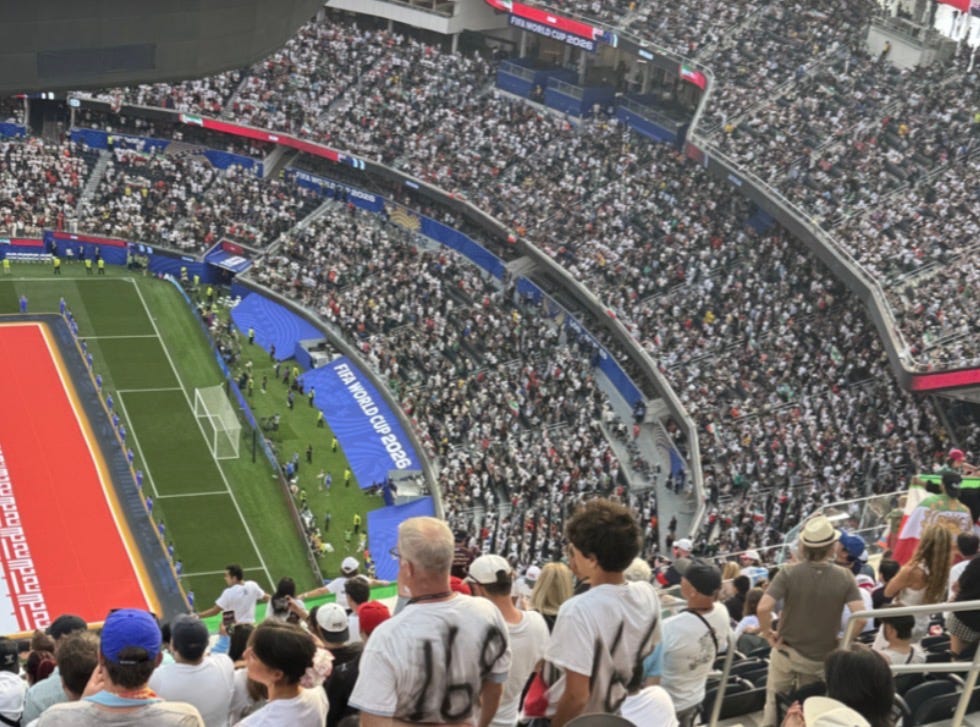
The twenty-three athletes representing Iran’s national team in the 2026 FIFA World Cup spent their lives chasing the shared dream of representing their nation at the highest level of international competition. Yet the months preceding the team’s travel to the United States underscored just how complicated and difficult this tournament was going to be for the Iranian national team. Recent months saw not just a major protest movement and crackdown in Iran, but a war that killed thousands of Iranians and triggered global economic consequences, which was the subject of high-stakes negotiations up until the very moment the team prepared to step on American soil to play in the home of the largest Iranian diaspora community on Earth.
After all of this, along with unprecedented visa restrictions, the team’s 2–2 draw against New Zealand Monday night was electric, with Team Melli coming from behind twice to draw, a reminder of why football remains the world’s game.
Yet, some of what happened off the field cast a shadow over the competition, which should have been all about the triumph of sport to transcend conflict.
Start with what most people in the stadium seemed to understand. The vast majority of fans at SoFi Stadium on Monday—over 70,000 in attendance—came to watch football. Many, including supporters of the Iranian national team, carry deep grievances against Tehran’s government. Some waved pre-revolutionary flags. Some booed the national anthem. These can be real and legitimate expressions of pain and protest. And yet, when the match began, the overwhelming majority cheered for Team Melli, because most people are capable of separating the worst actions of a government from the players representing their country.
That basic distinction held for most in attendance. However, it did not hold for everyone. A small but highly disruptive group of supporters of Iran’s deposed monarchy used the occasion to harass, intimidate, and even physically attack fellow Iranians for the simple act of watching a soccer match. Video footage from the stands shows a physical altercation by Pahlavist agitators and an older man holding an Islamic Republic flag. Whatever one thinks of the government that adopted the current national flag, assaulting an old man over the flag at a World Cup match crosses a clear line. The Associated Press reported that protesters snatched an official Iran flag from a fan, trampling and tearing it while others spat on it. One fan, Aida Ashouri, recounts that both she and her friend were grabbed and scratched by Pahlavi supporters who opposed their support of the national team, prompting Mexican fans to intervene and come to their defense.
A separate clip shows a less-heated confrontation, with a calm supporter of the team with the current flag confronted by an opponent of the government, who was then denounced by another individual herself. Outside the stadium, reporters noted that protesters chanted “President Trump, finish the job,” openly calling for renewed military strikes on Iran as fans walked in. When the dust has barely settled from a war that has killed thousands of civilians, bombed universities, water treatment plants, and elementary schools and the ink is barely dry on an agreement to end it, that kind of messaging goes beyond protest and into explicit advocacy for violence.
Online, the discourse has also hit new lows. One Iranian player celebrated his goal with a version of a popular celebration, widely used by some of the games most popular players, including from Brazil, England and the United States. In desperation to serve her own pro-war, anti-Iranian agenda, Laura Loomer derided the Iranians as “freaks” and bemoaned that they were granted entry to the country. Others echoed her and tried to claim it was a violent gesture toward spectators. Yet the video tells a different story: it is a player celebrating a goal on the world’s biggest stage using the same celebration as Neymar, Vinicius, and Phil Foden. That’s it.
This kind of behavior can be traced to a loud minority of the Iranian American community who support war. They are entitled to their opinions, and even to protest, but the escalation into physical violence was a shameful and outrageous display that should be widely condemned. The Iranian diaspora has more in common, yet political grievances are tarnishing what should be a shared communal experience and actively endangering members of the community - over a sport. We should be better than what was on display in Los Angeles last night.
Meanwhile, the players themselves—actual Iranians representing their country at the highest level—have faced conditions unlike those of any other team in the tournament.
ESPN reported that players described U.S. visa policies as creating “a lot of tension,” and Iran’s fan ticket allocation was revoked entirely, leaving thousands of supporters who had already booked travel unable to attend. Although all 31 players eventually received visas, their issuance was only after a considerable delay that disrupted their preparation for the tournament, forcing them to train in Tijuana, Mexico instead of Arizona as originally planned. Eleven members of the traveling party were denied entry, including federation president Mehdi Taj.
Players described being held for five hours in immigration controls before their opener, which any athlete can tell you is far from ideal when preparing for a match at any level. Adding insult to injury, the team wasn’t even allowed to stay overnight after their match, but instead was forced to leave the United States and return to their base camp in Tijuana, Mexico - an absurd requirement unheard of in international competition, which further denied the team proper recovery. Coach Amir Ghalenoei told reporters that officials denied the team adequate recovery time before sending them back across the border. Captain Mehdi Taremi captured the strain: “It’s supposed to be… tomorrow morning recovery, then we fly to Tijuana, then we return to [Los Angeles] again. But now, right now, we have to go back.” According to Taremi, the situation the team faces is a “disaster.” and BBC both reported Taremi calling the situation a “disaster.”
These are athletes who have trained their entire lives for this stage. They are not politicians. They are not policymakers. They are footballers and they should be allowed to do their job.
As an Iranian American civil society organization, NIAC will stand by basic standards of decency which should not be controversial: no one should be attacked for cheering their country on at the world cup. No one should be mobbed in the stands. Athletes should not be recast as enemy combatants over a goal celebration. The overwhelming majority of people—Iranian and non-Iranian alike—already understand this. It is worth saying clearly. The violent fringe does not represent the diaspora, but their outrageous behavior puts many in our community at risk and - regrettably - besmirches the reputation of our community on a global stage. We can, and must, do better.
Thankfully, those actions do not reflect the spirit of the game that filled SoFi Stadium on Monday night, when 70,000 voices roared for Team Melli and, if only for 90 minutes, it felt like a home for humanity.
Let them play.
