

The ongoing funeral ceremonies for Ali Khamenei, held four months after his killing in U.S.-Israeli strikes on February 28, 2026, have evolved into one of the most significant political and symbolic events in the history of the Islamic Republic. Through the large-scale mourning ceremonies in Tehran and the planned commemorations and burial events in Qom, Iraq, and Mashhad, the Iranian leadership has sought to project an image of national unity, regime continuity, regional influence, and political resilience in the aftermath of the war.
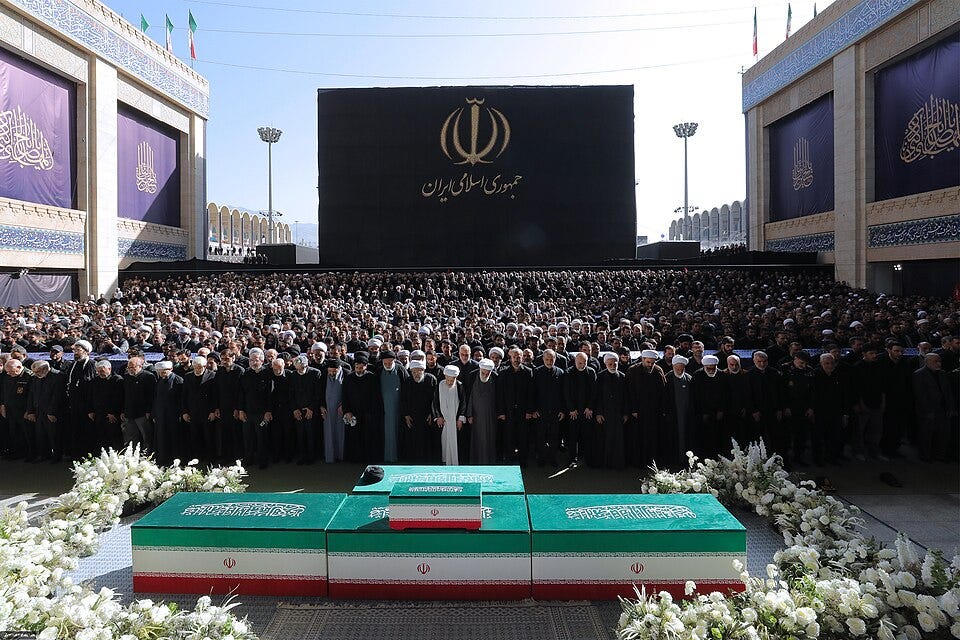

In Tehran, the main procession began at the Mosalla and was planned to continue for more than 10 hours along a roughly 10-kilometer route to Azadi Square. Authorities imposed extensive traffic restrictions in Tehran, Qom, and Mashhad, while state media emphasized images of vast crowds, red flags, and chants calling for “revenge” against the United States and Israel. The coffins of Khamenei and four members of his family who were killed alongside him in the February 28 strikes were transported on a specially designed ceremonial vehicle and accompanied by large crowds carrying portraits, religious symbols, and anti-American and anti-Israeli slogans.
Despite extraordinary official claims regarding attendance, there remains no independent assessment capable of verifying the size of the crowd. Iranian officials estimated participation between 12 and 20 million, while government spokesperson Fatemeh Mohajerani suggested that attendance exceeded 15 million people. Such figures should be treated with caution. Nevertheless, regardless of the precise numbers, the Islamic Republic appears to have succeeded in achieving one of its principal political objectives: projecting an image of mass domestic support, political continuity, and national resilience. The funeral demonstrated that the government continues to possess a substantial and highly mobilizable social base, capable of producing large-scale public displays of loyalty and support.
This message appears to have been recognized even by some of the Islamic Republic’s principal adversaries. Speaking to Axios, U.S. President Donald Trump said he was surprised by scenes of mourning during the funeral ceremonies. “I was surprised to see some Iranians crying,” he said, adding that he had believed that “people hated Khamenei.” Trump then suggested that the displays of grief might not have been genuine, remarking: “Maybe those tears were not real.”
Similarly, Israeli Prime Minister Benjamin Netanyahu acknowledged that, despite his belief that most Iranians oppose the Islamic Republic, the regime still retains a significant social base. “Iran is a country of about 90 million people. Around 80 percent of them hate this regime and would like to see it destroyed. But even so, there are still several million people — a minority — that they can bring into the streets,” Netanyahu stated. Referring to funeral chants of “Death to America,” “Death to Trump,” and “Death to Netanyahu,” he argued that these demonstrators represented “the face of the minority that has taken power and has held the talented people of Iran hostage.” While both leaders questioned the representativeness or authenticity of the mourning scenes, their remarks also implicitly acknowledged that the Islamic Republic was able to stage a substantial and politically significant display of public support.
The ceremonies also highlighted the emerging post-Khamenei leadership structure. Mojtaba Khamenei, who has assumed leadership of the Islamic Republic, was notably absent from the funeral prayer for his father and several family members, even as his brothers Mostafa, Meysam, and Masoud Khamenei appeared in the front row. Shortly afterward, however, a decree attributed to Mojtaba reappointed Gholamhossein Mohseni Ejei as head of the judiciary, signaling an effort to project institutional continuity despite his public absence. Speculation regarding Mojtaba’s absence has been fueled by reports that he was seriously wounded in the same attack that killed his father and remains under heavy security protection.
A major political controversy surrounding the funeral was the absence of Iran’s former presidents and other former senior officials. None of Iran’s former presidents attended the official memorial service, and according to criticism raised by Mohammad-Ali Abtahi - former chief of staff to President Mohammad Khatami - they were not formally invited. Abtahi argued that the funeral represented the “most important historical opportunity to demonstrate national cohesion” and criticized organizers for failing to invite former presidents, parliament speakers, ministers, and other political, cultural, and social figures, including individuals who had publicly disagreed with Khamenei during his lifetime. According to Abtahi, such participation could have projected a stronger image of national unity and political reconciliation.
Foreign participation gave the funeral a significant diplomatic dimension. Iranian officials claimed that representatives from nearly 100 countries attended the ceremonies, including at least eight heads of state or government and twelve parliamentary speakers. Senior representatives arrived from Pakistan, Iraq, Tajikistan, Armenia, Russia, Qatar, Oman, Saudi Arabia, China, India, Afghanistan, and several Iran-aligned non-state groups. The simultaneous presence of representatives of the Taliban government, the Afghan National Resistance Front, and the Fatemiyoun Brigade illustrated Tehran’s effort to maintain multiple channels of influence within Afghanistan. Delegations from Hezbollah, Hamas, Iraqi militias, and other members of the so-called “Axis of Resistance” also participated prominently.
One of the most striking and controversial aspects of the ceremonies was the reported recitation of different Quranic verses for different foreign delegations and political figures as they approached Khamenei’s coffin. For the Saudi delegation, organizers reportedly selected Verse 13 of Surah Al-Imran, which describes a battle between believers fighting in the path of God and unbelievers. Observers interpreted this as a symbolic message regarding regional competition and the Islamic Republic’s self-perception as a victorious and divinely-supported actor succeeding despite being outnumbered. For Turkey, organizers reportedly recited Verse 95 of Surah An-Nisa, emphasizing the superiority of those who struggle and fight over those who remain behind. This was interpreted by some observers as a criticism of Ankara’s cautious and shifting regional policies. For Qatar, verses from Surah Al-Fath were reportedly selected, emphasizing forgiveness, divine favor, and the completion of God’s blessing, reflecting Tehran’s relatively positive view of Qatar’s diplomatic and mediating role. For Pakistan, organizers reportedly chose Verse 80 of Surah Al-Isra, which refers to entering and departing with truthfulness. Some observers interpreted this as a signal regarding Islamabad’s role as a mediator between Iran and the United States.
One of the most controversial recitations concerned the family of Ayatollah Ruhollah Khomeini, including Hassan Khomeini. For this delegation, organizers reportedly selected Verse 95 of Surah An-Nisa, the same verse contrasting those who remain seated with those who engage in struggle and sacrifice. According to reports, Hassan and other members of the Khomeini family left the platform after hearing the verse, apparently interpreting it as a pointed political message rather than a neutral religious recitation. The incident triggered widespread discussion and criticism within Iran.
For Hamas, the selected verse reportedly praised those who had remained faithful to their covenant with God, including those who had achieved martyrdom and those still awaiting it. For Hezbollah, organizers reportedly recited the verse: “Do not weaken and do not grieve; you will be superior if you are believers,” a clear message of encouragement and continued support. For Ansar Allah (the Houthis), the selected verses reportedly praised steadfast believers who do not weaken in the face of adversity. For Iraq, organizers reportedly selected a verse emphasizing faith without doubt and steadfast commitment, which was interpreted as encouragement to maintain alignment with Tehran and the resistance axis.
These selective Quranic recitations generated criticism among reformist and moderate political figures. Javad Emam, spokesperson for the Reform Front, argued that the Quran should serve as a source of mercy, empathy, and national unity, rather than as an instrument for distinguishing insiders from outsiders. He warned that if reports regarding the intentional selection of verses were correct, such practices would undermine rather than strengthen national cohesion.
The funeral also unfolded against the backdrop of a fragile ceasefire and temporarily suspended U.S.-Iran negotiations. President Trump stated that both sides had agreed to delay negotiations until the funeral ceremonies had concluded. At the same time, both Washington and Tehran continued to signal that a return to military conflict remained possible if negotiations collapsed.
Overall, Khamenei’s funeral became a defining post-war political event for the Islamic Republic. The government used it simultaneously to project mourning, revenge, political continuity, diplomatic relevance, regional influence, and domestic legitimacy. Yet the absence of Mojtaba Khamenei from public ceremonies, the exclusion of former presidents and senior officials, criticism from figures such as Abtahi and Javad Emam, and the controversial use of Quranic verses all suggest that beneath the carefully managed image of unity, Iran’s post-Khamenei political order remains marked by unresolved questions regarding legitimacy, factional balance, and the future direction of the Islamic Republic.
Splendid article. Keep up the good work.
Not sure why you're quoting netanyahu here. There are more objective/truthful folks to ask