

The killing of Ayatollah Ali Khamenei marks the most consequential turning point in the ongoing conflict between the United States, Israel, and Iran. His death in the opening phase of coordinated U.S.–Israeli strikes was not merely a military development; it was a political and symbolic rupture that has accelerated the transformation of a bilateral confrontation into a full regional conflict.
What makes this moment historically significant is not only that Iran’s Supreme Leader was killed, but how and where it happened. Khamenei did not leave the country. He did not flee abroad. He died in Tehran, at the center of Iranian power.
Iranian state television later suggested that Khamenei had refused requests to relocate or take shelter despite warnings of possible strikes. If accurate, this detail reshapes the narrative of his final hours. Rather than being caught unaware, it would indicate that he consciously chose to remain in his office, fully aware of the risks. In that sense, his death would not merely be the outcome of a decapitation strategy, but also the culmination of a political posture he maintained for decades: never retreat, never flee, never appear weakened. For Khamenei, legacy was central. He cultivated the image of steadfastness—never negotiating under visible duress and never signaling vulnerability. Dying in place rather than departing the country reinforces that image for his supporters.
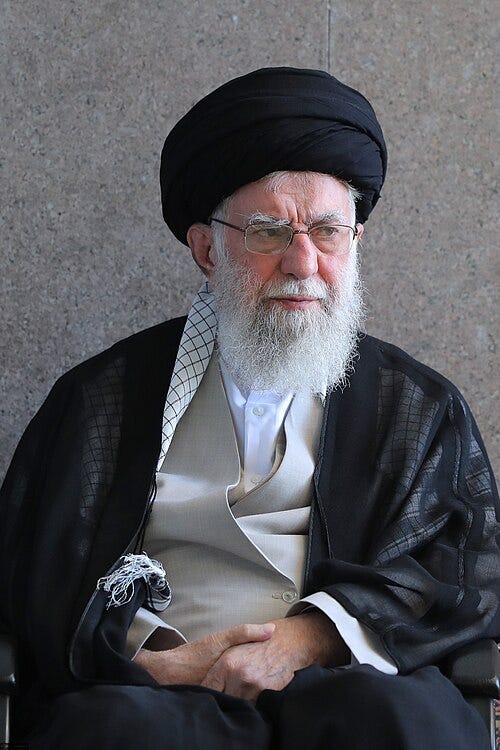

According to Israeli military officials, the opening strike lasted approximately one minute and targeted two separate locations simultaneously, killing around 40 senior Iranian commanders, including Khamenei. Israeli army spokesperson Colonel Nadav Shoshani stated that the attack eliminated “40 senior commanders thousands of kilometers away from Israel in broad daylight.”
Iranian sources confirmed the deaths of several high-ranking officials in addition to Khamenei, including Major General Mohammad Pakpour, commander of the Islamic Revolutionary Guard Corps; Ali Shamkhani, head of the Supreme National Defense Council; Abdolrahim Mousavi, Chief of the General Staff of the Armed Forces; Aziz Nasirzadeh, the defense minister; and senior intelligence officials. The loss of this cluster of leadership figures represents another severe blow to Iran’s command structure, albeit one that appears to have been anticipated to a greater degree than amid the outbreak of war in June.
Israeli authorities have also begun to report damage and casualties from Iranian missile retaliation. Initial strikes damaged 40 buildings, killing two people and injuring at least 20 others, although air-defense systems have intercepted the majority of incoming projectiles. Israel’s emergency services later confirmed that eight people were killed in an Iranian missile strike on the city of Beit Shemesh in central Israel, with 23 others injured, including two in critical condition. All wounded were transferred to hospitals. These figures underline that Iranian retaliation has carried a tangible human cost inside Israel as well.
Under Khamenei’s rule, Iran’s long-term security doctrine rested on three pillars: missile and drone capability, regional proxy networks, and nuclear leverage. This structure allowed Iran to project power indirectly, deter adversaries, and negotiate from a position of strategic ambiguity. After October 7 and the subsequent regional shifts, the proxy pillar weakened operationally and politically, while the nuclear program shifted from a bargaining instrument under sanctions pressure to a primary military target. As a result, by the time of this war, Iran relied most heavily on what it could deploy immediately and independently: its missile and drone arsenal.
On the day Khamenei was killed, Iran demonstrated that the war would not remain confined to its borders. It launched missiles toward Israeli territory and targeted U.S. bases and infrastructure across the Persian Gulf. The Islamic Revolutionary Guard Corps claimed that it had attacked the U.S. aircraft carrier USS Abraham Lincoln with four ballistic missiles, declaring that the confrontation had entered a “new phase.” While this claim has not yet been independently confirmed, the statement itself reflects the level of escalation Tehran seeks to project.
In a statement Sunday, U.S. Central Command confirmed the deaths of three servicemembers in the war, without sharing identifying details. According to a press release, “As of 9:30 am ET, March 1, three U.S. service members have been killed in action and five are seriously wounded as part of Operation Epic Fury. Several others sustained minor shrapnel injuries and concussions — and are in the process of being returned to duty. Major combat operations continue and our response effort is ongoing. The situation is fluid, so out of respect for the families, we will withhold additional information, including the identities of our fallen warriors, until 24 hours after next of kin have been notified.”
Iranian military statements further claimed that numerous American bases were struck and that advanced radar and air-defense systems were specifically targeted to degrade operational capability. The Strait of Hormuz quickly emerged as a central escalation lever, with Iran signaling restrictions and demonstrating its readiness to use the strategic chokepoint as geopolitical pressure. But the message from Tehran appears broader than the Strait of Hormuz alone. The attacks and threats suggest that the entire regional economic infrastructure - energy routes, aviation hubs, shipping lanes, and financial arteries - are now at risk. By expanding the battlefield to major Gulf hubs, Iran appears intent on conveying to Washington that continued escalation will have consequences not just for the region, but for the global economy.
The economic shockwaves are already visible. The United Arab Emirates reported that three people were killed and 58 injured in Iranian attacks. The UAE Ministry of Defense stated that it detected 165 ballistic missiles, intercepting 152, along with two cruise missiles, and that it identified 541 Iranian drones, intercepting 506 of them. Among the dead were nationals of Pakistan, Nepal, and Bangladesh.
Images have circulated showing damage to Dubai International Airport, one of the busiest airports in the world. Reports indicate that at least one person was killed and 11 injured in regional strikes affecting Dubai and Abu Dhabi airports. Four airport staff members were reportedly wounded. UAE authorities said they intercepted a drone targeting Zayed International Airport, though falling debris caused one fatality and seven injuries.
The broader impact on aviation has been profound. The conflict has triggered what officials describe as the largest disruption to Middle Eastern air traffic since the COVID-19 pandemic. Following the initial U.S.–Israeli strikes on Iran, multiple countries - including Iraq, Syria, Kuwait, Qatar, and the UAE - closed portions of their airspace. Civilian air traffic across the region was abruptly halted. Major airlines including Emirates, Etihad, Air France, British Airways, Air India, Turkish Airlines, and Lufthansa canceled flights. According to flight tracking data, by 10:00 a.m. GMT Sunday, more than 6,700 flights worldwide had been delayed and at least 1,900 canceled, in addition to thousands of cancellations the previous day. The economic implications extend far beyond military targets.
Despite suffering a historic loss at the top of its political and military hierarchy, Iran moved rapidly to project continuity. President Masoud Pezeshkian, in a televised address, confirmed that the interim Leadership Council has officially begun its work. Under Article 111 of the Constitution, a temporary three-member leadership body has been formed, consisting of Pezeshkian, Judiciary Chief Gholamhossein Mohseni-Ejei, and cleric Alireza Arafi, a member of the Guardian Council. This mechanism is designed to govern until a new Supreme Leader is selected. The swift activation of this constitutional process underscores the regime’s structural effort to prevent institutional collapse even after a decapitation strike.
Public reaction inside Iran has been sharply polarized and unmistakably intense. Following years of severe repression and particularly the recent suppression and killing of thousands of protesters last month, many Iranians openly celebrated the news of Khamenei’s death. For others - both within Iran and across parts of the region - Khamenei represented resistance against Israel and the United States. State television broadcast mourning ceremonies, while religious and political figures abroad issued condolences.
Reactions inside Iran were deeply divided. State television broadcast live images of mourners gathering in Tehran, Kurdistan, Gilan and other provinces, while official calls urged citizens to assemble in mosques, religious centers, and city squares for several nights of collective mourning. The flag atop the shrine of Imam Reza in Mashhad was lowered to black, and gatherings were also reported in cities such as Baghdad, Karbala, and parts of Kashmir. At the same time, videos circulated on social media showing groups of young people in towns including Galedar, Abdanan, Mehrshahr in Karaj, and other areas expressing joy and celebrating Khamenei’s death, with chants welcoming a “new world.” Reports described nighttime celebrations in parts of Tehran as well. Outside Iran, many members of the Iranian diaspora were also seen marking the news with celebrations, further underscoring the depth of political and emotional divisions surrounding his legacy.
International reactions further illustrate the widening geopolitical stakes. Russia condemned the killing as contrary to international law. Pakistan warned at the United Nations that continued escalation could destabilize the entire region. The political battle over what comes next has already begun. U.S. President Donald Trump described Khamenei’s death as justice and called on Iranian security forces to abandon the regime. Israeli Prime Minister Benjamin Netanyahu addressed the Iranian people directly, urging them to take to the streets and “finish the job,” stating that in the coming days thousands of regime targets would be struck and that “the help you have long wished for has arrived.” Meanwhile, Reza Pahlavi declared that Khamenei’s death marks the beginning of a “great national celebration” but not the end of the struggle, calling on security forces to defect and on Iranians inside and outside the country to intensify efforts to overthrow the Islamic Republic.
The regional consequences have been immediate and far-reaching. In Iraq, armed groups aligned with Tehran attempted to move toward the U.S. Embassy in Baghdad’s Green Zone, prompting security forces to deploy tear gas to prevent breaches. In Pakistan, protests in Karachi and other cities turned deadly after demonstrators attempted to storm U.S. diplomatic facilities, resulting in multiple fatalities and injuries. The conflict is no longer confined to state actors; it is mobilizing networks and populations across borders.
Khamenei had long warned that any direct war with Israel or the United States would become regional. That warning has materialized. Missiles have crossed borders. U.S. bases have been targeted. Gulf infrastructure has been threatened. Armed groups in Iraq have mobilized. Protests have turned violent in Pakistan. The conflict has entered a broader and more unpredictable phase.
Yet nothing is finished. Iran has suffered a historic leadership loss, but it has not collapsed. The United States and Israel have demonstrated deep penetration capabilities, but they now face a widening arc of retaliation and instability. The Strait of Hormuz remains a live escalation lever—but increasingly, the stability of the entire regional economy and, by extension, the global economic system is at stake.
Khamenei’s death is not the conclusion of this war. It marks the beginning of a new and uncertain chapter. Whether his legacy is ultimately defined as the fall of a long-standing dictatorship, the martyrdom of a resistance figure, or the catalyst for a broader regional transformation will depend on what unfolds in the coming days and weeks.