

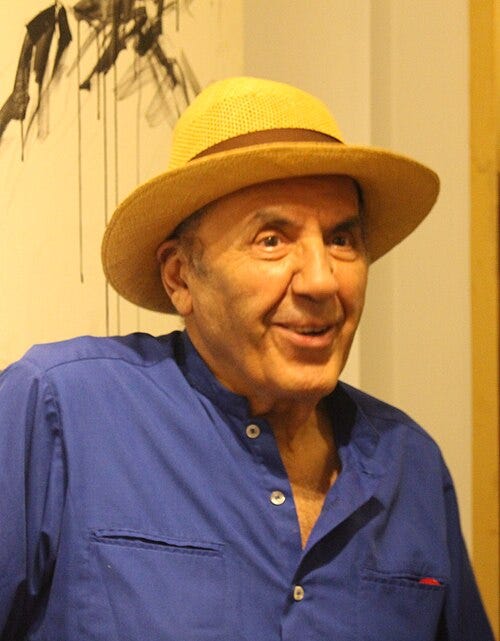
Javad Mojabi, the Iranian poet, novelist, satirist and art critic whose career spanned more than six decades, died on September 5, 2026, following an illness. He was 86. His family confirmed his death to Iranian media. A farewell ceremony is scheduled for September 9 outside his home in Tehran’s Kuy-e Nevisandegan neighborhood, followed by burial at Emamzadeh Taher in Karaj, the resting place of numerous Iranian writers and artists.
.jpg)
Mojabi’s death has prompted remembrances of him as an unusually versatile cultural figure. Readers knew him through poetry, fiction and satire; artists encountered him as a critic and chronicler of modern Iranian art. His working life also extended through newspaper offices and literary magazines. His published work includes more than 70 books, spanning poetry collections, novels, short stories, plays, children’s literature and critical studies.
Born in Qazvin in 1939, Mojabi grew up in a family whose traditions included storytelling, religious oratory and journalism. In his autobiographical recollections, he described encountering newspapers from across Iran at his uncle’s home. He traced part of his enduring appetite for reading and writing to those early experiences, and connected his humor to a family culture of joking and verbal invention.
He later studied at the University of Tehran and worked in government before becoming a prominent cultural journalist. From 1968 to 1979, he served as cultural editor of Ettela’at, one of Iran’s major newspapers. He also contributed to literary publications including Ferdowsi, Jahan-e Now, Khusheh, Adineh and Donyaye Sokhan, where he also served as editor. His career crossed the 1979 revolution and continued through decades of change in Iran’s literary life.
For Mojabi, satire was a way of questioning power, including the authority exercised by society itself. In a 2011 interview, he explained that satire was dangerous because it challenged power, but stressed that power extended beyond government to public opinion, rituals and customs. Social habits and accepted beliefs, in his view, were also subjects for critical scrutiny.
His intellectual development was similarly grounded in the freedom to reconsider inherited ideas. In a 2017 interview, Mojabi described moving to Tehran for university as a period of personal transformation. Exposure to existentialist thought encouraged him to consider how he could choose his own life and values. He identified freedom, justice and the rejection of racial and gender discrimination as principles central to his outlook. He said he had initially studied law hoping to advance justice as a judge, though he ultimately did not pursue that profession.
Alongside his writing, Mojabi helped preserve the history of modern Iranian visual art. His two-volume Ninety Years of Innovation in Iranian Visual Art drew on years of research into the development of modern painting and sculpture. The work documented artistic experimentation across generations, providing a lasting resource for understanding the people and ideas that shaped Iran’s modern art.
Mojabi continued creating during his final illness. Drawings and paintings made during his hospitalization at Iranmehr Hospital were presented under the title The White Nights of the Hospital and Me. Those works add a personal dimension to the extensive record he leaves behind: even during treatment, he continued finding material for art in his immediate surroundings.
The National Iranian American Council (NIAC) extends its deepest condolences to Javad Mojabi’s family, friends and all those mourning his passing. We honor his more than six decades of contributions to Iranian literature and the arts, his dedication to preserving Iran’s cultural heritage, and the generosity with which he encouraged younger writers and artists. His poetry, stories, humor and scholarship leave an enduring legacy for readers and creative communities in Iran and around the world.