

The first round of high-level Iran–U.S. negotiations in Switzerland produced diplomatic progress, even as President Donald Trump’s threatening social media post over Lebanon briefly disrupted the atmosphere and underscored the fragility of the process. The talks were held at the Bürgenstock resort overlooking Lake Lucerne, a venue owned by Katara Hospitality, part of Qatar’s sovereign wealth fund, a notable detail given Doha’s central role as one of the mediators. The negotiations entailed an intensive, reportedly 12-hour marathon round of discussions involving Iranian, American, Qatari, and Pakistani officials.
At the opening of the talks, Vice President JD Vance described the meeting as “historic”, saying its purpose was to “turn a new page” and begin “a new chapter” in relations with the Iranian people. Vance said Washington was seeking a broader transformation in the region based on stability and peace, and framed the negotiations as an opportunity to move beyond decades of confrontation.
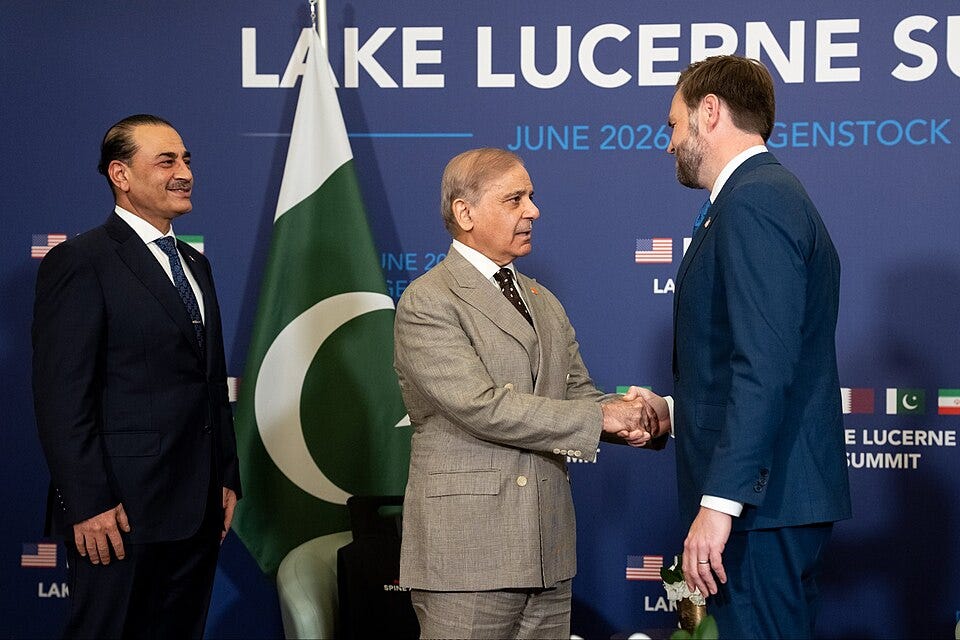

Vance was joined by Special Envoy Steve Witkoff and Jared Kushner, underscoring the degree to which the talks were being handled by figures close to Trump’s inner circle rather than treated as a routine diplomatic engagement. Their presence suggested that the administration viewed the Switzerland track as a high-priority initiative with potentially transformative implications.
However, moments after Vance’s remarks, Trump posted on Truth Social that Iran must immediately stop its allied forces in Lebanon from “causing trouble,” warning that if it did not, the United States would strike again “even harder.” The post created immediate tension. Iranian media reported that Tehran’s delegation formally complained to the American side and paused the talks for internal consultations.
Mohammad Bagher Ghalibaf, who led the Iranian delegation, responded sharply, saying Iran did not take American threats seriously and warning that Iran’s armed forces were prepared to respond if necessary. Iranian officials also avoided appearing in a joint photo or handshake ceremony with the American delegation, reflecting sensitivity to domestic political pressures in Tehran.
Despite the disruption, the negotiations continued and produced several concrete outcomes. Qatar and Pakistan issued a joint statement describing the first day of talks as “positive and constructive” and announcing that the parties had made “encouraging progress.” The agreements outlined include:
A roadmap to reach a final agreement within 60 days;
The immediate continuation of technical negotiations;
The creation of a High-Level Committee to oversee implementation and political coordination;
The establishment of a direct communication channel between Iran and the United States; and
The creation of a conflict-control mechanism focused on Lebanon.
The newly established High-Level Committee will supervise working groups on nuclear issues, sanctions relief, implementation, monitoring, and dispute resolution, providing a structured framework for advancing the memorandum of understanding. The establishment of a direct communication channel is intended to prevent incidents and misunderstandings in the Strait of Hormuz and ensure the safe passage of commercial shipping. This issue had become increasingly urgent following Iranian threats to close the waterway amid disputes over Lebanon.
Lebanon Emerges as the Central Challenge
As could be predicted following President Trump’s remarks, Lebanon appears to remain the most difficult issue in the negotiations. Under the memorandum of understanding, Iran, the United States, and their respective allies are expected to support an immediate and permanent end to military operations on all fronts, including Lebanon. However, Israel has insisted that its forces will remain in a security buffer zone in southern Lebanon, while Iran and Hezbollah have rejected any continued Israeli presence.
To address this challenge, the parties agreed to establish a Lebanon Conflict-Control Mechanism, facilitated by Qatar and Pakistan, to monitor compliance with the ceasefire and reduce the risk of renewed escalation. Iranian Foreign Ministry spokesperson Esmail Baghaei described the mechanism as a way to ensure that the memorandum is actually implemented rather than merely signed. He emphasized the principle of “commitment for commitment” and said Iran would monitor compliance continuously.
At the same time, unconfirmed reports suggest that Egypt and Saudi Arabia may be promoting a framework under which Israel would withdraw from southern Lebanon while Hezbollah would retain its weapons but commit not to use them. Such a formula would effectively postpone the contentious issue of Hezbollah’s disarmament while prioritizing a sustainable ceasefire. However, these reports remain unverified and should be treated cautiously.
Progress on Sanctions and Frozen Assets
Iranian Foreign Minister Abbas Araghchi described the negotiations as having produced “significant progress.”
According to Araghchi:
Restrictions on Iran’s oil and petrochemical exports have been suspended;
The naval blockade has been lifted;
Some frozen Iranian assets have been released;
A reconstruction and economic development initiative for Iran has begun; and
Significant progress has been made toward ending the conflict in Lebanon.
Iranian economic officials also announced that $12 billion in frozen Iranian assets could be released in two phases, with $6 billion released initially and another $6 billion later. Meanwhile, Hamid Bord, head of the National Iranian Oil Company and a member of Iran’s negotiating team, said discussions on lifting oil sanctions were pursued aggressively. He reported that Iranian vessels had already begun using previously restricted routes and that a substantial volume of oil exports had resumed.
Regional Support for the Negotiations
Pakistan’s Prime Minister Shehbaz Sharif described the negotiations as “successful,” citing the 60-day roadmap, technical talks, and the creation of implementation mechanisms as evidence of meaningful progress. The diplomatic process also received regional backing. On June 21, the foreign ministers of Saudi Arabia, Pakistan, Egypt, and Turkey met in Cairo to discuss regional developments and efforts to reduce tensions, including the U.S.–Iran memorandum of understanding.
Participants included:
Faisal bin Farhan (Saudi Arabia)
Mohammad Ishaq Dar (Pakistan)
Badr Abdelatty (Egypt)
Hakan Fidan (Turkey)
According to official statements, the ministers discussed Pakistan’s mediation efforts, developments in Lebanon, regional stability, and the need to preserve the diplomatic track. They emphasized continued coordination to reduce tensions and restore security throughout the region. The significance of these consultations is that the Switzerland process has evolved beyond a purely bilateral U.S.–Iran negotiation. It now encompasses Lebanon, sanctions relief, Gulf security, oil exports, maritime navigation, and broader regional stability.
Israeli Opposition and Continuing Risks
The talks continue to face substantial resistance from Israel. Prime Minister Benjamin Netanyahu reiterated that Israel would remain in its security buffer zone in southern Lebanon “as long as necessary.” He also declared that no political development would alter his commitment to preventing Iran from acquiring nuclear weapons.
Israeli Defense Minister Israel Katz similarly stated that Israeli forces would remain in southern Lebanon and retain full freedom of action against perceived threats. On the other side, Hezbollah Secretary-General Naim Qassem rejected any Israeli military presence inside Lebanon, while IRGC Quds Force Commander Esmail Qaani warned that Israel would face additional losses if it refused to withdraw.
These competing positions illustrate why Lebanon has become the first major test of the Switzerland framework. Success in reducing tensions there could reinforce the broader diplomatic process, while failure could empower opponents of diplomacy across the region.
A Fragile but Significant Breakthrough
The negotiations did not produce a final agreement, and substantial obstacles remain. Nuclear restrictions, sanctions relief, implementation mechanisms, Lebanon, regional security issues, and domestic political opposition in both countries all remain unresolved.
Nevertheless, the talks produced a framework that did not exist before:
A 60-day roadmap toward a final agreement;
A High-Level Committee overseeing implementation;
Technical working groups;
A direct Hormuz communication channel;
A Lebanon conflict-control mechanism;
Movement on sanctions relief; and
Progress on frozen assets.
Most importantly, the talks demonstrated that both sides remain committed to pursuing diplomacy despite significant political pressure and recurring crises. For that reason, Vance’s description of the meeting as “historic” may ultimately prove accurate. The Switzerland negotiations represent the most serious attempt in years to move the United States and Iran from military confrontation toward a structured diplomatic process. The breakthrough remains fragile, but it has established a framework that could, if sustained, reshape regional dynamics and potentially open a new chapter in U.S.–Iran relations.