

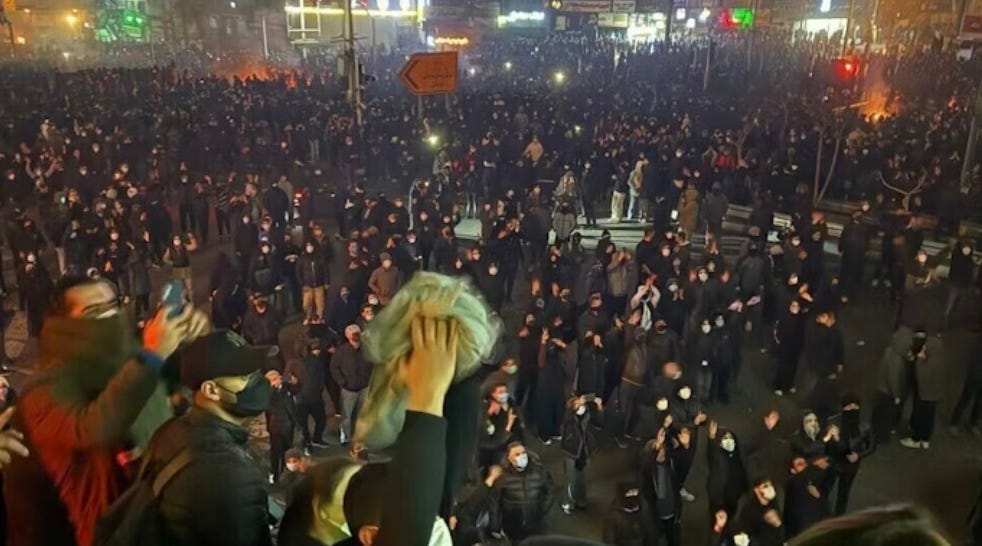
Seventeen days into Iran’s nationwide protest wave, the Islamic Republic appears—at least for now—to have succeeded in suppressing large-scale street mobilization following a tremendous wave of violence. In recent days, there have been no reports of demonstrations comparable to earlier phases of unrest. Some videos circulated on social media purporting to show active demonstrations were instead repackaged video from earlier days of the protest wave. Most major urban centers remain visibly quiet, and shops and small businesses in several cities have begun to reopen gradually, signaling a cautious and uneven return to daily routines under heavy security surveillance.
This comparative quiet, however, conceals the extraordinary human cost of the crackdown. According to the latest cumulative data released by the Human Rights Activists News Agency (HRANA), at least 2,403 protesters have been killed as of the end of the seventeenth day of unrest, including 12 children. In addition, nine non-protesting civilians and 147 members of security forces and pro-government affiliates have also been confirmed dead. HRANA further reports 18,434 arrests, 1,134 individuals seriously injured, and 97 cases of forced confessions broadcast on state media, while 779 additional death reports remain under review. Compiled amid a prolonged internet shutdown, these figures could still understate the true scale of casualties.
The near-total communications blackout, now exceeding 132 consecutive hours, has fundamentally reshaped the protest environment. While it has disrupted protesters’ ability to coordinate and document abuses, it has also enabled the state to carry out repression with minimal domestic and international visibility. Human rights organizations have warned that the blackout is facilitating abuses in what amounts to enforced silence.
As street protests have receded, the state has shifted from kinetic repression toward consolidation through judicial, economic, and symbolic means. Authorities have organized highly visible funerals for pro-government casualties, portraying them as “martyrs” of a foreign-backed terrorist campaign. State media has simultaneously saturated coverage with images of arson, vandalism, and destruction amid the demonstrations—including burned banks, damaged mosques, and public facilities—presenting violence as the defining feature of the unrest. This narrative functions not only to attempt to justify the crackdown, but also to discourage renewed mobilization by framing dissent as criminal, violent, and externally driven.
Alongside this narrative effort, the judiciary has moved aggressively to institutionalize repression. Judiciary Chief Gholamhossein Mohseni-Ejei has publicly called for rapid prosecutions and exemplary punishments, including public trials of alleged “ringleaders.” He has demanded expedited verdicts for those accused of participating in violence, signaling an intent to impose legal finality - including via capital punishment - after mass arrests rather than pursue reconciliation.
This strategy has extended beyond political activists into the commercial and social sphere. In Qom, authorities arrested Mohammad Saeedi-Nia, the owner of the well-known Saeedi-Nia café and confectionery chain, after he publicly supported protests and joined calls for a bazaar strike. The judiciary ordered the closure of all his businesses and the seizure of his assets and bank accounts, referring his case to an Article 49 court. The message to business owners and bazaar networks is unambiguous: even symbolic or rhetorical support for protest activity can result in financial ruin.
There remain no credible indications of division or hesitation within the security or judicial apparatus. On the contrary, messaging from the courts, parliament, Revolutionary Guards, and state media has been unified and uncompromising, reinforcing the impression that the state has opted for deterrence through overwhelming dominance rather than calibrated de-escalation.
Internationally, the crisis has increasingly merged with broader regional and global tensions. Qatar has warned that any escalation between Iran and the United States would have “catastrophic consequences” for the region, while confirming precautionary measures at the U.S.-hosted Al Udeid Air Base. Reports that some U.S. personnel have been advised to temporarily leave the base underscore the seriousness with which regional actors are treating escalation risks.
At the same time, President Donald Trump has continued rhetoric aligning with the protests and urging demonstrators on, vowing assistance. President Trump has repeatedly warned that killings of protesters - and also executions - would trigger a “very serious” U.S. response. He has also announced an immediate 25 percent tariff on countries trading with Iran, and declared that all negotiations with Iranian officials are suspended. His public messages—urging protesters to continue, promising that “help is on the way,” and hinting at imminent action—have circulated widely inside Iran despite the communications blackout. Yet, these calls do not appear to have brought significant protests back to the streets thus far.
These signals have reshaped political expectations on the ground, but unevenly. A distinct and politically visible segment of the protest constituency—particularly those aligned with Reza Pahlavi—has entered a waiting mode, increasingly focused on the possibility of U.S. military intervention. For this group, Trump’s statements are widely interpreted as a precursor to external action that could decisively shift the balance against the Islamic Republic.
At the same time, many other Iranians—including portions of the protest base—remain deeply skeptical of foreign military intervention, both on principle and in terms of its likely effectiveness. For these constituencies, the prospect of external attack raises fears of regional war, civilian harm, and the consolidation of state repression under the banner of national defense. This divergence has produced a clear political split within the broader opposition environment: between those waiting for an external shock and those wary of its consequences.
Meanwhile, major international actors have signaled resistance to escalation. China has reiterated its opposition to external intervention in Iran’s internal affairs, while Russia has stated it will continue economic cooperation with Tehran regardless of U.S. pressure. Several countries, including India and Canada, have urged their citizens to leave Iran, reflecting concern over instability without committing to confrontation.
Taken together, Iran has entered a new phase of the crisis: a phase of enforced silence rather than resolution. The government has regained control of the streets, but at the cost of mass casualties, widespread fear, economic intimidation, and accelerated judicial repression. Daily life is cautiously resuming—businesses reopening, routines restarting—but under the shadow of trials, asset seizures, and the threat of irreversible punishment. The protest movement has been neutralized operationally, not resolved politically.