

In the days following the ceasefire pausing 40 days of high-intensity warfare between Iran and the US-Israeli coalition, Iranian authorities appear to have moved swiftly to restore damaged civilian infrastructure with a focus on transportation networks. Bridges, tunnels, and rail lines across at least eight provinces were reopened within hours of being struck, using pre-fabricated temporary bridges and emergency bypass routing.
Yet a structural crisis of far greater magnitude lies behind this flurry of activity: estimated civilian damages of $270–$300 billion, an economy contracting by 6.1% in 2026, two million jobs already lost, inflation approaching 70%, and an internal government warning that full economic recovery could take 12 years.
.jpg)
The most operationally significant post-ceasefire achievement has been the rapid restoration of Iran’s transportation network. Houshang Bazavand, CEO of the Company for Construction and Development of Transportation Infrastructure, confirmed that strikes hit 4 operational railway bridge spans, 3 railway tunnels under construction, 4 highway tunnels under construction, and 5 highway bridge spans across Lorestan, Khuzestan, the Zanjan–Tabriz corridor, and the Mianeh–Tabriz road.
Bazavand stated that engineers and workers reopened all damaged routes within a maximum of 48 hours of bombardment, using pre-fabricated temporary bridges and emergency variant routing — while acknowledging that these are temporary measures and that full structural reconstruction will follow. The Iran Railway Crisis Management Center was activated within hours of the first strikes, with an emergency session involving all deputy directors of the national railway authority.
On the rail network, the Tehran–Mashhad line was restored overnight. The Tehran–Tabriz route and the international Tehran–Tabriz–Van service to Turkey resumed within four to five days. The seven-span railway bridge near Qom was repaired in less than 40 hours , and the Yahya Abad bridge in Kashan was restored within several days. The Chaharbagh bridge in Alborz Province was completely destroyed in the strikes, with a temporary structure placed within 48 hours. The Zanjan–Tabriz rail axis remains the single unresolved disruption in the national network, making it the highest-priority outstanding repair given its role in connecting northwestern Iran and supporting cross-border trade with Turkey.
The road situation in northwestern Iran has been particularly complex. The Hashtrud Bridge on the Tabriz–Tehran expressway, one of the country’s most strategically vital corridors, was destroyed in a strike. This closed a section of the expressway between kilometers 100 and 110, from Azizkendy to Ghoyun Gheshlagh near the Qaranqou Bridge. Authorities have designated an alternative route via the Azizkendy junction toward Hashtrud and then onward to Ghoyun Gheshlagh and back onto the Tabriz–Tehran expressway. The Governor of East Azerbaijan conducted four consecutive field visits to the repair site, coordinating directly with the Deputy Minister of Roads and Urban Development to secure funding and accelerate reconstruction, expressing hope that traffic on the route would be fully restored by Tuesday. The Deputy Minister himself visited the Hashtrud Bridge site on April 11, also inspecting the old Mianeh–Gharachaman tunnel, 90 kilometers from Tabriz, and the damaged bridge on the Mianeh–Bostanabad road, committing to urgent budget allocation and rapid reopening for travelers. In Kermanshah Province, three bridges were damaged — on the Eastern beltway, the Sarab-e-Niloufar axis, and in Ravansar district, with clearance and reconstruction beginning immediately.
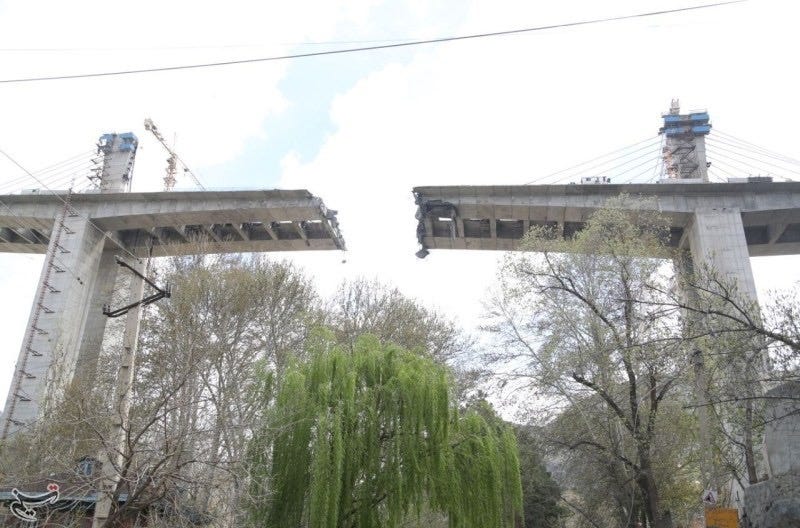
The most consequential single act of infrastructure destruction was the attack on the B1 Bridge over the Bilqan River in Karaj, Alborz Province. The B1 Bridge was described by Bazavand as an engineering masterpiece. The structure, approximately one kilometer in length and 136 meters in height, had been under construction since 2016 along the Shahid Soleimani Expressway and was days away from its official opening. U.S. missiles struck it on April 2, cutting it in half and killing eight people while wounding 95 others. Engineering consultants are now assessing whether the columns suffered critical structural deformation. According to Bazavand, there is an estimated 50% probability that the bridge will need to be fully demolished. If the columns are intact, repair will cost approximately 4 trillion tomans, while full reconstruction would require 12–13 trillion tomans. A decade-long national engineering project that was weeks from completion may need to be torn down and rebuilt from scratch.
Beyond transportation, Iran’s Education Minister reported that 775 of the 1,300 damaged schools have already been repaired. Government spokeswoman Fatemeh Mohajerani stated that reconstruction of damaged buildings would take between three months and two years. Iranian officials have estimated that 23,000 factories and firms were directly hit, with many neighboring businesses also forced to shut down. This disruption to supply chains will compound the civilian recovery challenge for months to come.
The speed of emergency repairs is real and should not be dismissed. Iran’s railway authority had pre-positioned crisis management protocols and pre-fabricated materials, and the response demonstrated genuine institutional preparedness. But Bazavand himself was explicit: current repairs are temporary. Emergency bypass routes are not the same as restoring infrastructure. A country may achieve the former while the latter stagnates, leaving the economy exposed to long-term damage. The credibility gap in all official figures further complicates assessment, since independent verification of damage and repair claims remains difficult under current access conditions.
The deeper constraints on recovery are economic and geopolitical. Large-scale reconstruction requires access to finance, foreign exchange, and imported capital goods, and Iran enters this phase with limited fiscal space, restricted external borrowing capacity, and continued far-reaching sanctions. Iran’s steel sector has seen an estimated 25–30% of production capacity taken offline, reducing both a key export stream and the raw material most needed for reconstruction itself. Iran’s central bank has warned President Pezeshkian that rebuilding the economy could take more than a decade.
Iran’s reconstruction story is ultimately two stories running in parallel. The first is one of impressive emergency engineering, with rail lines restored overnight, bridges reopened in 40 hours, and schools repaired within weeks, all carried out by workers and engineers operating around the clock. The second is one of a structural crisis of historic proportions, with the B1 Bridge facing possible demolition, the Zanjan–Tabriz corridor still severed, the Hashtrud expressway rerouted through village roads, and an economy that senior officials privately admit may not recover for a generation. The first story makes an immediate difference, the second is one that will play out over the long term.