

Iranian Oil Minister Mohsen Paknejad has resigned after months of mounting parliamentary scrutiny over Iran’s oil sales, indebted financial intermediaries known as “trustees,” and questions about billions of dollars in oil revenues. The government says he stepped down for personal reasons, and there is no official evidence establishing that these controversies caused his departure.
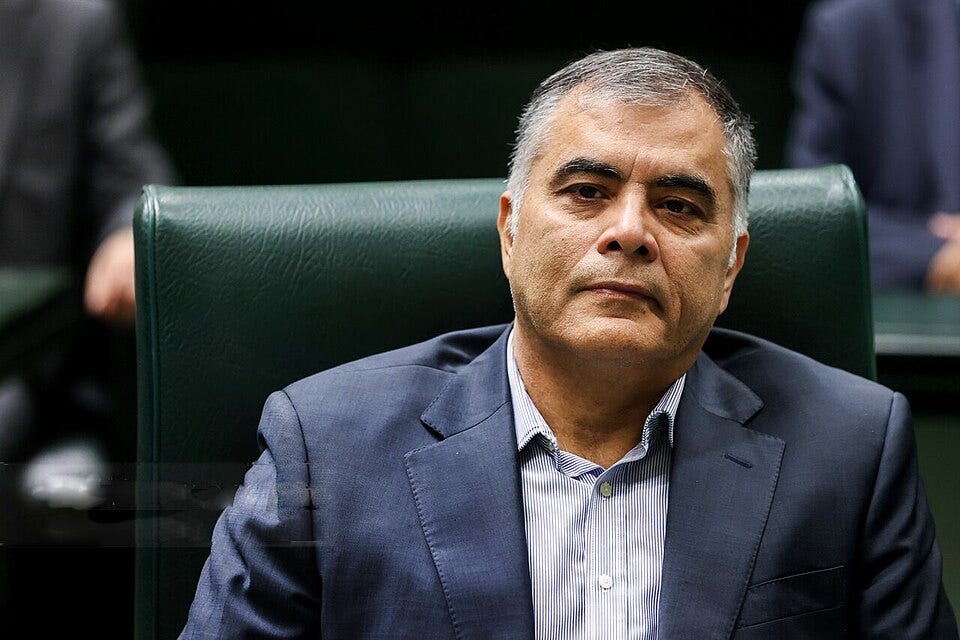

President Masoud Pezeshkian accepted Paknejad’s resignation on Sunday and appointed Hamid Bovard, the head of the National Iranian Oil Company (NIOC), as acting oil minister. Mehdi Tabatabaei, a senior official in the president’s office, said Paknejad had asked to resign some time ago for “personal reasons,” but Pezeshkian initially rejected the request before accepting it after the minister renewed his insistence on leaving.
The timing, however, is significant. Paknejad leaves just weeks after parliament opened an investigation into NIOC and the mechanisms Iran uses to sell oil and collect the proceeds under sanctions. Lawmakers have raised questions about the selection of intermediaries, oil sold on credit without sufficient guarantees, unpaid revenues and the supervision of the network Iran increasingly relies upon to conduct transactions outside the conventional international financial system.
The controversy centers on what Iranians call trasti-ha, or trustees. These are companies, traders and financial intermediaries used to sell oil, receive payments abroad or transfer money for Iranian institutions when sanctions make ordinary banking transactions difficult or impossible.
The trustee system is, in large part, a product of sanctions. Iran’s exclusion from much of the international banking system, combined with restrictions on shipping, insurance and oil transactions, has forced the country to construct alternative networks for moving both oil and money. These arrangements have helped Iran maintain substantial exports despite sanctions, but their secrecy also makes oversight considerably more difficult.
Iranian officials themselves have acknowledged some of the risks. Zabihollah Khodaeian, head of Iran’s General Inspection Organization, said this summer that one trustee failed to return $200 million and subsequently left the country. He said some trustees had “betrayed” the system, while also warning against assuming that every unresolved foreign-exchange obligation represented stolen money.
The issue has become an increasing focus in parliament. Hossein Samsami, a member of parliament’s Economic Commission, said in September that more than 86 million barrels of Iranian oil had been transferred on credit to one individual without adequate guarantees. According to Samsami, around 30 million barrels had reached final buyers while the status of more than 56 million barrels remained unresolved.
That does not mean 56 million barrels of oil literally disappeared. Samsami’s claim is that their disposition and the associated financial obligations have not been properly accounted for. The allegation has not yet been established through a completed parliamentary or judicial investigation.
The scrutiny has since expanded beyond that particular case. Another parliamentary investigation, described by lawmaker Ahmad Bigdeli and now supported by more than 40 MPs, is examining the sale of roughly 80 million barrels of oil to four specific traders or trustees, as well as pricing, discounts, credit terms, guarantees and the collection of revenues. It also covers NIOC’s international trading subsidiary, NICO, and reviews oil-sale practices going back a decade.
Samsami has directly criticized Paknejad’s handling of the issue. When announcing the investigation in September, he accused the minister of failing for nine months to answer his questions about indebted trustees and said the delay had provided some intermediaries with opportunities to avoid accountability. These are Samsami’s allegations, and the investigation has not yet produced findings establishing responsibility.
Other lawmakers have raised separate questions about the money flowing through the trustee system. Hadi Ghavami, a member of parliament’s Planning and Budget Commission, said investigations had identified approximately $3 billion in what he called khali-khani involving problematic trustees and Iranian banks. Khali-khani refers to transactions in which funds are recorded or represented as having been made available even though the underlying money has not actually reached the bank or become accessible.
Ghavami cited one case involving $300 million through Tourism Bank and $400 million through Bank Melli that he said had not properly returned to the banking system. He has also pointed to other cases that lawmakers intend to examine, though it is important to note that these figures remain allegations by a member of parliament rather than the findings of a completed audit or court proceeding.
The Oil Ministry has strongly rejected the broader accusations against Paknejad’s management. In a statement issued before his departure, the ministry described reports that oversight of trustees had deteriorated during his tenure as false. It specifically rejected claims that trustees had been allowed into the oil trade without proper vetting, that their number had tripled under Paknejad, and that his management had caused continuing problems with oil sales and the return of revenues.
The ministry also emphasized that trustee companies did not originate under Paknejad and had developed over previous years as a response to sanctions. That distinction is important. The current controversy centers not on the creation of Iran’s sanctions-evasion system, but rather how that existing system was managed and supervised during his tenure.
Iran has become increasingly dependent on opaque intermediaries precisely because normal mechanisms for selling oil and receiving payment have been restricted by sanctions. But the same secrecy that helps transactions evade sanctions can also make it harder for Iranian institutions to determine where oil and money ultimately go.
Paknejad was also confronting problems beyond the trustee controversy. Iran continues to face a serious domestic energy imbalance, particularly in gasoline, natural gas and electricity. Gasoline consumption has risen beyond domestic production capacity, forcing the government to use imports to close the gap. Paknejad himself acknowledged that using the country’s resources to import gasoline was economically unsustainable.
Those longstanding structural problems have become considerably more difficult during the ongoing war. Iran’s energy infrastructure has suffered attacks, while the combination of war, U.S. sanctions and physical restrictions on maritime exports has made both selling oil and receiving the resulting revenue substantially more difficult.
This is an important change from the conditions under which Iran developed its sanctions-evasion networks. Before the war, the central challenge was finding ways around financial and commercial restrictions while continuing to move oil, particularly to China. Iran now faces the additional problem of physical restrictions on its ability to load and export crude. Even a functioning network of trustees cannot generate revenue from oil that cannot reach buyers.
Shortly before his resignation, Paknejad said revenues from oil already sold would continue to be collected. Iranian officials have also repeatedly maintained that the country has been able to keep its oil industry operating despite wartime attacks. But the combination of disrupted exports, sanctions and unresolved questions over previously sold oil places unusual pressure on a sector that remains one of the government’s most important sources of foreign currency.
That makes the dispute over trustees consequential beyond the Oil Ministry. When oil revenues are delayed, inaccessible or disputed, the effects can eventually reach government finances, the foreign-exchange market and Iran’s ability to pay for imports. In an economy already dealing with high inflation, a weakened currency, war-related disruption and intensified sanctions, even temporary interruptions in access to export earnings can carry significant costs.
Paknejad’s departure does not resolve any of these issues. Bovard inherits an oil industry simultaneously confronting wartime disruption, sanctions, domestic energy shortages and an increasingly contentious debate over how Iran’s most important source of foreign currency is managed. In the weeks prior to his resignation, parliament had launched investigations into NIOC and NICO, more than 40 lawmakers were supporting scrutiny of major oil transactions, and members of parliament were publicly raising questions involving tens of millions of barrels of oil and billions of dollars in revenues.
The larger story is therefore not simply why one Iranian oil minister left office. It is how sanctions have transformed the way Iran sells its most important export, creating a parallel system that has helped keep oil and money moving, but has also made some of the country’s largest financial transactions harder to monitor and increasingly controversial inside Iran itself.