

Former President Mohammad Khatami offered an unusually revealing snapshot of Iran’s postwar politics this week in a conversation with journalists. He condemned the foreign attacks on Iran, praised the country’s resistance, defended negotiations with the United States, warned against a return to war, criticized continued internet restrictions, and called on the political system to address the structural problems that have alienated large parts of Iranian society. Both Khatami’s statements and other remarks from Iranian officials challenge simple categorizations and show continued debate with Iran’s political system.
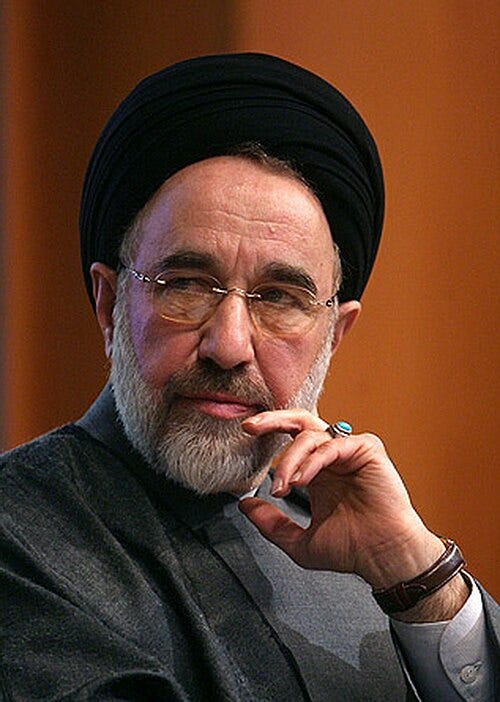

Khatami argued that the war had demonstrated something important about Iranian society: political dissatisfaction should not be confused with a lack of attachment to the country. Many Iranians who had serious grievances against the government, he said, nevertheless rallied around the country when it came under foreign attack.
But he also warned the government against interpreting that wartime solidarity as approval of the status quo. Khatami said strategic mistakes and structural problems had widened the distance between the state and society, pointing to economic hardship, public frustration and declining confidence in political institutions. In his view, the government now has an opportunity to address some of those grievances rather than assuming that national solidarity during the war erased them.
His position on foreign policy is similarly difficult to reduce to a conventional “hardliner versus moderate” divide. Khatami remains deeply distrustful of Washington and strongly critical of Israel, but he has also backed President Masoud Pezeshkian’s decision to negotiate with the United States and argued that Iran should avoid steps that could restart the war.
Iranians cannot be expected to live indefinitely under conditions of permanent conflict, he argued, making the case that protecting the country does not require rejecting diplomacy. Khatami has also challenged the continuation of wartime restrictions at home. While acknowledging the security pressures Iran faced during the conflict, he argued that prolonged internet restrictions are damaging and increasingly impractical in a country where millions of people depend on online access for work, commerce and everyday life.
Khatami is a former reformist president and has spent years criticizing important aspects of the Islamic Republic. His comments might therefore be dismissed as predictable opposition from Iran’s reformist camp. But the debate now unfolding over parliament’s proposed anti-infiltration legislation shows that the disagreements extend considerably further into the political establishment. As Iran Unfiltered previously reported, parliament has advanced legislation intended to strengthen the state’s ability to combat foreign intelligence penetration. The proposal has generated concern because of provisions that could affect contacts with foreign media, universities, embassies and other international institutions.
What has happened since is particularly revealing. President Pezeshkian’s government has now formally opposed the legislation, arguing that parts of the proposal conflict with constitutional protections and citizens’ rights. Vice President Majid Ansari has warned that the bill has created serious concern among academics, researchers and scientific institutions and could accelerate the migration of highly educated Iranians while damaging the country’s international standing.
The criticism is not coming only from the administration. Some members of parliament have questioned whether the legislation goes too far. Ahmad Bakhshayesh, a member of parliament’s National Security and Foreign Policy Commission, has cautioned that people should not come away believing that the government is choosing the easiest solution to the problem of foreign infiltration by restricting ordinary citizens. He has argued that Iran does need stronger counterintelligence protections, but that the legislation requires careful revision.
Most strikingly, Parliament Speaker Mohammad Bagher Ghalibaf has now intervened with what Iranian media have widely interpreted as a warning about the controversy. Ghalibaf said parliament should focus on the country’s urgent priorities and avoid consuming its political capacity on proposals that “worry elites” or “anger the people.” He described public trust as the country’s most important asset. His comments did not explicitly call for the bill to be withdrawn, but their timing - immediately after the backlash - has prompted speculation in Iranian media that parliament’s leadership may seek to slow or revise the proposal.
Ghalibaf is not a reformist critic standing outside the governing establishment. He is the speaker of a conservative-dominated parliament, a former commander in the Islamic Revolutionary Guard Corps, and one of the most powerful political figures in the country. Yet on this issue, the political line does not fall neatly between the government and its opponents, or between reformists and conservatives.
There is broad agreement across much of Iran’s political establishment that the intelligence penetration exposed during the war represents a serious national security failure and that the country needs better tools to confront foreign espionage. The disagreement is increasingly about how far the state should go in responding to that threat and what costs Iranian society should be expected to bear in the name of security.
That disagreement extends beyond the anti-infiltration bill. Khatami can support Iran’s armed resistance to foreign attack while opposing permanent war. Pezeshkian can negotiate with Washington while publicly expressing deep distrust of U.S. intentions. Ghalibaf can take a hard line on the Strait of Hormuz while warning his own parliament against legislation that risks angering the public. Members of the National Security Commission can demand stronger counterintelligence capabilities while questioning whether restrictions on ordinary interactions with the outside world are an effective way to achieve them.
These are not minor differences in rhetoric. They reflect genuine debate over how Iran should govern itself and respond to the pressures created by the war. Nor are those arguments confined to political elites. Iranian journalists, academics, business owners and other professional groups have entered the debate over the proposed legislation, while economic policy, internet access, social restrictions and the future of negotiations with Washington continue to generate their own disagreements.
None of this erases the limits of Iran’s political system. Opposition groups face significant restrictions, elections are tightly controlled, independent media operates under pressure, and the state retains extensive powers over organized political activity. But those realities can coexist with another one: Iranian politics is considerably more contested than the image of a single “hardline regime” making decisions for a politically-passive society.
The debate following the war makes that particularly visible. Iran’s political establishment agrees on some fundamental questions, including defending the country against foreign attack, while arguing intensely over what should happen next.
Khatami sees the national solidarity produced by the war as an opportunity for political reform and reconciliation. Pezeshkian’s government is pushing back against legislation it believes could further restrict citizens and isolate Iran’s scientific community. Members of parliament are publicly questioning the scope of a security initiative originating inside their own institution. And Ghalibaf is warning that public trust, not simply additional state authority, is a national security asset.
Those disagreements do not make Iran a pluralistic democracy. But they do make it a political system in which the boundaries between “hardliner,” “moderate,” “reformist,” “pro-government” and “anti-government” are often less useful than they appear from outside the country. Understanding those arguments - rather than flattening them into a single story about the Iranian state and Iranian society - may be particularly important now, as Iran debates not only how to recover from the war, but what kind of country should emerge from it.
Thank you so much for this insightful presentation of a complex situation. Makes our politics look downright primitive in comparison—-which it is!