

A new wave of political, civil, and cultural statements inside Iran following the bloody suppression of nationwide protests reveals a growing internal convergence around a central claim: Iran’s crisis is the product of domestic authoritarianism and can only be resolved by the Iranian people themselves —without foreign military intervention and through a peaceful, democratic transition.
At the center of this moment stands Mir-Hossein Mousavi, who issued a forceful statement from house arrest declaring that the ruling system has exhausted both its legitimacy and its capacity to govern. Mousavi, the former prime minister, Presidential candidate and Green Movement leader who disputed the results of the 2009 election that were widely viewed as fraudulent, has been under house arrest since February 2011 without formal charges.
Mousavi describes the recent killings as a historic catastrophe that has added a “black page” to Iran’s long history—one that will be remembered for decades, if not centuries. He argues that years of escalating repression have led the country to a point where the state no longer offers solutions to any of Iran’s overlapping political, social, or economic crises.
Crucially, Mousavi explicitly rejects foreign intervention, warning that the systematic silencing of reformist voices, civil society, and peaceful dissent has itself “rolled out the red carpet” for outside interference. He stresses that responsibility for this dangerous vulnerability lies with the authorities, not with society.
Mousavi proposes a constitutional referendum as the only viable path forward, grounded in three principles: non-intervention by foreign powers, rejection of domestic despotism, and a peaceful democratic transition. He also calls on military and security forces to lay down their arms and withdraw from political power, arguing that they will ultimately refuse to carry the burden of repeating mass violence.
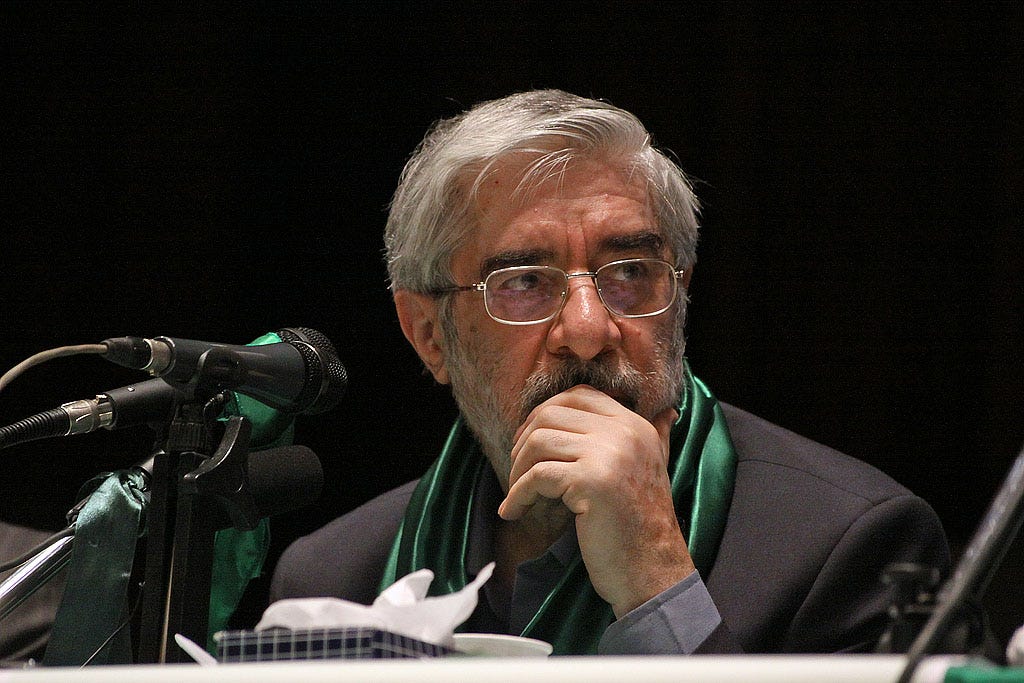

This position takes on sharper meaning when read in direct contrast to the approach advanced by Reza Pahlavi, the former crown prince of Iran who has sought to influence the course of the protests from outside the country. While Mousavi insists that sovereignty, legitimacy, and durable stability can only emerge from an internally driven national process, Pahlavi has openly called for foreign military action and external intervention as a means of overthrowing the Islamic Republic. In this context, Mousavi’s emphasis on non-intervention is not rhetorical; it represents a clear rejection of externally-imposed regime change. His warning reflects a widely held concern inside Iran that foreign military intervention would reproduce cycles of violence, fragmentation, and loss of national agency, rather than deliver democracy. Mousavi’s stance resonates with a broad spectrum of domestic voices who, despite differing backgrounds, converge on accountability, rejection of mass violence, and resistance to foreign-imposed outcomes.
This internally driven, anti-war perspective is further reinforced by Ahmad Zeidabadi, who issued a stark warning against what he described as the reckless convergence of political ambition within both segments of the ruling establishment and parts of the opposition. Zeidabadi cautioned that political adventurism—whether from inside power or from opposition figures operating safely abroad—risks dragging Iran into a dark, inescapable vortex of war, collapse, and permanent destruction. He urged Iranian decision-makers, including President Masoud Pezeshkian, to show courage not through defiance or ideological posturing, but through accepting personal political cost—even public humiliation—if necessary to preserve the country itself. Zeidabadi also appealed for openness toward regional mediation efforts, warning that rejecting diplomacy out of pride or factional rivalry would mark those responsible in history as having consciously sacrificed the nation. Addressing opposition figures abroad, Zeidabadi rejected the instrumentalization of public grief and bloodshed for political agendas, stressing that justice can be pursued indefinitely, but the time to prevent Iran from sliding into war and irreversible collapse is rapidly running out.
The Iranian Writers’ Association condemned the killings as a massacre carried out under near-total information blackout, accusing authorities of abducting the wounded from hospitals, conducting secret burials, and intimidating witnesses, including medical personnel. The association framed the violence as a war against society and warned that repression would not extinguish the struggle for freedom.
The Freedom Movement of Iran described the events as a profound human tragedy and placed full responsibility on the ruling authorities, regardless of competing narratives. While urging restraint and rejecting violence from all sides, the group emphasized that foreign exploitation flourishes precisely when domestic political participation is crushed, and called for an independent truth-finding commission and structural reforms.
From inside prison, Mostafa Tajzadeh characterized the crackdown as the most naked display of rule through fear in modern Iranian history. He accused the Supreme Leader of turning politics into a battlefield, rejected official casualty figures, and called for a national, independent truth commission, warning that while the current order is unsustainable, the direction of change remains uncertain amid the persistent shadow of war.
Former state broadcaster chief Mohammad Sarafraz acknowledged that the scale of bloodshed has rendered official propaganda ineffective, stating that fabricated narratives can no longer conceal reality—an indication of deepening fractures even among former insiders.
Molavi Abdolhamid, the Sunni Friday prayer leader of Zahedan, described the killings as an “organized massacre,” stressing that lethal violence against protesters is religiously forbidden and a violation of international law. He warned that the repression has created a deep and potentially irreversible rupture between state and society.
Imprisoned activist Mohammad Nourizad issued a defiant message from Evin Prison, declaring that years of repression have stripped the government of moral authority and that rule through fear no longer deters dissent.
Cultural figures have also intervened. Acclaimed filmmaker Asghar Farhadi rejected any justification for the violence, describing the events as an unjustifiable tragedy that has shaken Iran’s moral and human foundations.
A collective known as the Group of 17, including figures such as Nasrin Sotoudeh, Jafar Panahi, and Narges Mohammadi, explicitly labeled the killings a crime against humanity. The group identified the Supreme Leader and the structure of religious authoritarianism as the primary obstacle to Iran’s survival and called for a national front to organize a referendum and a constituent assembly, warning that any alternative path risks plunging the country into a destructive cycle of violence.
Academic bodies have echoed these concerns. The Iranian Sociological Association warned that the normalization of mass death would cause long-term damage to social trust, human security, and prospects for peaceful coexistence, emphasizing that no political or military rationale can justify such levels of human suffering.
Taken together, these statements reflect more than mourning and anger. They articulate a shared internal vision that rejects both authoritarian rule and externally engineered regime change, insisting instead on accountability, democratic transformation, and national sovereignty rooted in the will of the Iranian people themselves. In this landscape, Mousavi’s position stands out as a clear articulation of a long-suppressed but persistent idea inside Iran: that lasting peace, legitimacy, and freedom can only be rebuilt from within, not imposed from without.