

The attack on Saudi Arabia’s East–West oil pipeline, the Houthis’ strengthened position around Bab el-Mandeb and the postponement of regional talks in Oman have reinforced the same strategic point: Washington has not found a low-cost way to isolate Iran while insulating other Gulf exporters from the consequences. Developments in recent days have strengthened that conclusion, with another sharp decline in recorded Hormuz traffic and new attacks or incidents involving commercial vessels.

The larger contest is over whether the United States can separate two objectives that Tehran is determined to connect. Washington’s late-August economic campaign and naval blockade seek to stop Iranian trade while protected transit windows keep some oil from U.S. partners moving through the Strait of Hormuz. Iran has responded that if its own exports are blocked, other Gulf producers should not expect normal access to global markets.
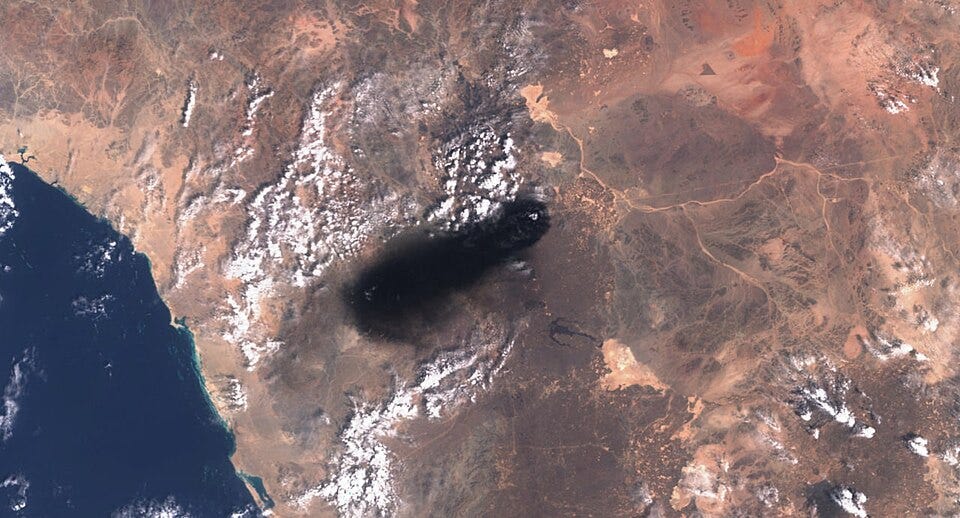
The September 10 strike on Saudi Arabia’s East–West pipeline exposed the vulnerability of the kingdom’s principal alternative to the Strait of Hormuz. The 1,200-kilometer system had recently moved roughly four to five million barrels per day from Saudi oil fields near the Persian Gulf to Yanbu on the Red Sea. Satellite imagery showed severe damage at a major pumping facility. Regional officials have said repairs could leave most of the pipeline out of service for three to five weeks, although partial operations may resume sooner. Riyadh has not issued its own repair timetable.
Who conducted the attack remains somewhat unclear. Saudi Arabia said the drones were launched from Iraq and blamed Iran-aligned fighters there. Baghdad confirmed that the launch originated in Maysan province, seized launch equipment near the Iranian border and opened an investigation. Iran has denied involvement, while the Islamic Resistance in Iraq denied conducting the strike but described the accusation as “an honor we do not claim.”
The strategic significance does not depend on establishing the precise chain of command. Iran has openly warned that if it cannot export oil, other Gulf producers will not be able to export normally either. An attack that disables Saudi Arabia’s principal Hormuz bypass therefore advances the logic Tehran has publicly articulated, regardless of who issued the operational order.
The Houthis’ advances have created a similar problem at the other end of that bypass. The group has taken Mayun (Perim) Island inside Bab el-Mandeb and the Greater and Lesser Hanish islands farther north, while strengthening its position around the mountainous approaches overlooking the strait. These gains do not give the Houthis uncontested control of Bab el-Mandeb, and commercial traffic continues. But the mountainous terrain is considerably harder to retake than low-lying coastal areas and gives the group a more durable ability to threaten shipping through the waterway.
The Houthis have said navigation remains safe for vessels other than Saudi-linked shipping, while continuing missile and drone attacks against Saudi targets. For Riyadh, that creates vulnerability at both ends of its main Hormuz alternative: the pipeline carrying crude westward to Yanbu is badly damaged, while tankers leaving the Red Sea terminal toward Asia must pass through Bab el-Mandeb, where the military balance has shifted in the Houthis’ favor.
The pressure on Riyadh has increased further in recent days. Saudi Arabia has sought additional regional support as Houthi forces consolidated their gains, while Washington and European governments have so far stopped short of intervening directly to try to reverse the advances. U.S. officials also reportedly met Houthi representatives in Muscat over the weekend, where the Houthis indicated that their 2025 ceasefire with Washington remained in effect and that their current maritime threats were directed primarily at Saudi-linked rather than U.S. or general international shipping. That leaves Saudi Arabia facing a more immediate threat to its Red Sea route without the potential of additional U.S. military protection or intervention.
Developments inside Hormuz reinforce the problem, although they also show that the strait is not completely sealed. Preliminary Kpler data showed only four commodity-vessel transits on Monday - two bulk carriers leaving the Persian Gulf and two empty oil tankers entering - down from ten on Sunday and far below prewar levels. TankerTrackers, however, reported from satellite imagery that VLCC supertankers were moving through Hormuz in both directions during daylight hours, while more crude, LNG and LPG was being transferred ship-to-ship in the Gulf of Oman.
The two observations are not necessarily contradictory because vessels operating without AIS can be missed by conventional tracking. Regardless, the picture is one of severely disrupted but adapting trade: some large tankers are still crossing and traders are finding ways to move cargo, but normal, predictable high-volume navigation has not returned.
The damaged Panama-flagged tanker El Gaia illustrates the continuing risk. Iran’s Islamic Revolutionary Guard Corps Navy said the vessel entered the southern route Tehran considers unauthorized, struck Iranian naval mines and caught fire. CENTCOM rejected that account, saying El Gaia had previously been disabled by an Iranian missile and was struck again by an Iranian drone last week while anchored off Oman. The competing accounts cannot be independently verified. Oman’s Maritime Security Center says an Omani naval vessel evacuated 23 crew members, while two remained missing, and the tanker is being towed toward an Omani port.
A separate incident followed Monday night, when the United Kingdom Maritime Trade Operations agency reported that another vessel in Hormuz was struck by an unidentified projectile. No significant damage was reported and the attacker has not been identified. The incidents underline the limitation of the U.S.-backed southern route: military protection may allow individual ships to transit, but it has not yet created sufficiently predictable conditions for normal commercial navigation. Iran is simultaneously trying to make its own authorization commercially relevant, warning vessels, insurers and maritime service providers of penalties for using routes Tehran considers unauthorized.
The shifting events and retaliatory pressure on Saudi Arabia’s oil exports may be complicating the diplomatic path ahead, at least temporarily. Oman had planned to bring Iran, Iraq and the six Gulf Cooperation Council states together to discuss navigation through the Strait of Hormuz, but Foreign Minister Badr Albusaidi said the meeting was postponed “in the interests of consensus.” Tehran said Saudi Arabia requested the delay, though Riyadh has not publicly confirmed that account.
Saudi caution reflects a genuine dilemma. Joining an arrangement that solidifies an Iranian role in managing traffic through the Strait of Hormuz while Saudi infrastructure is under attack could be perceived as rewarding or bowing to coercion. But rejecting such an arrangement does nothing to address the continued threats to the kingdom’s oil infrastructure, which is likely to remain at significant risk so long as the Iran war continues to spread across the region.
The postponement also does not necessarily end the Iran–Oman track. Tehran and Muscat have discussed a temporary navigation framework involving routes through waters under their jurisdiction, and could potentially move ahead without a broader Gulf agreement.
Iranian officials are increasingly explicit about what they want in return for reducing pressure. Mohsen Rezaei, secretary of Iran’s Supreme National Security Council, said Monday that there would be no new negotiations until Iran’s existing conditions were fulfilled, adding that the “equations concerning oil and the straits have changed.” President Masoud Pezeshkian has similarly said that if Washington returns to the Islamabad memorandum and implements its commitments, Tehran will implement its own.
Washington’s intensifying economic pressure is continuing, however. Treasury Secretary Scott Bessent has called on people worldwide to provide information about Iran’s remaining financial and commercial networks, saying actionable information could qualify for financial rewards. The initiative expands the U.S. campaign to sever Iran’s banking, shipping, aviation and other commercial connections. Washington is trying to demonstrate that Iran can be economically isolated without destabilizing the wider regional economy, while Tehran is using the vulnerability of regional energy routes to argue that the two cannot be separated.
Foreign Minister Abbas Araghchi met Chinese Foreign Minister Wang Yi in Beijing on Wednesday, adding another dimension to the diplomatic picture. China remains the largest buyer of Iranian oil and Tehran’s most important major-power economic partner. Wang called for Iran and the United States to return to the Islamabad understanding and resume substantive dialogue, while also emphasizing the importance of restoring navigation through the Strait of Hormuz to protect global energy supplies and supply chains. Beijing therefore has interests on both sides of the emerging equation: it opposes Washington’s escalating pressure on Iran but also has a major economic stake in restoring predictable energy flows through Hormuz and Bab el-Mandeb. Araghchi’s visit also comes as a possible meeting between Xi Jinping and Donald Trump is being discussed, and Treasury Secretary Scott Bessent has indicated he will be meeting his Chinese counterpart, He Lifeng, this coming weekend with Iran sanctions on the agenda.
The civilian costs are also spreading. Fighting in Yemen has displaced tens of thousands of people. Inside Iran, disruption to maritime imports and financial restrictions has sharply increased transportation costs for medicines and contributed to shortages of some imported drugs. Higher oil, insurance and shipping costs distribute the consequences well beyond the governments making the strategic decisions.
The central conclusion remains that Washington has not succeeded in separating Iran’s economic isolation from the security of its partners’ exports. Iranian crude exports through Hormuz remain effectively halted, but Saudi Arabia’s principal overland bypass has been badly damaged and the strategic balance around its Red Sea outlet has shifted in favor of the Houthis.
Hormuz itself is neither normally open nor completely closed. Tankers are adapting through limited crossings, reduced electronic visibility and ship-to-ship transfers. But Iran does not need to stop every tanker to preserve its leverage. It needs to make excluding Iran from regional energy trade sufficiently costly and risky for everyone else.
An Iran–Oman navigation arrangement therefore remains the most plausible near-term mechanism for reducing that pressure. Broader Gulf participation would make it more durable, but Tehran may not require unanimous regional approval to begin implementing a bilateral framework with Muscat. The developments of the past week suggest that Iran’s central strategic wager - that it cannot be economically isolated without imposing substantial costs on the wider region - has not yet been disproved.