

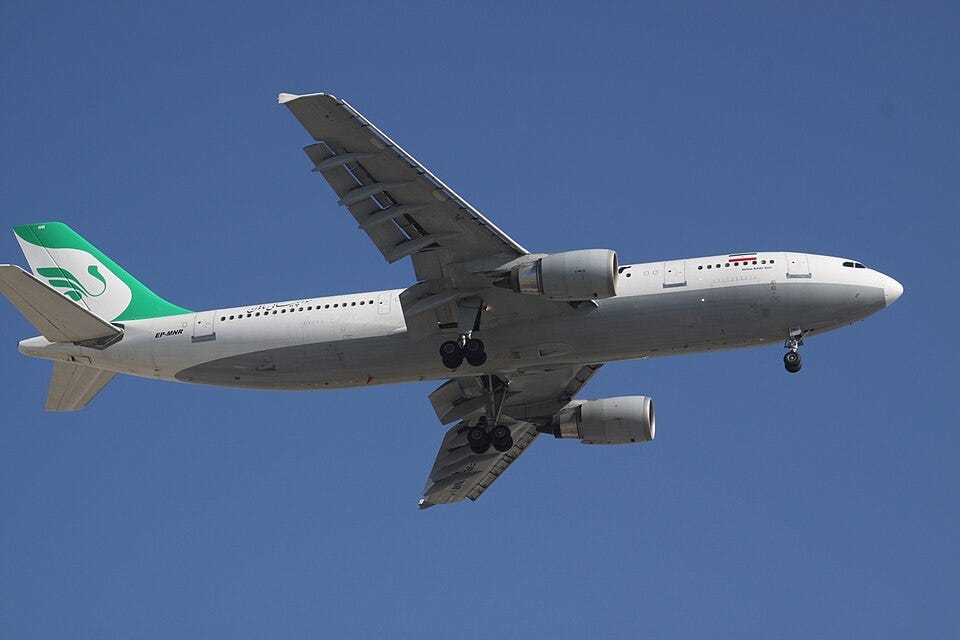
The arrival of a Mahan Air flight from Tehran to Sana’a on July 3, following the signing of an air transport agreement between Iranian and Houthi-controlled Yemeni aviation authorities, represents one of the most consequential developments in the Yemen conflict in years. The flight, which reportedly traveled through Omani airspace and returned to Tehran several hours later, was followed by competing narratives, mutual threats, and renewed concerns that Yemen could once again become a major arena of regional competition.
.jpg)
The flight was historic not simply because it was a direct connection between Iran and Houthi-controlled Yemen, but because it appears to have been the first publicly acknowledged international flight into Sana’a outside the Saudi-led coalition’s framework since the coalition intervention began in 2015. Its significance therefore extends well beyond aviation or humanitarian access and touches directly on questions of sovereignty, regional influence, deterrence, and the emerging security order in the Middle East.
From the perspective of the Houthis (Ansar Allah) and Iran, the flight represents an effort to challenge what they describe as a long-standing blockade that has isolated millions of Yemenis living in Houthi-controlled territories. The Sana’a airport was also heavily bombed by Israel amid regional tensions in May 2025, further diminishing air-related transport and travel.
Houthi officials stated that the aircraft transported patients, wounded civilians, and stranded Yemenis and characterized Saudi efforts to prevent the landing as a continuation of policies that have contributed to Yemen’s humanitarian crisis. They have argued that reopening regular flights between Sana’a and Tehran is both a humanitarian necessity and an assertion of their political legitimacy as the de facto governing authority over much of northern and western Yemen.
For Tehran, the operation also carries broader strategic significance. Since the recent regional war, Iran has sought to demonstrate that the “Axis of Resistance” remains operational and capable of maintaining strategic depth across the region. Reestablishing direct access to Sana’a would strengthen Iran’s ties with one of its most important regional partners while signaling that Tehran remains capable of projecting influence despite years of sanctions, military pressure, and diplomatic isolation. From this perspective, the flight was not merely a logistical operation but also a political statement about Iran’s continuing regional role.
At the same time, the internationally recognized Yemeni government and Saudi Arabia view the same development through a fundamentally different strategic lens. Yemen’s Presidential Leadership Council convened an emergency meeting immediately after the flight and condemned it as a violation of Yemeni sovereignty, arguing that only the internationally-recognized government possesses the legal authority to regulate the country’s airspace and international transportation links. Saudi-backed Yemeni officials further alleged that the flight may have transported Iranian advisers and personnel, although independent confirmation of these claims remains unavailable.
For Saudi Arabia, the issue extends beyond Yemen itself. Since launching its intervention in 2015, Riyadh has viewed limiting Iranian influence on the Arabian Peninsula as a central national security objective. The prospect of regular direct flights between Iran and Houthi-controlled Yemen raises concerns in Riyadh that Tehran could establish a more permanent logistical, political, or military presence near Saudi Arabia’s southern border and adjacent to the strategically vital Red Sea corridor. Saudi officials and coalition representatives therefore see the flight not as an isolated humanitarian initiative but as a potential challenge to the regional security architecture that has existed for more than a decade.
The strategic importance of the issue is amplified by geography. The Houthis control Sana’a, the port of Hodeidah, and much of Yemen’s Red Sea coastline, placing them near the Bab al-Mandeb Strait, one of the world’s most important maritime chokepoints. For Iran and its allies, maintaining influence in Yemen provides strategic leverage over a second critical international shipping route. For Saudi Arabia, Gulf states, Israel, and the United States, preventing any single adversarial power from consolidating control over these corridors remains a core security objective.
The timing of the flight also carries symbolic significance. It occurred on the same day that Saudi representatives traveled to Tehran to participate in funeral ceremonies for former Iranian Supreme Leader Ali Khamenei, highlighting the complex reality of contemporary Middle Eastern diplomacy: regional rivals are simultaneously pursuing diplomatic engagement and strategic competition.
The immediate danger is that both sides may interpret restraint as weakness. The Houthis have warned that future attempts to prevent flights into Sana’a could result in attacks on Saudi airports and critical infrastructure, while the Saudi-led coalition has threatened to respond with “unprecedented force” to any threats against Saudi territory or Yemeni sovereignty. Such mutual deterrence dynamics have repeatedly escalated into broader conflicts throughout the region.
From a policy perspective, the challenge is not simply determining which side’s legal or political claims are stronger, but preventing Yemen from becoming the catalyst for another regional confrontation. A sustainable approach would likely require acknowledging the legitimate interests and concerns of all parties: humanitarian access and political recognition concerns raised by the Houthis and Iran; sovereignty and security concerns raised by the internationally-recognized Yemeni government and Saudi Arabia; and broader international concerns regarding regional stability and maritime security.
One potential path forward could involve internationally monitored civilian air corridors into Sana’a, including independent inspections of passengers and cargo, transparent reporting mechanisms, and renewed diplomatic engagement on a broader political settlement in Yemen. Such arrangements would not resolve the underlying political conflict, but they could reduce the risk that disputes over access, sovereignty, and influence trigger another cycle of regional escalation.
Ultimately, the dispute over a single flight between Tehran and Sana’a reflects a larger question confronting the Middle East after the recent war: whether the region’s emerging order will be shaped primarily through competition and deterrence, or through negotiated arrangements that accommodate the core security interests of rival regional powers. The answer to that question may determine not only the future of Yemen, but the trajectory of the broader Middle East for years to come.