

With just hours remaining before President Trump’s self-imposed deadline for a deal to end the Iran war, the President’s rhetoric on the war has reached an unprecedented and deeply alarming level. Trump has warned that “a whole civilization will die tonight, never to be brought back again” if Iran does not comply with U.S. demands. Earlier statement tied this threat to potential attacks on critical civilian infrastructure including all of the nation’s bridges, power plants, and essential national systems.
This language represents a dangerous shift into genocidal rhetoric, where the destruction of civilian life is an explicit goal. This is a direct threat to a civilization of more than 92 million Iranians, whose survival depends on electricity, transportation, water, and public services.
Iran has reportedly responded to the civilizational threat by cutting off direct communication with the United States. While prior, direct communication between the U.S. and Iran was likely limited, mediators appear to be continuing to bridge the gaps and stave off further escalation.
Developments on the ground indicate that the war is increasingly centered on civilian infrastructure, with reported attacks and disruptions continuing to impact roads, bridges, railways, airports, and energy systems. Warnings issued to civilians to avoid transport networks further underscore the extent to which everyday spaces are being transformed into potential targets, heightening risks for ordinary people and limiting their ability to move safely.
In stark contrast to this escalation, a different response is emerging from within Iran itself. Reports indicate that in cities such as Kermanshah and Ahvaz, citizens have formed human chains around critical facilities, including the Bisotun power plant, placing themselves in direct proximity to infrastructure at risk. These actions, while potentially dangerous, reflect a broader effort by ordinary people to protect essential services and prevent further damage to civilian life. Likewise, artist Ali Ghamsari staged a symbolic sit-in at the Damavand power plant yesterday, performing on his tar instrument in an effort to protect a plant that provides significant power to the populous capital of Tehran.
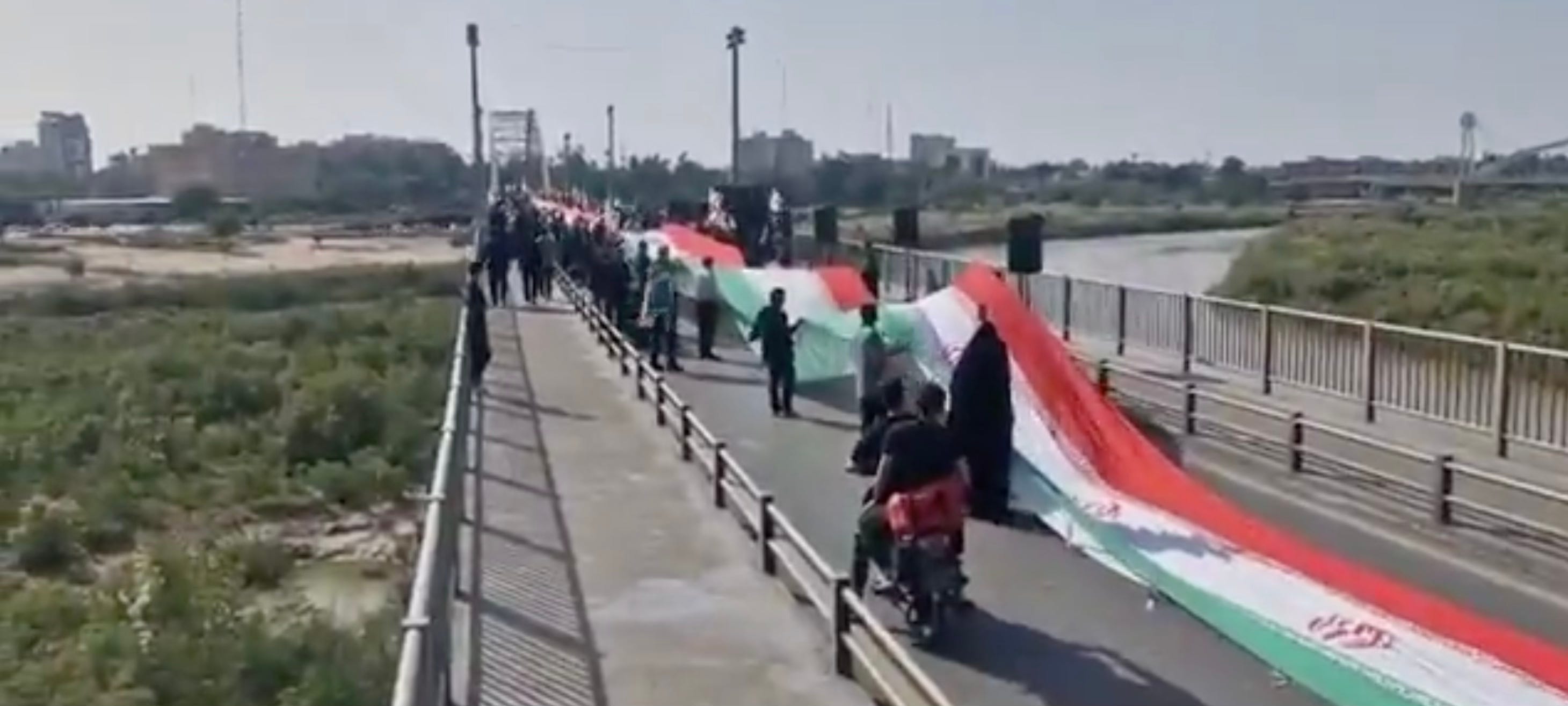
Parallel to these civic actions, voices from Iran’s cultural community are increasingly speaking out against the war and the targeting of civilians. Oscar-winning filmmaker and frequent critic of the Islamic Republic Asghar Farhadi has called on artists and cultural figures worldwide to raise their voices against the “destructive aggression,” particularly the attacks on civilian infrastructure, emphasizing the human cost of such actions.
This message has been echoed domestically by prominent Iranian actors. Hootan Shakiba has described a war that fails to distinguish between civilian and military targets as a “war crime,” directly condemning the ongoing attacks on non-military infrastructure. Similarly, Mohsen Tanabandeh, responding to Trump’s rhetoric, invoked themes of historical resilience and national identity, emphasizing the deep-rooted connection between people and their land and signaling a broader societal response grounded in endurance rather than escalation.
Taken together, these developments point to a widening gap between military escalation and civilian response. While threats of expanded attacks continue, segments of Iranian civil society - from ordinary citizens to leading cultural figures - are visibly mobilizing around the protection of life and infrastructure, rather than supporting further escalation.
The implications of this trajectory are significant. When infrastructure becomes a central target, the effects extend far beyond immediate military objectives, disrupting healthcare, transportation, energy access, and economic stability. Such impacts are cumulative, long-lasting, and disproportionately borne by civilians, increasing the humanitarian risks associated with continued escalation.
As the deadline approaches, the situation reflects a stark contrast. On one side, escalating threats frame the conflict in terms of destruction and irreversible consequences. On the other, civilian actions and cultural appeals emphasize preservation, restraint, and the protection of everyday life.
In this context, the urgency of de-escalation becomes increasingly clear. The continued targeting—or threatening—of civilian infrastructure risks deepening the humanitarian impact of the conflict and expanding its scope beyond immediate military considerations. The message emerging from within Iranian society is not one of escalation, but of preservation—an effort to maintain the basic foundations of life in the face of growing threats.