

The situation surrounding Iran’s women’s national football team has become an international political and humanitarian issue after several players reportedly sought asylum in Australia during the AFC Women’s Asian Cup. The developments have drawn attention from governments, international organizations, and supporters, reflecting the broader political climate surrounding Iran amid ongoing regional tensions.
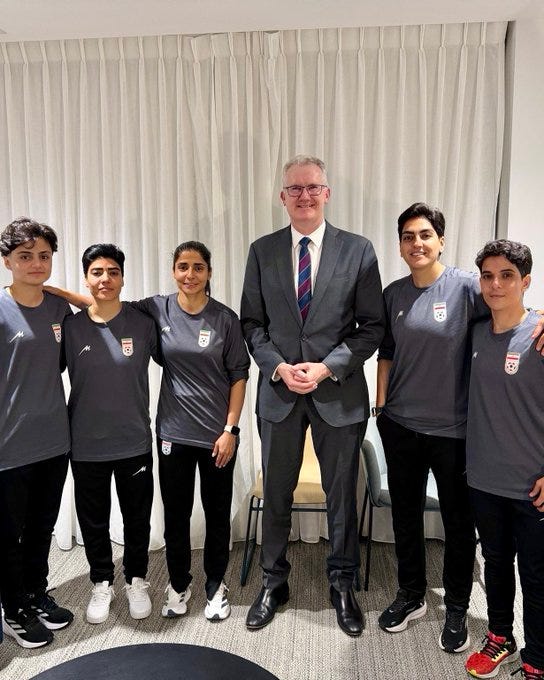
According to Australian officials, several members of the Iranian women’s national football team have received humanitarian visas and are now permitted to remain in Australia. The players were identified by Australian authorities as Atefeh Ramazani-Zadeh, Zahra Sarbali, Mona Hamoudi, Fatemeh Pasandideh, and Zahra Ghanbari. Australian Home Affairs Minister Tony Burke confirmed that he personally met the athletes and signed their humanitarian visa applications after they indicated that they wished to stay in Australia for safety reasons.
Australian authorities stated that the players left their team hotel and were transferred by police to a secure location, where discussions regarding their immigration status continued for several days. According to Burke, the players emphasized that they are not political activists but athletes seeking personal safety. He also noted that the Australian government would offer the same opportunity to other members of the team if they choose to remain in the country.
According to a report by Tasnim News Agency, Mohaddeseh Zolfi, a member of Iran’s women’s national football team, withdrew her request for asylum in Australia and announced her intention to return to Iran. Iranian state-affiliated media claimed that her earlier asylum request had been made under significant pressure from the Australian government and what they described as hostile media outlets.
The controversy began during Iran’s participation in the Women’s Asian Cup in Australia. In the team’s first match, several Iranian players refused to sing the Iranian national anthem, an act that drew significant attention and reportedly led to threats from hardline supporters of the Iranian government. In subsequent matches, however, the players sang the anthem and performed a military-style salute during its broadcast, a gesture that raised concerns among observers that the athletes may have been under pressure from Iranian authorities or worried about the safety of their families.
Following Iran’s elimination from the tournament after a 2–0 defeat to the Philippines, hundreds of Iranian supporters gathered outside the stadium in Gold Coast, chanting slogans such as “Save our girls.” Some supporters attempted to block the team bus, urging the players to remain in Australia rather than return to Iran.
The case has also attracted political attention in the United States. Former U.S. President Donald Trump publicly urged Australia to grant asylum to the players, warning that forcing them to return to Iran could put their lives at risk. In a social media post, Trump stated that if Australia refused to provide protection, the United States would be willing to accept them. The statement is notable given that the Trump administration has recently deported some Iranian refugees back to their country after denying them asylum, even during periods of intensified repression against protesters in Iran, highlighting a striking contrast in policy rhetoric. Iranians generally remain barred from securing visas, asylum or refugee status in the United States.
Iranian authorities have responded by urging the team to return home. In a statement, Iran’s Prosecutor General’s Office said the players could return to Iran “with calm and reassurance.” The statement claimed that some players had been influenced by emotional reactions and what it described as “enemy provocations,” referring to what Iranian officials called the “American-Zionist war.” Authorities suggested that the actions of certain players had been politically exploited by Iran’s adversaries.
Meanwhile, Iran’s Football Federation criticized Trump’s comments as “direct political interference” in football affairs, calling on FIFA to prevent political tensions from affecting international football competitions. Separate reporting this week indicated that the men’s soccer team, Team Melli, will not participate in the 2026 World Cup in the United States given the ongoing war and American involvement in killing Iran’s Supreme Leader.
Reports from journalists in Australia indicate that the remaining members of the Iranian team face difficult decisions. Some players are reportedly considering returning to Iran due to fears that their families could face pressure or retaliation if they remain abroad. Others are believed to be exploring options for staying in Australia or traveling to third countries.
The case highlights the intersection of sports, politics, and human rights during a period of heightened regional conflict. For the athletes involved, the decision whether to remain abroad or return home carries profound personal consequences, as it could affect not only their own futures but also the safety and well-being of their families in Iran.