

Iran finished the 2026 Asian Games in Aichi-Nagoya in sixth place with 52 medals, including 19 gold, 18 silver and 15 bronze. It was a notable performance for a country competing in the middle of a major war and under severe economic and logistical pressure. Some of the most significant results came from Iranian women, who won 14 medals - three gold, six silver and five bronze - and recorded several first-ever achievements in the country’s sporting history.
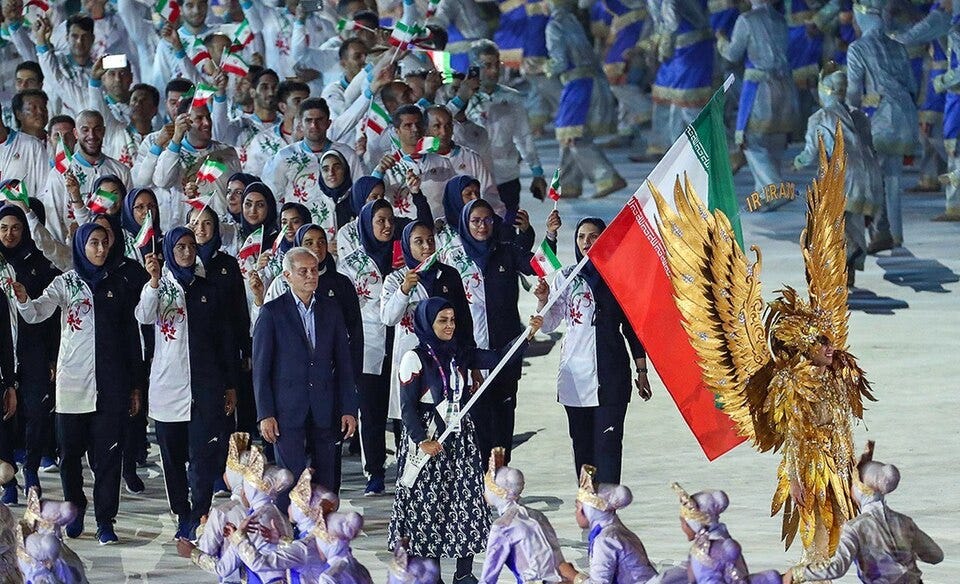

Iran sent 305 athletes to Japan, including 95 women, for the competition that is held once every four years. Some of the biggest breakthroughs came in rowing. Fatemeh Mojallal became the first Iranian woman to win an Asian Games rowing gold, while Zeinab Norouzi and Kimia Zarei won another gold in the lightweight double sculls. Iranian women also collected additional medals in rowing, making it one of the strongest parts of the women’s delegation.
The breakthroughs extended well beyond rowing. Reyhaneh Karimi became the first Iranian woman to win an Asian Games medal in weightlifting, while Zahra Zarei took silver in the 400 meters, the first Asian Games medal ever won by an Iranian woman in a running event. Iran also returned to women’s artistic gymnastics at the Asian Games after an absence of roughly half a century. Saghar Moradi added another gold in taekwondo, continuing the rise of a women’s program that has already produced Iranian champions at the world level.
The results are significant not only because of the medals, but because several came in sports where Iranian women had little or no international presence a generation ago. For much of the period after the 1979 revolution, women’s participation in competitive sport was constrained by dress requirements, gender segregation, limited investment and restrictions affecting participation in particular disciplines.
That landscape has gradually changed. Iranian women now compete internationally in a much broader range of sports, participate more regularly in international tournaments and training camps, and have access to national-team programs that either did not exist or were considerably weaker two or three decades ago. Women’s professional and semi-professional leagues have also expanded, while female champions have become increasingly visible figures in Iranian media and popular culture.
The Asian Games provide one measure of that transformation. Iranian women gradually moved from limited participation toward medal contention in taekwondo, shooting, rowing, karate, wushu and other sports. At Jakarta in 2018, Iran’s women’s kabaddi team won the country’s first Asian Games gold in a women’s team sport. At Hangzhou in 2023, women collected numerous medals but failed to win a gold. However, Aichi-Nagoya produced three women’s championships and breakthroughs in weightlifting, track and field, rowing and gymnastics.
Weightlifting is particularly revealing. Iran has one of the world’s strongest traditions in men’s weightlifting, but organized elite competition for Iranian women is comparatively new. It has now produced its first female Asian Games medalist. A similar pattern can be seen in rowing, where sustained training, equipment, coaching and international competition have produced women capable of defeating the best athletes in Asia.
Zarei’s 400-meter silver may be even more revealing. Iranian women have previously achieved international success primarily in sports such as shooting, martial arts and rowing. Winning Iran’s first women’s Asian Games medal in a running event suggests that the expansion of elite women’s sport is beginning to reach disciplines where Iranian women have historically had a much smaller international presence.
These developments have occurred alongside broader changes in Iranian society. Women’s participation in organized sport has become considerably more normalized. Women’s leagues operate across numerous disciplines, female athletes increasingly have access to international competition, and women have gradually gained access to stadiums for some men’s sporting events after decades of restrictions.
For younger Iranian women, there is also now something that barely existed for earlier generations: a visible pathway from local sport to international competition. Olympic medalists, world champions and Asian champions provide models for younger athletes, while clubs, federations and national teams provide a more developed institutional pipeline.
It is not possible to attribute Iran’s improving results to social change alone. Coaching, federation investment, individual generations of talented athletes and the relative strength of Asian competition in each sport all matter. But the longer-term pattern suggests that as the practical space available to Iranian women in sport has expanded, so has the range of disciplines in which they are capable of competing and winning internationally.
That expansion remains incomplete. Iranian women are still absent from a number of sports contested by women from other Asian countries. Some of these absences reflect competitive priorities and limited resources, while others are connected to longstanding restrictions involving clothing, gender segregation and the organization of particular sports.
There is another important context for Iran’s performance in Aichi-Nagoya. These Asian Games took place while Iran was fighting a major regional war and facing a combination of U.S. sanctions, disruptions to transportation and trade, and severe economic pressure at home.
Those conditions would ordinarily be expected to make elite sport more difficult. International travel and training camps become more complicated, imported equipment becomes more expensive or inaccessible, and Iranian sports federations earning revenue in rials face much higher costs when competing abroad. Access to foreign expertise and regular international competition can also become harder.
Athletes themselves are not insulated from these conditions. Their families face the same inflation, economic uncertainty and wartime disruptions affecting other Iranians. Against this backdrop, finishing sixth in Asia with 19 gold medals suggests that Iran’s sporting system has so far proved more resilient than might have been expected under wartime conditions. Despite the effects of war and economic isolation, the Aichi-Nagoya results show that these pressures have not yet translated into a broad collapse in international performance.
At a moment when Iran is largely seen internationally through the lens of war, sanctions and political confrontation, Aichi-Nagoya offers a different view of changes taking place inside the country. Iranian women are entering areas of competitive sport that were largely closed or inaccessible to previous generations, and where sustained opportunities have emerged, some are already reaching the top of Asia.