

Iran’s parliament has approved new provisions that would punish citizens for interviews with media outlets designated as “hostile” and impose severe penalties for providing certain unpublished information to foreign entities. While the measures are not enforceable law yet, as additional approval measures are still required, they could significantly expand the Iranian state’s control over communication with foreign media, with implications for freedom of expression, independent journalism and the flow of information out of the country.
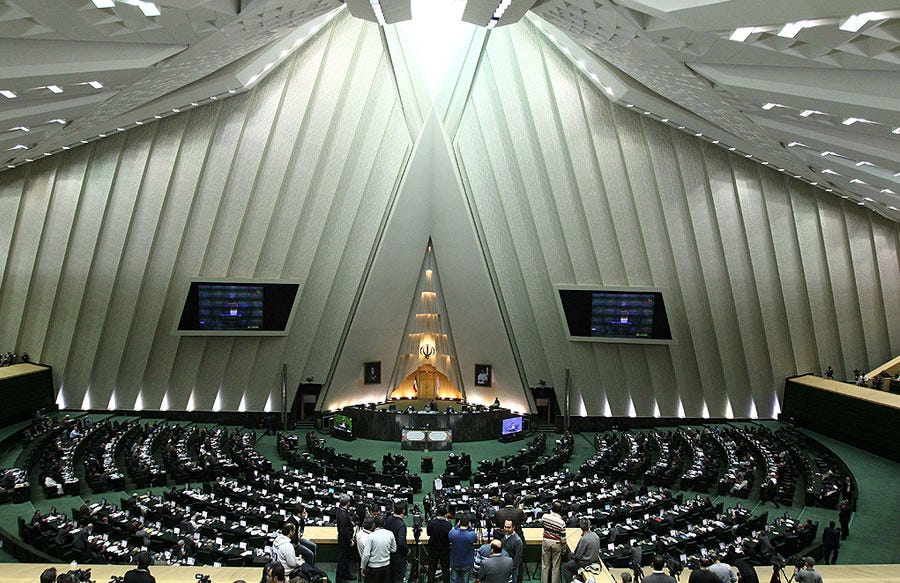

The provisions are part of a broader bill titled “Countering the Influence of Intelligence Services and Foreign Governments or Entities.” Under Article 22, approved by parliament on October 6 with 174 votes in favor, six against, and two abstentions, Iranian citizens can be punished for giving interviews or participating in discussions with media outlets or individual media figures publicly designated as “hostile” by the Ministry of Intelligence. The restriction also covers certain media organizations linked to foreign governments under classifications established by the bill.
Violations can carry sixth-degree penalties under Iran’s Islamic Penal Code, including imprisonment for six months to two years, 31 to 74 lashes, fines, and restrictions on certain social rights. Government officials are exempted from the provision. The measure gives the Ministry of Intelligence broad authority to determine which media organizations and individuals fall within the prohibited categories. Earlier this year, the ministry published a list identifying dozens of media organizations and individuals as “hostile.”
The legislation expands restrictions adopted following the June 2025 war that criminalized sending certain information, images, and videos to designated media organizations. The new provision goes further by potentially making participation in an interview or discussion itself a criminal offense, even when the communication does not involve classified information.
Giving a security agency the authority to determine which journalists citizens may communicate with, while attaching prison and corporal punishment to violations, raises serious questions about Iran’s international obligations on freedom of expression and creates substantial potential for arbitrary enforcement and self-censorship. Iran is a party to the International Covenant on Civil and Political Rights, which protects the right to seek, receive, and impart information and ideas across borders. Any restrictions on these rights must meet requirements of legality, necessity, and proportionality.
The legislation also reflects a broader shift in the Iranian state’s approach to information during wartime. Since the June 2025 phase of the war, authorities have increasingly treated the movement of information itself as a security issue, amid concerns that photographs, videos, location data and contacts with foreign organizations could be used by hostile governments or intelligence services. Article 22 significantly widens that logic: instead of criminalizing the transfer of particular categories of sensitive information, it potentially criminalizes interviews or participation in discussions with designated media outlets regardless of whether sensitive or classified information is shared.
Parliament separately approved Article 20, which targets the unauthorized provision of unpublished official information, reports, data, or statistics to entities defined under the legislation as foreign agents. The provision applies to information obtained through a person’s professional responsibilities or contacts and can carry five to ten years in prison as well as permanent disqualification from the position through which the information was obtained or provided. Significantly, the information does not necessarily have to be formally classified as secret or confidential.
While it is expected that Iranian authorities would have concerns about espionage and the disclosure of sensitive information during wartime, the new provisions reach beyond classified information, potentially criminalizing ordinary communication based primarily on who receives it. Broad categories such as “hostile media,” “foreign agents,” and “unpublished official information” also leave considerable discretion to security and judicial authorities.
The consequences could extend well beyond professional journalists. Researchers, academics, civil society activists, public employees, witnesses to abuses, and ordinary citizens could face greater risks when communicating with journalists or organizations abroad. This could make it more difficult to expose corruption and misconduct, document human rights violations, report on labor and social grievances, or provide independent accounts of events inside Iran.
The restrictions could be particularly consequential during the current war, when access to independent information is critical to documenting both domestic developments and the consequences of the conflict. If citizens face criminal punishment simply for speaking with particular media organizations, witnesses could be deterred from sharing a wide range of information, including arbitrary detention, mistreatment, civilian casualties, and other potential abuses. The result is not only a restriction on individual expression but also a significant obstacle to public accountability.
The parliamentary vote advanced the provisions, but they are not yet enforceable law. The legislation must still complete Iran’s required legal review process, including review by the Guardian Council. The final scope of the restrictions will therefore depend both on whether the provisions survive that process and, if enacted, how security and judicial authorities interpret and enforce them.
The broader significance of the measure is not limited to foreign-based Persian-language media. If enacted in its current form, it would mark a further expansion of wartime security restrictions into ordinary civilian communication. The key change is that criminal liability would increasingly depend not only on what information an Iranian shares, but on whom they speak to, giving security authorities considerably greater influence over the boundaries of permissible contact between Iranian society and the outside world.