

Iran’s political and security establishment is facing a difficult strategic choice as President Donald Trump dismisses the need for an agreement with Tehran, senior Iranian officials threaten a broader military response to renewed attacks, and the Assembly of Experts calls for reconsidering the country’s nuclear commitments and defense doctrine. Meanwhile, continued attacks on shipping in the Strait of Hormuz and an expanding American naval presence suggest that the current confrontation remains far from resolved.
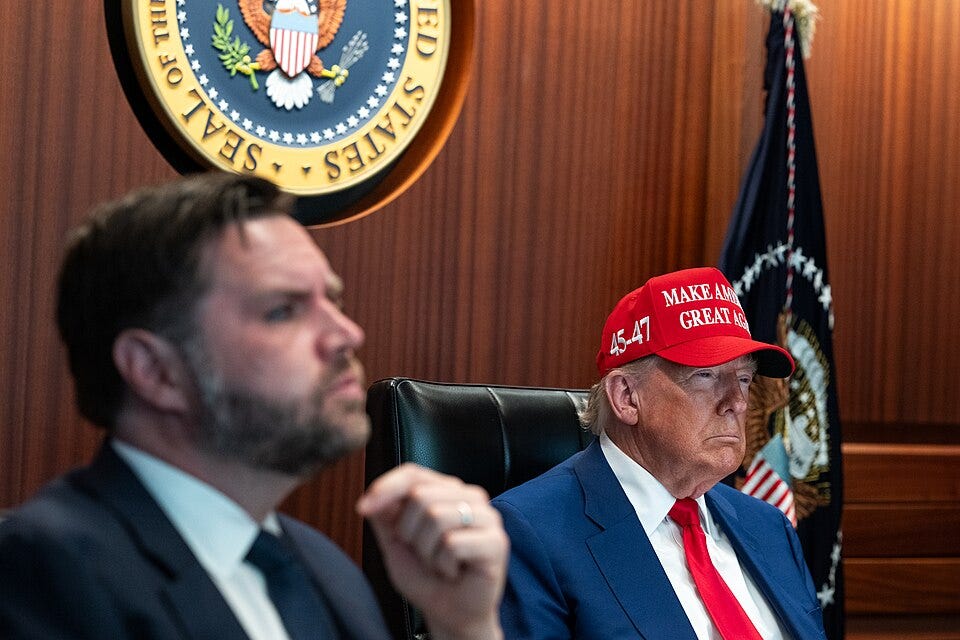

On Thursday, November 12, Trump declared that Washington no longer needed an agreement with Iran and instructed Vice President JD Vance to focus on domestic priorities rather than negotiations to end the war. Claiming that the United States controlled substantial Iranian financial assets and held the advantage in the Strait of Hormuz, Trump dismissed the need for further diplomatic concessions.
His remarks contrasted with earlier statements suggesting that renewed military attacks were unlikely and diplomatic contacts through Qatar were progressing. They also followed reports that Vance had been considering direct talks with a senior Iranian security official, potentially Mohsen Rezaei, secretary of Iran’s Supreme National Security Council. The shift has added uncertainty to Tehran’s calculations, particularly because Iranian officials have been awaiting a formal American response to their latest diplomatic communication.
In an interview with Al Jazeera on November 11, Parliament Speaker Mohammad Bagher Ghalibaf, who heads Iran’s negotiating delegation, emphasized that Tehran would not accept an indefinite continuation of the condition its leadership describes as “neither war nor peace.”
Ghalibaf attributed this position to Supreme Leader Mojtaba Khamenei but made an important distinction: ending the uncertainty did not necessarily require an agreement with Washington. Iran, he argued, could also strengthen its military capabilities and establish more durable deterrence. His remarks suggest that Tehran is considering how to prevent another war even if negotiations fail, rather than relying exclusively on diplomacy.
Ghalibaf also claimed that Iran had reached an understanding with Oman concerning maritime traffic arrangements in the Strait of Hormuz, reiterating that the waterway would not return to its prewar arrangements. Oman has not independently confirmed the full agreement as described by Ghalibaf, but the statement reflects Tehran’s effort to make future management of the strait part of any regional settlement.
A more confrontational position emerged from Rezaei’s interview with Lebanon’s Al Mayadeen television network. He rejected reports of active negotiations or an impending meeting with Vance, describing accounts of diplomatic progress as misleading. He argued that Washington was circulating such reports to ease economic pressure and influence energy markets while refusing to address Iran’s demands.
Rezaei also declared that Iran would not transfer any of its enriched uranium stockpile outside the country, including to Russia. He said Moscow had already been informed and argued that Iran needed the material for future civilian applications, including nuclear-powered ships and submarines.
This position challenges proposals under which Russia could receive Iranian enriched uranium as part of a nuclear agreement, potentially narrowing one avenue for compromise. His reference to naval nuclear propulsion also raises technical and safeguards questions, although it does not establish that Iran has begun such a program or decided to develop nuclear weapons.
Rezaei further insisted that any settlement must end hostilities across the region, particularly in Lebanon. He warned that renewed American attacks would trigger strikes against military facilities involved in those operations, potentially including US bases in Europe. The warning signals an effort to expand the geographical scope of Iran’s declared deterrence strategy, although its ability to carry out attacks against distant, heavily defended targets remains uncertain.
Senior Iranian military commanders reinforced this message during a visit to an underground missile facility. Chief of General Staff Ali Abdollahi warned that Iran would reveal additional capabilities in any future conflict, while Revolutionary Guard Aerospace Force Commander Majid Mousavi claimed Iranian forces could respond to threats both within and beyond the region. Iranian media also displayed ballistic and cruise missiles, including designs whose specifications and operational capabilities remain unverified.
The most significant institutional development came on November 12, when Iran’s Assembly of Experts called for examining withdrawal from the Nuclear Non-Proliferation Treaty (NPT) and reconsidering the country’s defense doctrine. The Assembly argued that attacks on Iranian nuclear facilities had undermined confidence in international institutions and urged authorities to reassess existing commitments. Although it has no direct authority to withdraw Iran from the treaty, its intervention gives greater prominence to demands already raised by conservative lawmakers and political groups. The Foreign Ministry, however, continues to affirm Iran’s NPT membership, and no formal decision to withdraw has been announced.
The military environment is adding urgency to these debates. According to US Naval Institute reporting, the USS George Washington and USS George H.W. Bush carrier strike groups were operating in the Arabian Sea as of November 9. A third group, led by the USS Theodore Roosevelt, had departed Singapore and was moving toward the Indian Ocean, with an eventual Middle East deployment expected.
The Roosevelt is expected to replace the George Washington, although overlapping deployments could temporarily place three American carrier groups near the region. Reports that the Bush deployment has been extended further suggest that Washington intends to maintain a substantial naval presence. These movements increase military pressure on Tehran but do not independently establish a decision to launch another major offensive.
Meanwhile, the Strait of Hormuz remains a major flashpoint. Although some commercial vessels and oil tankers continue to pass through the waterway, repeated attacks on shipping demonstrate that maritime traffic remains dangerous and far from normal. The Revolutionary Guard continues to enforce Iran’s restrictions on shipping routes, while vessels attempting to use alternative passages face the risk of attack. On Thursday, the IRGC reported that two supertankers carrying more than four million barrels of oil had been disabled by explosions after entering what it described as an unauthorized route. The claim has not been independently verified, but it forms part of a broader pattern of attacks and disruptions that underscores the instability of the current situation.
Despite the military buildup and increasingly confrontational rhetoric, a continuation of the existing standoff may also be an option under consideration in Washington. Rather than pursuing either a comprehensive agreement or another major military offensive, the United States could maintain its naval blockade, financial restrictions and military pressure while avoiding large-scale escalation.
Recent statements by Secretary of State Marco Rubio lend weight to this possibility. Speaking after a Group of Seven meeting, Rubio argued that sanctions and maritime restrictions were already imposing such severe economic costs on Iran that another major military campaign was unnecessary. He maintained that Washington remained open to what he described as a genuine agreement but dismissed Tehran’s conditions as unrealistic.
Trump’s latest remarks point in a similar direction. By emphasizing American control over Iranian financial assets and the Strait of Hormuz while declaring that Washington does not need an agreement, he appears willing to maintain pressure without committing to either renewed warfare or a negotiated settlement.
This approach could prolong precisely the condition Iranian officials say they want to end: neither a comprehensive war nor a durable peace, but continuing economic pressure, maritime confrontations, military threats and uncertainty over future attacks.
For Tehran, such a scenario presents a difficult challenge. Its leaders have repeatedly emphasized that the current situation is unacceptable, yet they have limited options for compelling Washington to negotiate on Iran’s terms without risking further escalation. Military demonstrations and threats of broader retaliation may strengthen Iran’s deterrence posture, but they also carry the danger of miscalculation.
Iranian Foreign Minister Abbas Araghchi has condemned Washington’s economic strategy, particularly Rubio’s suggestion that financial pressure could eventually force Tehran to compromise. Araghchi described the approach as inhumane and argued that attempts to use economic hardship against the Iranian population would ultimately fail.
The consequences for ordinary Iranians remain substantial. Continued restrictions on trade and shipping, uncertainty over oil exports and the possibility of renewed attacks complicate economic recovery and place additional pressure on households already struggling with inflation and declining purchasing power. Even without another large-scale military campaign, an extended confrontation could impose significant costs on Iranian society.
The latest developments therefore present Tehran with three possible paths: renewed negotiations leading to a settlement, another round of military escalation, or a prolonged continuation of the current confrontation without either war or peace.
Ghalibaf’s emphasis on ending uncertainty, Rezaei’s rejection of concessions over enriched uranium, and the Assembly of Experts’ call to reconsider Iran’s nuclear commitments illustrate the pressures shaping the Iranian response. Yet none of these statements establishes that Tehran has decided to abandon diplomacy or fundamentally change its nuclear policy.
The central question is whether Iran can secure an agreement that addresses its security concerns, or whether Washington’s willingness to sustain economic and military pressure will leave the country facing an extended period of instability. For ordinary Iranians, the difference between these outcomes will be measured not only in diplomatic or military terms, but in their prospects for economic recovery, security and a return to normal life.