

The United Arab Emirates has transformed from one of Iran’s most important economic partners and commercial lifelines to one of its most bitter enemies in a short period of time. With hostilities continuing even beyond the tentative ceasefire struck in early April, Iran and UAE relations have soured dramatically with little indication that the deterioration can be reversed.
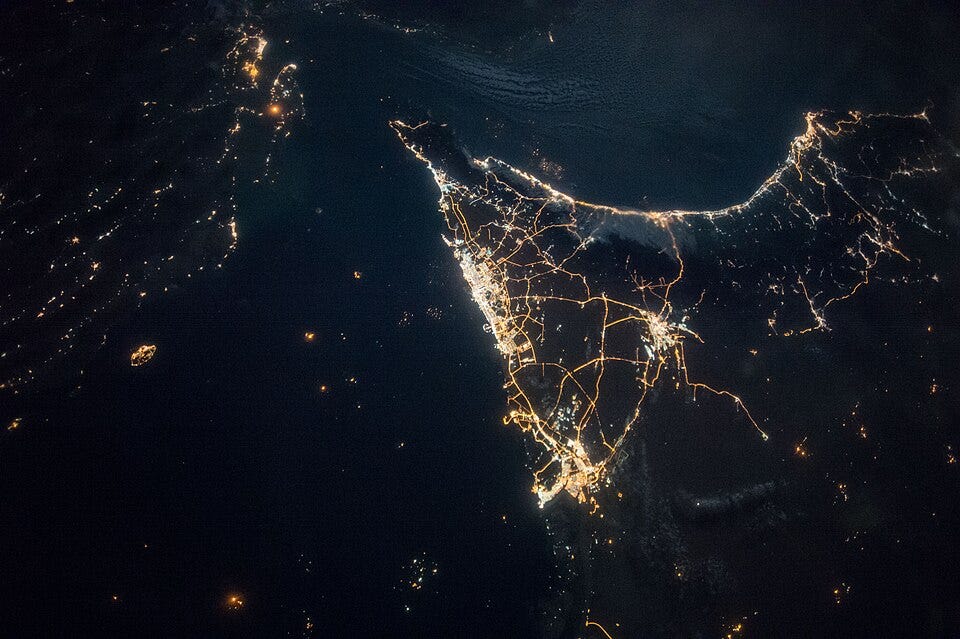

For decades, Dubai functioned as Iran’s primary gateway to the outside world. Even during periods of heavy international sanctions, Iranian businesses, traders, shipping companies, and financial networks relied heavily on the UAE’s open ports and liberal trade environment. Tens of thousands of Iranians lived and worked in Dubai and roughly a third of all goods entering Iran - ranging from electronics and auto parts to cosmetics and clothing - flowed through UAE re-export channels, representing billions of dollars in annual trade. For much of the past two decades, the UAE ranked either first or second among Iran’s trading partners, often competing closely with China. This deep economic interdependence long acted as a stabilizing force preventing direct confrontation.
Yet beneath this economic partnership, a deeper geopolitical rivalry never disappeared. One of the oldest unresolved disputes between the two countries concerns the islands of Abu Musa, Greater Tunb, and Lesser Tunb near the Strait of Hormuz. Iran has controlled the islands since 1971 and considers them inseparable parts of Iranian territory, while the UAE continues to claim sovereignty over them in international forums.
The recent war between Iran and the U.S.-Israeli coalition appears to have transformed that longstanding rivalry into something far more dangerous. Reports of repeated U.S. strikes from UAE territory emerged during the war, either in response to or provoking Iranian retaliation against targets in the UAE. These reports were recently corroborated by the Wall Street Journal, which reported that the UAE had secretly participated in direct military operations against Iran, including strikes on refinery facilities on Iran’s Lavan Island in the Persian Gulf after the ceasefire had been announced. Separately, US Ambassador to Israel Mike Huckabee confirmed that Israel had deployed Iron Dome air-defense batteries and personnel to the UAE under the Abraham Accords.
On May 13, 2026, Netanyahu’s office publicly announced that he had made a secret wartime visit to the UAE during “Operation Roaring Lion” and met with Emirati President Sheikh Mohammed bin Zayed. The Israeli statement described the meeting as producing a “historic breakthrough” in bilateral relations. The UAE denied the claim, calling it “entirely unfounded.”
Iranian Foreign Minister Abbas Araghchi responded with sharp rhetoric, stating that the UAE had become “an active partner in aggression against Iran.” He accused Abu Dhabi of participating in strikes against Iranian targets and called alignment with Israel against Iran a “foolish gamble” and “unforgivable.”
The diplomatic rupture has been swift and far-reaching. The UAE recalled its ambassador from Tehran , one of the clearest signals of a formal breakdown in bilateral relations. UAE authorities also announced the arrest of a group allegedly linked to Iran’s security apparatus. Iran, in turn, formally demanded compensation from Gulf states for allowing their territory and airspace to be used in operations against the Islamic Republic.
From Tehran’s perspective, the UAE has crossed a fundamental red line by moving from quiet normalization with Israel into what Iran describes as active military and security cooperation. An Iranian parliamentary national security official even declared that the UAE’s status as a “neighbor” had been revoked and replaced with the designation of “hostile base.”
The UAE’s demographic structure also creates significant vulnerabilities. Although the country’s population is around 11.3 to 11.8 million, Emirati citizens make up only about 11 to 12 percent of the population, while expatriates comprise 88 to 89 percent. Dubai’s economy depends heavily on maintaining an image of stability, safety, and predictability attractive to investors, tourists, and multinational corporations.
During the war, Iran appeared to deliberately target this vulnerability. Within the first 48 hours of the conflict, Iran launched attacks across GCC countries, with the UAE bearing the heaviest share of missiles and drones. According to the UAE Ministry of Defence, by early April 2026 the country had intercepted 537 ballistic missiles, over 2,000 drones, and nearly two dozen cruise missiles. Despite claims of widespread interceptions, attacks still caused major damage: Dubai International Airport’s Terminal 3 was struck, a fire erupted at Jebel Ali Port, and at least 13 people were killed and more than 220 injured.
The Strait of Hormuz has now become one of the most critical pressure points in the confrontation. Iran’s Revolutionary Guards declared that the UAE’s port of Fujairah falls within a maritime zone where Tehran claims security jurisdiction, increasingly framing Hormuz not as an international waterway but as a strategic zone under Iranian authority.
The deteriorating maritime security environment escalated further on May 14, when the UK Maritime Trade Operations center reported that a commercial vessel near Fujairah had been seized by unauthorized personnel and directed toward Iranian territorial waters. Between late February and mid-May 2026, UKMTO recorded 47 maritime security incidents in the region, including 27 attacks, 18 suspicious activities, and 2 hijackings. Approximately 20 percent of the world’s oil and liquefied natural gas passes through the Strait of Hormuz, making it the world’s most important energy chokepoint. Disruptions to shipping have already contributed to rising global energy prices and fears of broader economic instability.
At the same time, tensions have spilled into the civilian sphere. The UAE has reportedly moved to terminate residency permits for Iranian nationals, close Iranian businesses and exchange networks, and restrict institutions tied to the Iranian community. The large Iranian diaspora in Dubai - once a vital bridge between the two societies - now finds itself caught between two increasingly hostile governments.
The broader significance of this crisis is that it marks the collapse of a fragile but durable arrangement that long defined Iran-UAE relations: economic interdependence coexisting alongside geopolitical rivalry. The UAE increasingly sees Iran as its principal long-term threat, while Tehran now views Abu Dhabi as an active adversary aligned with Israel and the United States.
Notably, this dynamic transpires amid shifting alignments of other regional actors. Saudi Arabia and Iran reached a formal agreement to thaw tensions in March 2023, brokered by China. While Iranian reprisals also struck targets in the Saudi kingdom amid the war, including the U.S. embassy compound in Riyadh and U.S. aircraft stationed at bases in the country, Saudi Arabia appears to be taking a more cautious stance toward Iran rather than moving toward another full rupture in relations. Likewise, tensions between Saudi Arabia and the UAE have heightened in recent months, with ruptures over policy in Yemen and Sudan and the UAE leaving the The Organization of the Petroleum Exporting Countries (OPEC).
Whether the Iran-UAE confrontation stabilizes or escalates further may ultimately depend on whether the region can return to the old model of managed rivalry and economic coexistence, or whether the war has permanently transformed the UAE from Iran’s most important economic gateway into one of its most consequential regional adversaries.