

Wartime strikes continued in recent days as Iran sought to challenge both commercial shipping through the Strait of Hormuz and American warships enforcing the naval blockade on Iran, triggering U.S. strikes on Iranian oil tankers. Iran also unveiled the capture of a state-of-the-art American autonomous underwater vehicle (AUV) that was operating in the Strait of Hormuz, displaying the underwater drone for state media on Tuesday.
Attacks on Saudi energy facilities have added another source of disruption to an already strained regional energy system, as the U.S. continues to exert sanctions pressure and some mediation efforts continue.
.jpg)
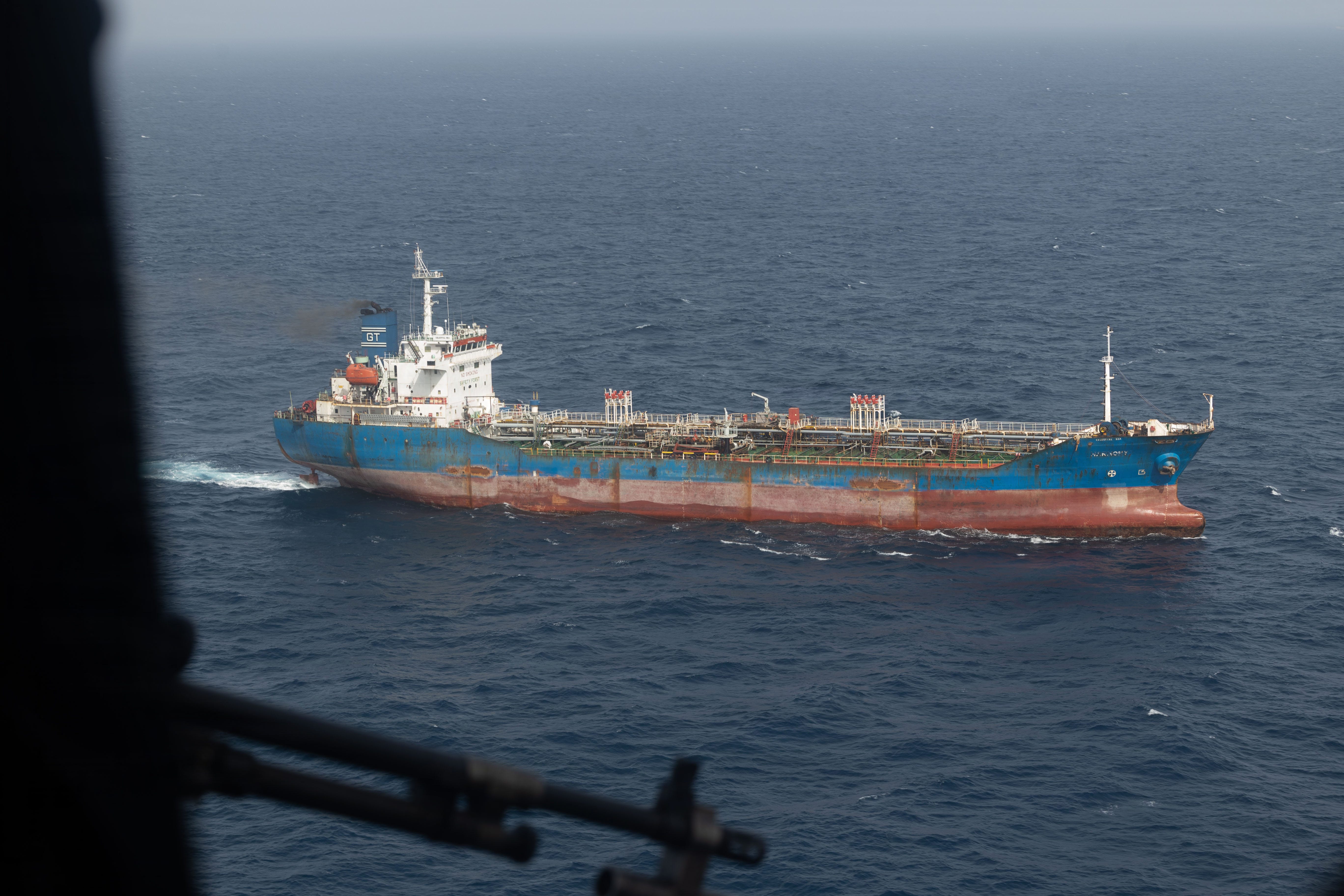
The latest exchange expanded the American campaign against Iran’s tanker fleet. U.S. Central Command said Saturday that it struck three Iranian oil tankers after the Islamic Revolutionary Guard Corps fired ballistic missiles at two American naval vessels. Admiral Brad Cooper, CENTCOM’s commander, explicitly linked the response to economic damage, signaling that firing at American warships would bring greater losses to Iran’s commercial fleet. Defense Secretary Pete Hegseth reinforced the threat, saying further Iranian attacks on U.S. vessels would be answered by destroying Iranian tankers.
That formulation broadens the retaliatory policy Washington had already begun implementing. Earlier attacks were described as a response to Iranian strikes on commercial shipping. The latest announcement also makes Iran’s oil carriers potential targets following attacks on American military vessels.
Iranian reporting placed one attack near Kharg Island, a major center of the country’s oil exports. Reports from the area described a tanker struck near the island’s anchorage, while Iranian state broadcasting said crews from two attacked tankers reached shore in lifeboats. One was reportedly empty and the other was carrying oil. The accounts provide a reminder that attacks intended to impose economic losses also expose civilian crews to the fighting.
Iran responded with additional attacks and warnings, although the results of its operations remain unverified. The IRGC said it targeted three tankers traveling through unauthorized routes in the Strait of Hormuz along with three other U.S.-linked vessels. It separately announced an attack on an American unmanned surface vessel attempting to enter what it described as a protected area. Iranian officials also claimed that attacks involving new anti-ship weapons forced American warships to withdraw. CENTCOM said a U.S. aircraft carrier and guided-missile destroyer successfully evaded multiple Iranian attacks and that no American personnel were harmed.
The capture of an advanced underwater drone Tuesday, announced by the Islamic Revolutionary Guard Corps-Navy, is a notable win for Iran that could allow the country to learn from the American technology and better counter certain U.S. military operations. The drone has been identified as an Anduril Industries Dive-LD, capable of performing operations over ten days and to a depth of 6,000 meters, with advertised capabilities including intelligence, surveillance and reconnaissance and mine warfare. The U.S. had not yet confirmed the loss of the AUV at the time of publication.
The U.S. lost an advanced RQ-170 Sentinel spy drone over Iran in 2011, with Iran claiming to have hacked the drone’s navigation system and guiding it down for a smooth landing. Iran went on to reproduce versions of the drone years later, and drones now form a critical component of Iran’s force projection. Like that capture, the Anduril AUV appears to be undamaged and intact, potentially allowing for significant intelligence and engineering advances.
Supreme National Security Council Secretary Mohsen Rezaei has now outlined the maritime component of the revised strategy he previously promised. In a televised interview Sunday, he announced plans for an exclusion zone extending from the area of the American blockade toward the Persian Gulf. Ships moving without Iranian authorization, he said, could be placed on a blacklist and face restrictions on subsequent passage. He also threatened insurance consequences, although how Tehran would enforce those consequences remains unclear.
The IRGC navy added a more specific geographical warning Monday. Its political deputy, Ali Mohammadi, identified the vicinity of Oman’s Khasab port as the point beyond which ships disregarding Iranian arrangements could face attack. For vessels loading at Persian Gulf ports and then approaching Hormuz, Khasab is being presented as a threshold for onward passage through the strait. Mohammadi also challenged the safety of the southern route promoted by Washington, particularly at night, and instructed vessels to use Iran’s designated corridor.
Iranian lawmakers are pursuing restrictions through a parallel legislative process. Parliament’s National Security and Foreign Policy Commission approved a provision Sunday that would prohibit passage by vessels or cargoes linked to countries, companies and individuals imposing unilateral sanctions or taking hostile action against Iran. Commission spokesperson Hassan Ghashghavi said the armed forces’ General Staff would identify hostile actions, while the Supreme National Security Council would identify sanctioning parties. The provision remains a committee decision, not an enacted law.
Shipping data continues to show severe disruption through the Strait of Hormuz. Kpler figures reported Monday put the ten-day average at ten commodity vessels daily, the lowest since May, down from more than fifteen on Friday. Initial counts recorded two crossings Saturday and six Sunday; a subsequent update revised Sunday to eight and recorded seven Monday. Tracking can miss ships operating without transponders, but the available figures still indicate exceptionally limited traffic. They also demonstrate why announcements of either complete closure from Tehran or secure passage from Washington require scrutiny.
Tehran is simultaneously presenting maritime arrangements as a possible foundation for diplomacy. Rezaei said a proposed international shipping corridor with Oman was approaching signature and linked it to reciprocal commitments concerning safe passage and security for Iran. He argued that earlier reliance on intermediaries’ assurances had proved inadequate. His remarks suggest Tehran wants practical guarantees against renewed attacks, with control over shipping serving as a means of securing them.
Qatar’s renewed involvement provides a concrete diplomatic development. Foreign Ministry spokesperson Esmaeil Baghaei confirmed that a Qatari delegation met Foreign Minister Abbas Araghchi in Tehran to discuss reducing tensions. Araghchi also spoke separately with his Saudi and Turkish counterparts about regional developments and diplomatic efforts. On Tuesday, Qatar said it was working with partners, including China, to resume U.S.-Iran negotiations. The contacts show that mediation efforts are ongoing, although no breakthrough or new negotiating session has been announced.
Washington’s economic campaign is meanwhile reaching institutions outside Iran that handle its overseas revenue. On Friday, the Treasury Department sanctioned Turkey’s Golden Global Investment Bank and two subsidiaries, alleging that the bank helped move Iranian oil earnings from China through Turkey and offered banking services involving networks associated with the IRGC’s Qods Force. These are the American government’s stated grounds for the designations, rather than independently-established findings.
The banking sanctions seek to target a vulnerability distinct from the movement of oil itself. Exporting a cargo does not necessarily give Iran access to the proceeds. Restrictions on intermediaries can complicate payments and encourage other financial institutions to avoid transactions involving Iran, increasing costs even where trade continues. Rezaei insisted that Iran was both selling oil and receiving payment. That assurance addresses an important domestic concern, but does not establish how much revenue is available or how reliably it can be transferred.
Economic Minister Ali Madanizadeh’s visit to Moscow offered a more practical picture of the obstacles facing Iranian trade. Meeting Iranian businesspeople Monday night, he described obtaining essential goods from Eurasia, particularly Russia, as a priority. Traders raised problems involving foreign exchange, letters of credit for agricultural imports and long queues at Astara customs. Madanizadeh promised follow-up, including efforts to accelerate installation of inspection equipment. These complaints show that alternatives to maritime trade depend on functioning financial arrangements and border infrastructure as well as supportive relations with neighboring countries.
The pressure is also reaching Iranian households through fuel prices. Government spokesperson Fatemeh Mohajerani announced Sunday that gasoline purchased with station cards would rise to 10,000 tomans per liter beginning Tuesday, doubling that rate. She said the monthly allocations of sixty liters at 1,500 tomans and fifty liters at 3,000 tomans would remain unchanged. The government promised to use additional revenue to support livelihoods. The increase therefore falls on the higher-priced purchasing channel, rather than applying equally to every liter motorists buy.
Parliament Speaker Mohammad Bagher Ghalibaf acknowledged the domestic strain alongside his threats of stronger military retaliation. He identified currency volatility, inflation, unemployment and market management as urgent problems affecting livelihoods. People could endure hardship, he argued, but should not have to tolerate poor management. His remarks recognized that maintaining domestic support requires more than assurances about military capabilities: officials must also address the everyday consequences of the confrontation.
The energy costs are increasingly visible in the United States as well. Average gasoline prices reached $4.15 per gallon on Labor Day, a record for the holiday, while diesel reached an all-time high of $5.90. Disrupted shipping through Hormuz is one contributor, alongside other pressures including attacks on Russian refineries. Diesel costs have implications beyond motorists because trucking and freight networks pass higher fuel expenses through the wider economy. The figures demonstrate that the effects of constrained energy flows extend well beyond the immediate combat zone.
Attacks on Saudi energy facilities have added another complication to efforts to keep supplies moving. Saudi authorities said Tuesday that Houthi missile and drone attacks disrupted operations at some facilities and caused fires, with 73 people reported injured across the attacks. The Houthis described the operation as retaliation for Saudi airstrikes in Yemen.
For energy markets, the significance lies in the accumulation of risks across different parts of the regional system. The Saudi attacks do not establish that the kingdom’s main export routes or its East-West Pipeline have been disabled. They do, however, add uncertainty around energy infrastructure while shipping through the Strait of Hormuz remains sharply constrained. Iran’s efforts to preserve imports, Qatar’s mediation and mounting fuel costs all underline the same practical urgency: restoring dependable trade requires arrangements that protect vessels and infrastructure, alongside a reduction in the attacks that keep undermining them.