

Iran received unusually broad political backing at this week’s Shanghai Cooperation Organization summit, with China, Russia, India, Pakistan and the group’s other members condemning military attacks on Iran and rejecting unilateral economic pressure. President Masoud Pezeshkian used the same gathering to send another message: Tehran still wants a way back to an agreement with Washington.
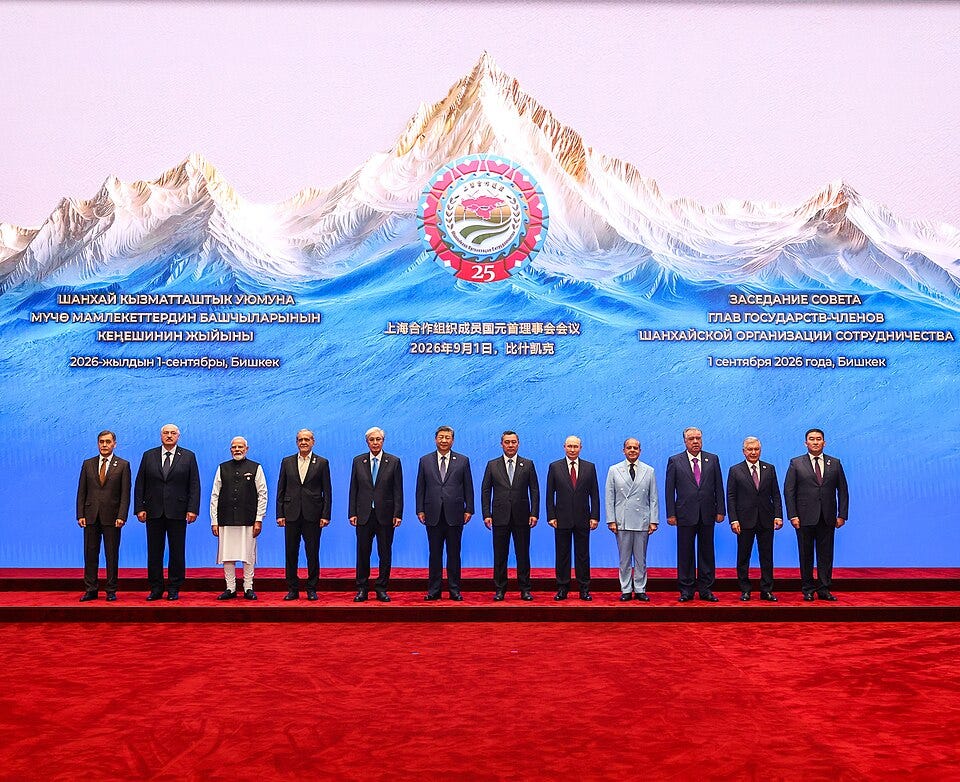

The ten SCO members adopted the Bishkek Declaration alongside 27 other cooperation documents. The declaration condemned military attacks against Iran that it said had caused civilian casualties and significant economic damage, expressed condolences on the death of Iranian Supreme Leader Ali Khamenei, reaffirmed Iran’s sovereignty and territorial integrity, and called for the conflict to be resolved through political and diplomatic means.
It also addressed another major source of pressure on Tehran. SCO members rejected unilateral coercive measures outside the framework of the United Nations and World Trade Organization and warned about their effects on the global economy. They separately reaffirmed the right of states under the Nuclear Non-Proliferation Treaty to research, produce and use nuclear energy for peaceful purposes without discrimination.
For Tehran, the significance is that this was not simply another statement of support from China and Russia. India, Pakistan and the Central Asian members signed the declaration as well, despite having very different relationships with both Iran and the United States. Turkey, Saudi Arabia and Qatar are also dialogue partners of the organization, giving the SCO a political reach beyond the countries usually associated with Iran’s “look East” strategy.
While the SCO is not an alliance committed to defending Iran, it does complicate Washington’s effort to turn military and economic pressure into broader international isolation. Countries that the United States would need to make such a strategy effective are publicly opposing attacks on Iran and rejecting unilateral economic coercion.
Yet Pezeshkian’s most important message in Bishkek may have been that Iran wants to use that support to strengthen its position, not to close the door on the United States. Speaking as renewed fighting threatens to undo months of regional diplomacy, Pezeshkian returned to the Islamabad memorandum that briefly halted the Iran-U.S. war in June. He accused Washington of violating an agreement bearing President Donald Trump’s signature less than two weeks after it was reached, but added that if the United States returns to its commitments, Iran will “immediately” reciprocate.
The setting made that offer particularly significant. Pezeshkian was offering Washington a diplomatic off-ramp from a summit where some of the world’s largest non-Western powers were simultaneously backing Iran against military attacks and unilateral economic pressure.
His meetings on the sidelines reflected the same effort to preserve multiple options. Pezeshkian met Russian President Vladimir Putin, with both sides discussing bilateral relations and ways to expand cooperation. Before the meeting, Kremlin spokesman Dmitry Peskov had said Pezeshkian would likely brief Putin on developments between Tehran and Washington.
Pezeshkian also spoke briefly with Chinese President Xi Jinping for several minutes on the sidelines, while Foreign Minister Abbas Araghchi held a separate meeting with Chinese Foreign Minister Wang Yi. The absence of a full Pezeshkian-Xi bilateral meeting has prompted some Iranian observers to question whether relations with Beijing are developing as Tehran had hoped, particularly after Iran appointed a special representative to oversee ties with China.
But there is not enough evidence to interpret the brief encounter as a change in Chinese policy toward Iran. It is not publicly known whether Tehran sought a formal meeting, and Beijing has its own reasons to carefully calibrate its relationship with Iran, including its much larger economic relationship with the United States and an interest in avoiding unnecessary confrontation with Washington. China’s decision to sign the Bishkek Declaration backing Iran against attacks and unilateral pressure is itself an important counterpoint to suggestions of a broader rupture.
Iran also tried to move the SCO discussion beyond political declarations. Pezeshkian proposed creating an SCO bank, an export and investment insurance union, and an energy consortium - mechanisms that could, at least in theory, make trade and investment among members less vulnerable to outside pressure. The documents adopted at the summit also included an action plan for developing ports and logistics centers across SCO countries through 2030.
These proposals come as Washington intensifies efforts to pressure Iran’s trading partners. Tehran has increasingly looked to China, Russia and neighboring states for trade, transportation and financial connections that are harder for the United States to disrupt. The question now is whether the political support Iran received in Bishkek can be converted into practical economic arrangements that actually reduce the impact of U.S. pressure.
While positive for Tehran, opposition to sanctions does not necessarily mean governments will accept the costs of defying U.S. secondary sanctions. India and the Central Asian states have important relationships with Washington, and even China balances its relationship with Tehran alongside much larger global interests. The SCO also offers Iran no equivalent of a collective defense guarantee.
Still, the summit challenges two simplified narratives about Iran’s position after months of war: that Tehran can simply be isolated into submission, or that China and Russia provide an alternative bloc capable of insulating it from the United States. Neither is quite true. Iran has more diplomatic and economic relationships than the first argument assumes, but those partners have interests and limits of their own. Tehran’s response appears to be to use those relationships to make isolation more difficult and increase its bargaining power, while continuing to pursue a negotiated exit from the conflict. That was ultimately the message Pezeshkian carried to Bishkek: Iran has partners willing to push back against attacks and economic pressure, but it is still leaving Washington a path back to diplomacy.
This is censored when compared to the sources, you have become such kun tanbul