

Iran is pursuing two measures to contain the pressure on household budgets: freezing prices for a limited basket of food staples in the capital and selling dollars directly to individuals to stabilize the currency market. The initiatives come as war, the U.S. naval blockade and expanding sanctions constrain the economy, while inflation erodes salaries and savings. A reported disagreement over how to spend a prospective Russian loan also highlights competing demands on the government’s resources.

The measures address different parts of the crisis. Tehran Municipality’s “Zero Inflation” program promises unchanged prices for selected foods for six months. The central bank’s intervention aims to ease pressure on the rial by making foreign currency available for purchase. Neither amounts to comprehensive protection against the rising cost of living.
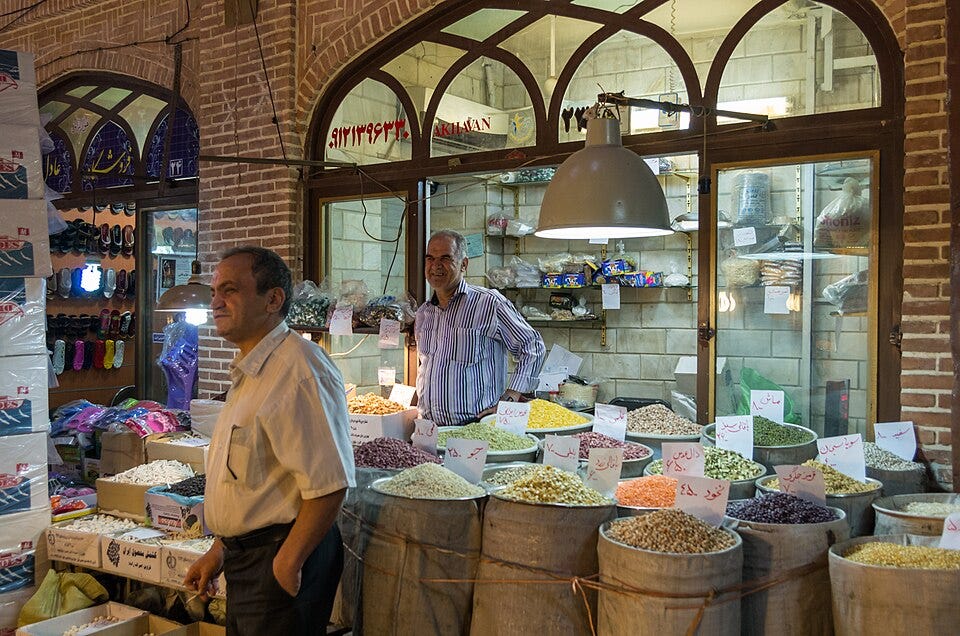
The municipal program began on September 29. According to Tasnim’s account of the launch, Mayor Alireza Zakani said an initial basket of 12 essential products would be offered at 108 municipal produce markets, with 18 Shahrvand stores joining afterward. The basket includes rice, meat, cooking oil, sugar, pasta, dates, soy products and several varieties of legumes. Chicken, tomato paste and cheese are scheduled to be added during Aban, the Iranian month beginning in late October.
“Zero Inflation” refers to the intended price freeze for those products within the program, not to inflation across Iran. Purchases are subject to household allocations based on family size. Residents can buy in person or through the Shahrzad platform, using electronic food-voucher credit, bank cards or a combination of the two.
Rent, healthcare and medicines, transportation, clothing, education and utility bills remain outside the food-price arrangement. Even purchases of food beyond the covered products and household allocations remain exposed to market prices. Families could receive meaningful help with groceries while still facing a rising overall cost of living.
Nor does freezing prices restore earlier affordability; rather, it halts any further increases from an already-high mark. An October 5 report by Mehr listedfrozen beef or lamb at 1.545 million tomans per kilogram, Indian rice at 280,000 tomans per kilogram and Pakistani basmati at 335,000 tomans. Holding those prices steady would prevent further increases within the program, but households would still need enough income or voucher support to purchase them. By comparison, in October 2025, several Pakistani super basmati brands were roughly half as expensive, priced between 160,000 - 220,000 tomans per kilogram.
President Masoud Pezeshkian on October 4 ordered the formation of a committee to develop mechanisms for stabilizing prices of goods covered by the national electronic food-voucher system, known as kalabarg. Its members include the central bank governor, the agriculture and interior ministers, the head of the Plan and Budget Organization, and Tehran’s mayor. Mayor Zakani subsequently identified Urmia, Mashhad and Ahvaz as cities that had expressed readiness to adopt the model. That indicates plans for expansion, underscoring that the same benefits are not yet available nationwide.
The urgency is evident in official statistics. According to the Statistical Center of Iran, consumer prices in Shahrivar, the month ending in September, were 89.8 percent higher than a year earlier. Twelve-month average inflation reached 73.6 percent, while prices rose 4.2 percent during the month alone.
The central bank is meanwhile attempting to contain the currency’s decline through direct dollar sales of up to $10,000 per person. The program offers foreign currency for purchase at rates close to the market; it is not a cash payment or a $10,000 benefit distributed to households.
The dollar has recently traded around 270,000 tomans, 2.7 million rials, on the open market. This represents a continued slide in the purchasing power of Iranian currency, having passed the 200,000 toman to dollar mark in mid-August. At the central bank’s dollar sale rate, buying the maximum allocation would cost approximately 2.7 billion tomans, placing it well beyond the means of many families struggling with daily expenses. Its intended household benefit would therefore come indirectly, if greater dollar availability helped stabilize the exchange rate and reduce pressure on prices.
In an October 6 interview on Iranian state television, Central Bank Governor Abdolnaser Hemmati said the bank had secured $2 billion for the currency market. He described the intervention as a demonstration to President Donald Trump and Treasury Secretary Scott Bessent that Iran did not lack foreign-exchange resources.
Hemmati attributed the currency’s rise primarily to inflation expectations, psychological pressure and capital flight, rather than a shortage of reserves. He said the market had reached relative stability following the intervention and that buyers under the new program had purchased an average of approximately $5,000 each. Those statements represent the central bank’s assessment; several days of trading cannot establish whether stabilization will last.
Hemmati also said Iran had provided $24.9 billion in foreign exchange from the beginning of the Iranian year through mid-Mehr, compared with $28 billion during the corresponding period a year earlier. He described the decline as roughly 12 percent, affecting some industrial needs while saying allocations for essential goods had not fallen and those for medicines had increased by 30 percent. These figures concern foreign-exchange provision. They do not, on their own, establish whether medicines or food have become more affordable or whether supplies have reached every community.
The governor said funds previously held through oil-trading intermediaries or insecure channels had been moved to safer locations. He also reported that approximately $21 billion in export earnings had not returned to the domestic economic cycle since the beginning of the previous Iranian year, with roughly $13 billion identified. His remarks highlight the importance of access to existing earnings alongside efforts to generate new revenue.
The government’s interventions are taking place under a physical blockade as well as escalating financial sanctions. Reuters reported on October 6 that Iranian oil exports had fallen to zero under the U.S. blockade, even as shipments from other Gulf producers recovered. The interruption of new exports constrains an important source of foreign currency and government revenue. Restrictions on banking and trade add further obstacles to financing and transporting supplies.
Against that background, the government’s economic coordination headquarters reviewed a proposed seven-point package on October 3. Tasnim reported discussions covering exchange-market instability, public revenue and expenditure, imports and essential goods, but its account did not provide a detailed breakdown of the package.
Municipal officials argue that advance purchasing, contracts with producers and fewer intermediaries can help sustain the food-price program. Economist Davoud Souri, speaking to Eghtesadnews in an interview carried by Iranian media, questioned its financing and what would happen after six months. His concern was whether the resources and financial consequences had been established before implementation.
A separate report about Russian financing illustrates the competition among immediate consumption needs, government revenue and investment in productive capacity. An October 6 report attributed to Fars and republished by Iranian outlets said Russia was ready to transfer a loan equivalent to $1 billion, but disagreement among Iranian agencies over its use had delayed Tehran’s submission of account details.
According to that account, the Plan and Budget Organization favored vehicle imports that would generate customs revenue. The Oil Ministry sought equipment for the petroleum sector, while the Agriculture Ministry wanted essential-goods imports. The report described the money as the first installment of a broader $20 billion loan understanding. It did not establish that the funds had reached Iran, and its explanation for the delay was not accompanied by responses from the agencies concerned.
Each proposed use serves a different objective. Food imports could support immediate household needs; petroleum equipment could help sustain or restore future earnings; vehicle imports could bring in customs revenue. No direct connection has been established between the Russian loan and funding for the food-price program. Together, however, the two stories show the difficult allocation decisions facing authorities under economic pressure.
For households, the test is practical: whether covered food remains available, whether support reaches beyond Tehran, and whether currency intervention produces lasting relief from price increases. A stable price for part of the grocery basket would help, but families must still pay for housing, treatment, transportation and the many other expenses outside the arrangement. The government’s response will ultimately be judged against that full household budget.