

Hossein Khajeh Amiri, the celebrated Iranian singer known by his stage name Iraj, died on Wednesday, August 12, at the age of 94. One of the most distinctive and powerful voices in modern Iranian music, Iraj’s career stretched from the golden age of Iranian radio and cinema before the 1979 revolution to a much quieter life after the establishment of the Islamic Republic.
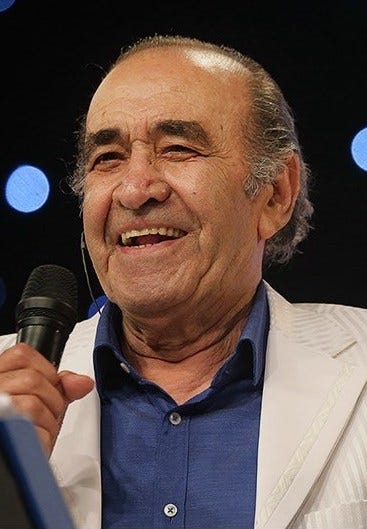

Born in 1933 in Khaledabad, near Natanz in Isfahan Province, Iraj came from a family with deep roots in the Isfahan school of Persian classical singing. His grandfather and father were steeped in the traditional vocal repertoire, and Iraj began singing as a child, including in religious passion plays. After moving to Tehran as a teenager, he continued his musical training and studied with Abolhasan Saba, one of the most influential figures in 20th-century Iranian classical music.
His unusual stage name was itself a product of the restrictions surrounding his early career. Khajeh Amiri was an army officer when he began performing on radio, at a time when military personnel were not permitted to sing publicly. To conceal his identity, he adopted the first name of his younger brother, Iraj, and the name remained with him for the rest of his career. He eventually retired from government service with the rank of lieutenant colonel.
Iraj’s breakthrough came through Iranian radio and, in particular, the legendary Golha programs created by Davoud Pirnia. Beginning in the 1950s, Golha brought together many of Iran’s most important singers, composers, poets and instrumentalists and became one of the central institutions of modern Persian music. Iraj became one of its best-known voices, performing a classical Persian repertoire alongside some of the country’s leading musicians.
His voice was remarkable for its range, volume and control. Mohammad Reza Shajarian, one of the most influential Iranian classical vocalists of the generation that followed him, described Iraj’s voice as a “measure and standard” in the history of Iranian singing. Other leading musicians, including Ali Tajvidi and Homayoun Khorram, similarly praised his ability to execute difficult vocal passages and traditional tahrir with unusual power and ease.
But Iraj’s cultural significance extended well beyond classical music. Unlike many traditional vocalists, he moved easily between the formal world of Persian dastgah music and popular songs written for mass audiences. His voice became inseparable from the popular cinema of the 1960s and 1970s, particularly through songs lip-synced on screen by superstar Mohammad Ali Fardin.
The 1965 blockbuster Ganj-e Qarun was particularly important in bringing Iraj’s voice to a mass audience. Fardin appeared on screen while Iraj supplied the singing voice, a combination repeated in other films and remembered by generations of Iranian moviegoers. Iraj later described his years singing for cinema as among the happiest and most successful of his life.
That versatility also made him controversial among some purists, who questioned why a singer trained in the classical tradition would perform popular, koocheh-bazari and film songs. Iraj defended the choice, arguing that his repertoire represented many different colors of Iranian music. His friend and contemporary Akbar Golpayegani similarly argued that Iraj understood something essential about performance: a singer also had to understand what ordinary people wanted to hear.
The 1979 revolution abruptly ended that world. As the Islamic Republic imposed sweeping restrictions on music, Iraj largely disappeared from public cultural life. He later said that he had not formally been declared banned, but that no one would give him work. For years, his singing was largely confined to private gatherings.
Unlike many prominent pre-revolutionary singers who left Iran, Iraj remained in the country. In later years, as restrictions eased somewhat, he resumed limited public activity and devoted part of his time to teaching younger singers, but he never returned to anything resembling the prominence he had enjoyed before the revolution.
His legacy nevertheless survived through recordings of the Golha programs, classical performances and the films whose stars once appeared to sing with his voice. His repertoire ranged from demanding traditional vocal performances to popular songs including “Pirahan-e Soorati,” “Parandeh,” “Az Hend Oumadam,” and compositions by some of Iran’s leading songwriters and composers.
Iraj’s stature among other musicians perhaps best explains why his death is significant beyond nostalgia for a famous singer. Hassan Kassai, the legendary master of the ney, famously called him the “Pahlavan-e Avaz” — the “Champion of Persian Singing.” Mohammad Reza Shajarian regarded Iraj as a predecessor and described his voice as a benchmark against which exceptional Iranian voices could be measured.
His death marks the loss of one of the last major voices connecting several worlds of Iranian culture: the classical tradition of the radif, the sophistication of the Golha radio era, and the immensely popular cinema and music culture of pre-revolutionary Iran. His music crossed generations, social classes and political divides, becoming part of the shared cultural memory of Iranians inside the country and across the diaspora.
NIAC extends its deepest condolences to Iraj’s family, loved ones, fellow artists, and the generations of Iranians who grew up with his voice. His extraordinary contribution to Persian music and Iranian culture will endure far beyond his passing. At a time when Iranians have endured war, repression, displacement and deep political divisions, figures like Iraj are also a reminder of the cultural heritage that continues to connect Iranians across borders and generations. His voice was part of that shared heritage, and its place in Iran’s cultural history will not be forgotten.