

Iran’s long-running gasoline imbalance is beginning to look less like a manageable economic problem and more like a serious vulnerability. Domestic gasoline consumption is again running well above production, the government says it cannot afford the imports it relied on last year, wartime damage has weakened parts of the refining system and the renewed U.S. naval blockade has made replacing the shortfall substantially more difficult.
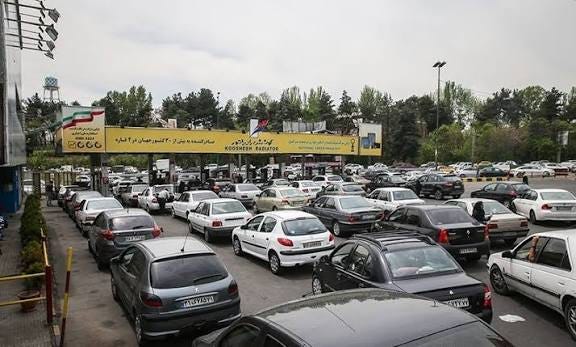
The impact is already becoming visible at the consumer level. Reports from Kurdistan describe drivers exhausting their subsidized allocations and then lining up early in the morning for station cards that provide only limited quantities of 5,000-toman gasoline. In some locations, according to IranWire’s reporting, the station allocation is exhausted by mid-morning. Similar, though scattered, reports of supply limitations have emerged from Tehran and other provinces. These reports do not yet demonstrate a nationwide physical shortage, but they show what the national “imbalance” looks like once the burden reaches individual filling stations.
Vice President Esmail Saqabe Esfahani, head of Iran’s Energy Optimization and Strategic Management Organization, acknowledged on state television that some provinces are already seeing stations exhaust their available gasoline supplies at certain locations. He said this was occurring “naturally” in some areas because, as he put it, “there really is no gasoline.”
Confusing announcements on gasoline pricing in Kerman Province have only added to the focus on the nation’s gasoline. Standard subsidized gasoline has been sold based on tiered pricing, with the first 60 liters sold in a month priced at 1,500 tomans, the next 50 liters at 3,000 tomans and another 40 liters sold at 5,000 tomans. Provincial officials announced that, beginning early Thursday, gasoline consumption above the existing subsidized tiers would be sold at what they described as the refinery cost: 87,200 tomans per liter (50 cents per liter). The Pezeshkian administration has empowered provincial governors to act with greater autonomy, and Kerman has been experiencing more severe shortages than other provinces.
But the experiment barely got started. Within hours, officials announced that the refinery-rate plan had been suspended following intervention by Kerman’s governor and consultations with national authorities. The governor subsequently insisted that there had been no change in gasoline prices and that the plan would not go forward for now.
Saqabe Esfahani now provided important context for what happened in Kerman. He said no national decision had been made to change gasoline prices and stressed that figures circulating in the media, including 87,200 and 23,000 tomans per liter, were not government-approved prices. But he also confirmed that the basic structure proposed in Kerman - preserving subsidized allocations while allowing additional consumption to be sold at an unsubsidized price - is one of three gasoline policies now under serious consideration by the government.
The extraordinary gap between 5,000 tomans - the third tier subsidized rate - and 87,200 tomans helps explain the government’s dilemma. Iran has spent years selling gasoline at a tiny fraction of its replacement cost, while consumption has continued to climb faster than domestic production. According to a new analysis published by the state news agency IRNA, Iran produced roughly 99 million liters of gasoline per day while consuming 87 million in 2019. By 2024, consumption reached around 130 million liters per day against production of about 112 million, leaving a daily deficit of approximately 18 million liters. According to Saqabe Esfahani, Iran is consuming roughly 135 million liters of gasoline per day while domestic production is approximately 121 million liters per day. That leaves a gap of roughly 14 million liters per day that must be covered through imports or strategic reserves.
The government, he said, is now in the final stages of choosing among three approaches to bring consumption closer to that available supply. The first would leave prices unchanged but limit distribution to roughly 121 million liters per day, meaning filling stations could stop dispensing fuel once their daily supplies were exhausted. The second is essentially the model proposed in Kerman: maintain subsidized allocations but sell consumption above them at an unsubsidized price. Under the third, roughly 30 million liters would be reserved for public transportation and the remaining 91 million liters would be allocated to people rather than vehicles. Soqabe Esfahani stressed that none of the three has yet been approved and said any final policy would be explained publicly before implementation.
Saqabe Esfahani framed the same problem as an increasingly difficult budgetary choice. He said direct gasoline imports cost approximately $2.7 billion last year and estimated that continuing imports could require roughly $4.5 billion this year. The question, he said, is whether scarce foreign currency should be spent on gasoline when the country also needs to finance higher-priority imports such as medicine and essential goods.
The present crisis cannot be explained by the war alone. Iran’s gasoline problem was already structural before the first bombs fell. Aging and inefficient vehicles, weak public transportation, rapid growth in private-car use, highly subsidized fuel and large price differences with neighboring countries have all contributed to demand growth and smuggling. IRNA itself concludes that repeated rounds of rationing and price increases over the past two decades have slowed consumption only temporarily rather than changing the underlying trend. Some projections indicate gasoline demand could rise to roughly 162 million liters per day by 2029 while production reaches only about 129 million, which would leave a deficit above 30 million liters per day.
Critically, the war has removed many of the mechanisms the government previously used to manage the gasoline production imbalance. Iran’s refining system suffered substantial wartime disruption. The Isfahan and Abadan refineries were among facilities struck during the initial U.S.-Israeli campaign, while the Persian Gulf Star refinery - the country’s largest gasoline producer - was impacted by disruption to condensate supplies from South Pars after strikes around Asaluyeh. Fuel-storage facilities in Tehran and Alborz were also struck. Iran’s National Oil Refining and Distribution Company maintained that nationwide distribution continued, but the broader damage reduced the flexibility of a system that was already struggling to match demand.
The second escape valve was imports. President Masoud Pezeshkian has now publicly acknowledged that importing gasoline has become much more difficult, and suggests that the government no longer has the money to continue importing gasoline at the same level. He also explicitly tied the problem to the renewed U.S. naval blockade, saying Iran is “under blockade” and cannot import gasoline through its normal routes.
This makes the blockade relevant to the gasoline crisis even though Iran is itself a major oil producer. Crude oil underground is not the same thing as usable gasoline at a filling station. Iran has to refine sufficient volumes domestically or import the difference. While wartime strikes impaired refining and energy infrastructure, the maritime blockade has restricted oil-export revenue and normal import routes. That combination leaves Tehran with fewer dollars to pay for fuel imports, fewer options to import and at precisely the moment when the domestic supply system is under greater pressure.
Smuggling complicates the picture further, particularly along Iran’s eastern and western borders. The huge difference between subsidized Iranian fuel prices and prices across the border creates powerful incentives for illicit trade. Officials cited smuggling concerns as part of the rationale for tighter access in border provinces and for the announced pricing change in Kerman. But these measures also place the cost of enforcement on ordinary residents, who can find themselves rationed because the government has been unable to control larger trafficking networks.
Diesel presents a somewhat different picture. The government maintains that diesel supply has remained stable and says imports have now fallen to zero, portraying this as evidence that the distribution system survived both rounds of war without a national shortage. But that national claim coexists with increasingly frequent complaints at the sectoral level. Farmers have warned that diesel allocations are insufficient for combines and agricultural machinery, while truck drivers have long complained that fuel allocations calculated from recorded mileage do not always correspond to their actual consumption.
Iran appears closer to an acute crisis in gasoline than in diesel, but tighter diesel rationing would potentially have broader economic consequences. Trucks move food and industrial goods across a vast country; diesel powers agricultural machinery, mines, construction equipment and backup generators. A serious disruption in diesel supply therefore would not simply create lines at filling stations. It could quickly increase transportation costs, disrupt agricultural production and feed directly into prices throughout the economy.
All three potential approaches under discussion to manage the problem impose a cost somewhere: keeping prices unchanged while limiting physical supply risks shortages and lines at filling stations; charging an unsubsidized price above existing allocations transfers more of the cost to heavier consumers; and allocating gasoline to individuals rather than vehicles would fundamentally restructure a subsidy system that has existed for years. The alternative - continuing to fill the gap through imports - requires billions of dollars in scarce foreign currency at a time when the government says both its finances and access to external supplies are constrained.
The last option carries its own political history. Iran’s last major gasoline price shock, in November 2019, triggered nationwide protests that were met with lethal repression. That memory helps explain the government’s caution. Saqabe Esfahani said Pezeshkian has specifically instructed officials that any change involving gasoline must first be discussed with the public, including the available alternatives and the reasons for the government’s eventual choice. He said any approved policy would be explained several weeks before implementation.
For now, Iran is still supplying gasoline nationwide. That is an important distinction from a nationwide fuel shortage. But the system is increasingly being held together through quotas, restrictions, existing refinery output and efforts to suppress demand at precisely the moment when the government has less money, less refining flexibility and fewer avenues for imports.
The gasoline “imbalance” that Iranian officials have warned about for years is therefore entering a new phase. The structural problem was created at home, through years of distorted pricing, inefficient vehicles, inadequate public transportation and failure to restrain demand. But the war and blockade have sharply reduced the government’s ability to manage that problem. The aborted Kerman plan is now particularly revealing: the 87,200-toman price was not national government policy, according to Soqabe Esfahani, but the underlying model is one of three options Tehran is seriously considering. Another would avoid a price increase altogether but accept the possibility that filling stations simply run out once the country’s available supply has been distributed. The government is no longer debating whether Iran has a gasoline imbalance; it is deciding who will bear the cost of closing it.”