

The situation remains tense between Iran and the United States as a series of explosions in the Strait of Hormuz, reports of attacks on Iran’s southern coast, and an expanding American military presence coincide with a new round of regional mediation. Today, Friday, October 30, a Qatari delegation arrived in Tehran for talks with Iranian officials, just one day after the commander of U.S. Central Command briefed President Donald Trump at the White House on possible military options against Iran.
The developments come ahead of the November 3 U.S. midterm elections, which has loomed large in statements, commentary and analysis on the Iran war. Widespread reports indicate that Washington and Israel are considering another major military campaign against Iran after the vote to determine the make-up of the U.S. Congress for the next two years. At the same time, the return of Qatari mediators, continuing regional consultations, and a recent letter from Vice President JD Vance to Tehran suggest that diplomatic efforts have not been abandoned.
Iran’s state news agency IRNA confirmed today, on Friday, October 30, that a Qatari delegation had arrived in Tehran for discussions with senior Iranian officials on bilateral relations and regional developments. Reuters separately reported, citing an official familiar with the negotiations, that the visit was part of efforts to reach a U.S.-Iran agreement and had been coordinated with Washington.
The visit followed Qatar’s presentation of a draft peace proposal earlier in the week. A senior Iranian official described the proposal as unacceptable, with disagreements remaining over the sequence of negotiations. Washington wants Iran’s nuclear program addressed from the beginning, while Tehran insists that the United States first end its blockade of Iranian ports and remove restrictions on Iranian oil exports, following a familiar sequence to the previously-agreed Memorandum of Understanding from June.
The renewed diplomatic activity comes against a backdrop of increasingly dangerous incidents in and around the Strait of Hormuz. On Thursday, October 29, Iran’s Islamic Revolutionary Guard Corps (IRGC) Navy announced that three oil tankers had exploded and caught fire after entering what it described as an unauthorized southern shipping corridor. According to the IRGC, the vessels had disabled their tracking equipment, ignored warnings, and entered waters containing naval mines.
The announcement followed an Iranian military claim on Tuesday, October 27, that another tanker had struck a mine east of the strait. Iranian authorities have reported multiple tanker incidents within several days, although the identities of the vessels and the causes of the explosions have not been independently established.
Britain’s United Kingdom Maritime Trade Operations (UKMTO) separately reported a vessel on fire near Khasab, Oman, while other maritime reports described attacks involving unidentified projectiles. These accounts confirm serious incidents affecting commercial shipping but do not establish that mines caused all the explosions reported by Tehran. Iran’s explanation of mines is viewed by many to be a stand-in for the true cause of many of the attacks: drones and missiles fired by its military forces, thus allowing authorities to obfuscate the nature of the attacks.
On Friday, October 30, Iranian media also reported further confrontations involving vessels attempting to navigate routes that the IRGC considers unauthorized. The incidents have renewed a dispute over who controls passage through the waterway. Iran insists that commercial ships follow designated routes under its supervision, while the United States has sought to establish alternative corridors that bypass Iranian restrictions with some degree of success.
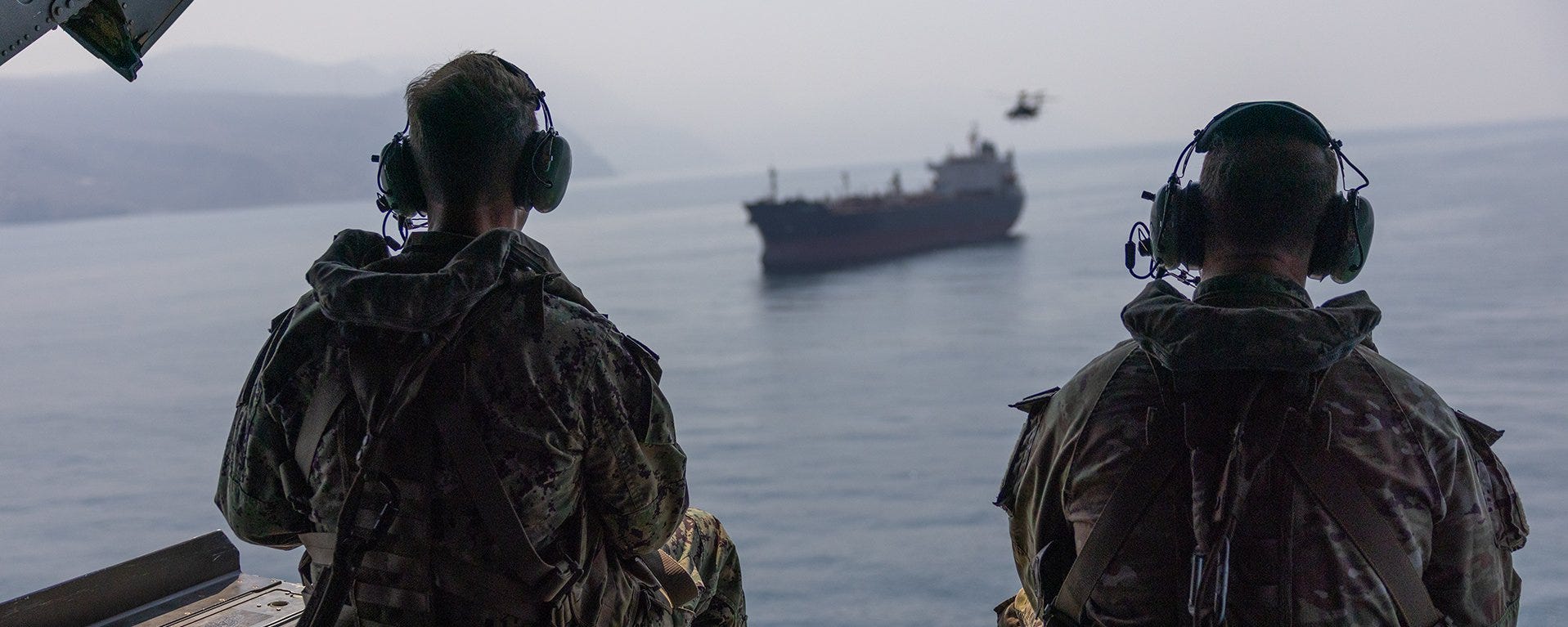
CENTCOM Commander Brad Cooper visited the Strait of Hormuz on Sunday, with published photos showing him flying in a Chinook helicopter overseeing the passage of a commercial vessel through the waterway. CENTCOM’s press release on the visit asserted that the U.S. had successfully cleared the shipping lanes of sea mines, stating “over 95% of ships navigating the Strait of Hormuz have sailed through safely despite the IRGC’s unwarranted aggression, clearly demonstrating that the United States and regional partners control the international waterway.”
The maritime confrontation has been accompanied by reports of explosions along Iran’s southern coastline. Late Thursday, October 29, and early Friday, October 30, residents and Iranian media reported explosions around Qeshm Island and the coastal area of Sirik in Hormozgan Province. IRNA acknowledged reports of explosions and lights in the sky, while Tasnim attributed some of the activity to Iranian forces intercepting what it described as a hostile aircraft. Other accounts suggested that American forces had targeted an Iranian missile launcher on Qeshm or military facilities near Jask. However, the available evidence does not independently establish that these explosions resulted from American strikes, and the reported targets and damage remain unconfirmed.
The explosions near the southern coast are part of a wider series of incidents reported in several parts of Iran over recent days. On Sunday, October 25, reports emerged of explosions and air-defense activity in Tehranpars, northeastern Tehran, as well as an explosion near villages in the Sirik area of Hormozgan Province. On Wednesday, October 28, an explosion was also reported in Isfahan, although its cause was not independently established.
Iranian authorities have offered explanations for some of these incidents, including controlled detonations of unexploded military ordnance left from earlier fighting. Such operations were announced in locations including Qasr-e Shirin in Kermanshah Province, Dezful in Khuzestan, and areas south of Isfahan. Officials said the detonations were conducted to dispose of dangerous munitions.
These official explanations do not necessarily account for every reported explosion. There is currently insufficient evidence to establish a connection among all the incidents or conclude that they represent a coordinated campaign. Nevertheless, the occurrence of suspicious explosions in several geographically separate locations within a matter of days raises questions about their causes, particularly amid reports of renewed American military preparations.
Iranian military officials also claimed on Thursday, October 29, that their forces had intercepted an American MQ-1 drone east of the Strait of Hormuz and taken control of another unmanned aircraft through electronic warfare. Washington disputed elements of the Iranian account.
Meanwhile, the United States appears to be reinforcing its military presence in the Middle East, with recent reports suggesting deployments of the USS Theodore Roosevelt carrier strike group and the USS Makin Island amphibious ready group to the Middle East region. These deployments would involve thousands of additional sailors and Marines, combat aircraft, helicopters, and naval equipment. American officials have not characterized every deployment as preparation for an imminent attack, and some movements may be part of scheduled rotations. However, the expanded presence gives Washington additional capabilities for sustained air and maritime operations against Iran.
On Thursday, October 29, Admiral Brad Cooper, commander of U.S. Central Command, met Trump at the White House, alongside Defense Secretary Pete Hegseth, Joint Chiefs Chairman General Dan Caine, Vice President JD Vance, Treasury Secretary Scott Bessent, and other senior officials. According to Axios, Cooper briefed Trump on the effectiveness of the American naval blockade, efforts to escort commercial tankers through the Strait of Hormuz, and the economic pressure campaign coordinated with the Treasury Department. Sen. Chris Murphy (D-CT) has suggested that the Trump administration’s war plan is “insane” and conflicts with America’s responsibility to uphold the laws of war, pointing at plans to massively target Iranian civilian infrastructure.
Diplomatic contacts with regional interlocutors have continued to be extensive. Prior to the Qatari delegation’s visit to Tehran, President Masoud Pezeshkian met Qatar’s Emir Sheikh Tamim bin Hamad Al Thani in Moscow, where the two discussed the war and efforts to reduce tensions. Saudi Arabia, Turkey, Pakistan, and other regional governments have also been involved in consultations.
Foreign Minister Abbas Araghchi said on Wednesday, October 28, that Iran remained in close contact with intermediaries and was considering proposals related to its own plan for ending the conflict. Tehran has maintained that any agreement must address the American blockade, restrictions on Iranian oil exports, and guarantees against renewed attacks.
Along with Vice President Vance’s letter, these contacts suggest that Washington is keeping diplomatic options available even as it expands its military capabilities. Yet it appears as if Washington is open to a cave from Tehran amid escalating military pressure, rather than preparing to make necessary concessions to end the war on a permanent basis mindful of restraints on Iranian leaders.
The Strait of Hormuz remains central to the stand-off. Tehran regards its ability to restrict maritime traffic as an important source of leverage against American military and economic pressure. Washington, meanwhile, is attempting to maintain commercial passage without accepting Iran’s conditions, undermining Iranian leverage with a considerable deployment of American military assets.
The confrontation also carries substantial economic and civilian consequences. Continued disruptions threaten energy exports from Persian Gulf producers, increase shipping and insurance costs and complicate commercial transportation. For Iran, military operations along the southern coast and restrictions on maritime trade threaten ports, fishing communities, transportation networks, and businesses already struggling with the consequences of war.
The developments of the past week could still plausibly point in two directions at once. The American military buildup, high-level planning meetings, and continuing confrontations in the Strait of Hormuz provide evidence of preparations for possible renewed fighting. At the same time, the Qatari delegation’s return to Tehran, regional mediation, and continuing communications between Washington and Iranian officials indicate that negotiations remain an active possibility.
Neither set of developments establishes what will happen next. Military preparations may strengthen Washington’s position in negotiations, but they could also lead to further confrontation, particularly if incidents involving ships, aircraft, or coastal installations produce casualties or trigger retaliation. With the U.S. midterm elections approaching and regional mediators continuing their efforts, the coming days may prove extraordinarily consequential on whether the current escalation is a prelude to another major round of war.