

Iran is experiencing a converging economic, political, and security crisis marked by record-breaking currency depreciation, sharp price volatility, and expanding street protests, particularly among shopkeepers and market traders. What began as localized economic protests has rapidly evolved into broader unrest, unfolding alongside austere budgeting, institutional deadlock between the government and parliament, renewed international sanctions, and unusually stark wartime rhetoric from senior officials.
On Sunday, December 28, large numbers of shopkeepers and citizens gathered in Tehran, particularly along Republic Street, around Aladdin Mobile Mall, and in Shoush Iron Market, chanting protest slogans and calling on other merchants to join them. Videos circulating on social media show widespread store closures or semi-closures, especially inside Aladdin Mall and in parts of the Grand Bazaar, including Saray-e Ahan-garan and Cheragh Bargh. Protesters were heard chanting “Don’t be afraid, we are all together,” and some marched from inside Aladdin Mall toward Hafez Bridge at the intersection of Republic and Hafez streets.
As of this week, demonstrations expanded geographically and intensified greatly, with protests reported in Saadi Street, Istanbul Square, and other parts of Tehran. Video evidence suggested larger turnout and broader dispersion than on the first day. At the same time, similar protests emerged outside the capital, including in Qeshm Island, where shopkeepers in Dargahan closed their businesses and chanted anti-government slogans, underscoring the national dimension of the unrest. The cities of Kerman and Hamadan also saw protests.
These protests coincided with extreme turbulence in Iran’s currency and gold markets. During Sunday’s trading, the U.S. dollar surged beyond 144,000 tomans, the euro exceeded 169,000 tomans, and the British pound reached approximately 194,000 tomans. The Emami gold coin climbed to 169 million tomans, marking an increase of more than 10 million tomans in a single day, while one gram of gold approached 6 million tomans. Although prices eased slightly later in the day, the rapid and repeated spikes triggered panic among traders, leading many merchants and currency dealers to suspend transactions altogether. Numerous official exchange offices reportedly closed, some posting notices stating that no currency trading would take place.
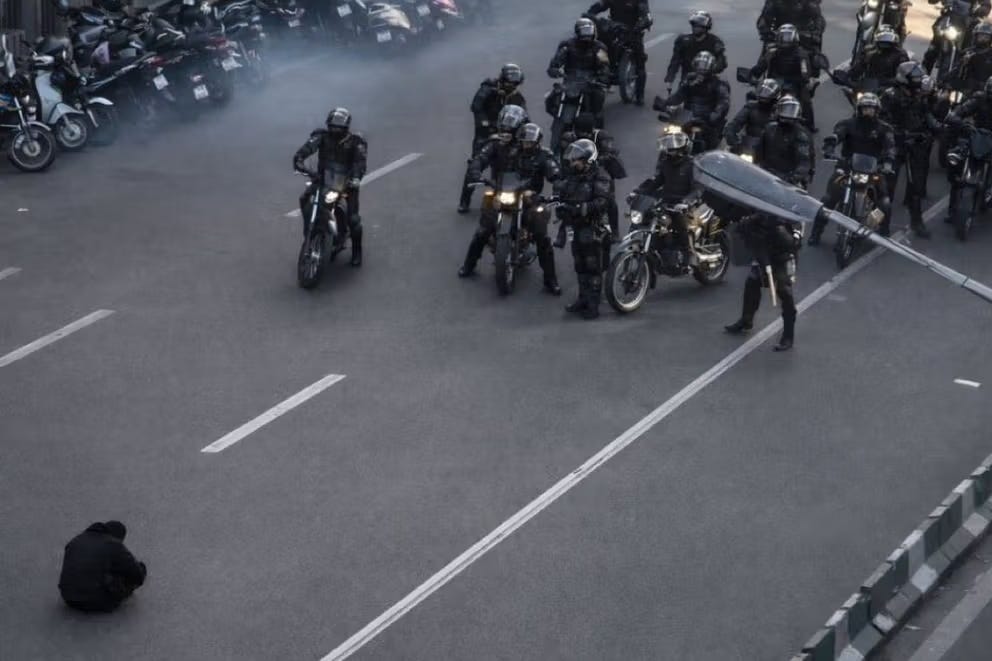
As protests continued into a second day, security forces intervened. Videos documented police and anti-riot units deploying tear gas to disperse demonstrators near Aladdin Mall, Hafez Bridge, and Bagh-e Sepahsalar. Footage showed blocked streets, burning trash bins, and a heavy riot police presence. Protest slogans increasingly went beyond economic grievances, including explicit political chants and direct criticism of security forces, reflecting growing politicization of the unrest.
Against this backdrop, Masoud Pezeshkian delivered unusually stark remarks in a rare interview published on a website affiliated with Ali Khamenei. Pezeshkian described Iran as being engaged in a “full-scale war” with the United States, Israel, and Europe, characterizing it as more complex and damaging than the eight-year Iran–Iraq war. He argued that Iran is now under economic, financial, political, and psychological siege, rather than facing a conventional battlefield.
Pezeshkian explicitly linked current economic hardship to the return of international sanctions following the activation of the UN snapback mechanism by Britain, France, and Germany, as well as to declining oil revenues, stating that Iran’s oil price has fallen from roughly $75 to $50 per barrel, reducing national income by $25 per barrel. He also pointed to disruptions caused by the recent 12-day war with Israel, which he said reduced production and services. Despite these pressures, the president announced plans to convert approximately $2.5 billion into domestic currency before Norooz to finance voucher-based subsidies (kalabarg) for targeted populations.
These remarks coincide with the government’s proposed 1405 budget, widely viewed by analysts as austerity-oriented. The draft budget includes a projected 70 percent reduction in revenues from oil sales, bond issuance, and oil-for-product barter arrangements, alongside a proposed 20 percent wage increase for public sector employees—less than half of the official inflation rate, which exceeded 42 percent according to Iran’s Statistics Center. Pezeshkian acknowledged deep “imbalances” across key sectors, including energy, water, public finance, and governance, while stating that revenue from fuel price adjustments would be redistributed through vouchers rather than used to cover deficits.
Iran’s parliament rejected the overall framework of the budget. Mojtaba Yousefi, spokesperson for the Joint Budget Committee, cited inflationary risks, unrealistic revenue assumptions, and declining purchasing power. However, parliamentary criticism revealed a central contradiction: lawmakers warn that insufficient revenues could force borrowing and fuel inflation, while simultaneously demanding higher wages, pensions, and increased spending in areas such as development and defense—without identifying credible new revenue sources. In a parliamentary session, Pezeshkian openly challenged MPs, asking where the money should come from, and warning against reliance on “illusory revenues and unavoidable costs.” Past experience suggests that parliament has often resolved such tensions by expanding expenditures while inserting unrealistic revenue projections, deferring fiscal consequences to later in the year.
Amid the currency turmoil and protests, the government also signaled a shift in monetary leadership. Mehdi Tabatabaei, deputy for communications at the presidency, announced that by presidential decision Abdolnasser Hemmati will become Governor of the Central Bank of Iran. While state media have not formally confirmed the departure of Mohammad Reza Farzin, semi-official outlets widely report his removal. Hemmati previously served as central bank governor under the Rouhani administration and was recently impeached and removed as economy minister, underscoring deep political divisions over economic management.
Taken together, these developments point to a compound crisis in which currency collapse, austerity budgeting, renewed sanctions, and wartime framing reinforce one another. The persistence and geographic spread of protests—combined with security force intervention and institutional deadlock—highlight deep domestic vulnerabilities, including eroding purchasing power, collapsing market confidence, and unresolved contradictions in economic governance. Absent credible revenue planning, coherent monetary–fiscal coordination, and tangible protection for household incomes, economic shocks are likely to remain a powerful trigger for further unrest in the months ahead.