

The United States and Iran carried out their heaviest exchange of attacks in weeks on Tuesday night and Wednesday morning, widening a confrontation that has become a contest over which side can absorb military, economic and political pressure for longer. The latest round also offered a clearer picture of the strategies taking shape on both sides: Washington is trying to degrade Iran’s ability to disrupt the Strait of Hormuz while tightening its economic isolation, while Tehran is attempting to demonstrate that it can continue retaliating across the region, keep pressure on shipping and rely on economic and diplomatic relationships with countries unwilling to join the U.S. campaign.

U.S. Central Command said American forces struck Iranian air-defense systems, radar sites, maritime assets, mine-laying capabilities and communications facilities linked to the Islamic Revolutionary Guard Corps. Iranian officials said more than 40 locations across southern, western and central Iran were hit, with attacks reported in Hormozgan, Khuzestan, Kermanshah, Kerman and along the Persian Gulf and Gulf of Oman coasts. Iranian state television also reported a strike near the runway at Jiroft airport, although local officials said there were no casualties and the runway and airport buildings were not damaged.
The pattern of targets suggests that a major American objective was degrading Iran’s ability to threaten shipping through the Strait of Hormuz while locating and destroying the missile, drone and maritime systems Tehran can use to retaliate. CENTCOM specifically identified Iranian maritime assets, mine-laying capabilities, radar and communications systems among its targets, while U.S. reporting has indicated that anti-ship cruise-missile and drone launchers were also attacked.
Four members of the IRGC Aerospace Force were also reported killed in Kermanshah. Iranian authorities have not said what they were doing when they were killed or identified the specific target of the U.S. strike. But the timing raises an important possibility. Iran’s Aerospace Force was conducting missile operations against U.S. bases across the region that night, while Iranian authorities separately reported shooting down an American drone near Khomein. Taken together, those developments suggest U.S. drones or other surveillance and strike assets may have been operating over Iran as Iranian forces were launching their retaliation. It is therefore plausible that the Aerospace Force personnel killed in Kermanshah were operating or preparing a missile launcher when they were located and struck. There is not yet enough evidence to establish that, however, and it remains an analytical inference rather than a confirmed account of the strike.
The apparent strategy is significant. Rather than attempting a single decisive attack on Iran’s military, Washington appears to be trying to suppress the capabilities Tehran uses to impose costs on commercial shipping and American forces around Hormuz
The human cost inside Iran was also substantial. Iranian authorities reported military casualties in several provinces. In addition to the four IRGC Aerospace Force personnel killed in Kermanshah, local officials reported three Basij members killed on Lavan Island. In Khuzestan, provincial authorities said seven people were killed and eight wounded in strikes around Ahvaz and Aghajari.
The most serious reported civilian incident occurred in Kohestak, a coastal village in Sirik County in Hormozgan, where a U.S. strike hit a residential location hosting a wedding. The head of Hormozgan University of Medical Sciences said four people were killed - including two children, the youngest only four years old - and 65 wounded. Earlier Iranian reports put the toll at five dead and as many as 68 injured. Several of the wounded remained in intensive care, and images published by Iranian media showed civilian casualties, including children.
New evidence has raised additional questions about what happened. Open-source researchers geolocated the house where the wedding was taking place roughly 130 meters — about 430 feet — from a communications tower that was also struck. Imagery from the scene indicates that the residential building itself was hit, while weapons analysts examining debris reportedly recovered there have identified components consistent with a U.S.-made SLAM-ER precision-guided cruise missile, although that identification has not been officially confirmed.
Iranian officials have called the Kohestak strike a war crime. CENTCOM, responding to reports of civilian casualties, said it was aware of the incident and maintained that U.S. forces do not target civilians, but that Iran’s Islamic Revolutionary Guard Corps does. The United States has not yet publicly explained whether the residential building was itself a target, what it believed was located there, or how a precision-guided weapon came to strike a wedding gathering more than 100 meters from the communications tower that was also attacked.
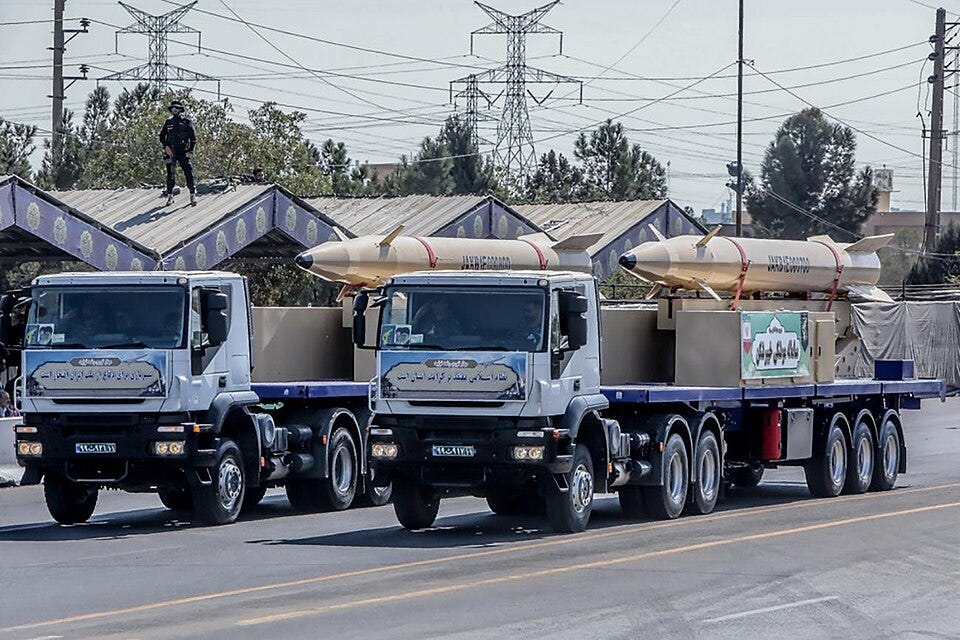
Iran began retaliating within hours, and the geographical breadth of its response was notable. The IRGC and regular army announced missile and drone attacks against U.S. military positions in Jordan, Bahrain, Kuwait, the United Arab Emirates and Erbil in Iraqi Kurdistan. Regional governments confirmed incoming Iranian missiles or drones in several of those countries, although Tehran’s claims about the damage inflicted remain largely unverified.
One of the most consequential Iranian claims involved Camp Titin, a U.S. Marine Corps facility roughly 15 kilometers south of Aqaba on the northern Red Sea, close to Jordan’s borders with Saudi Arabia and Israel. U.S. military records show that Titin has long been used for American-Jordanian training, including exercises involving Marines, rapid-response forces and maritime infrastructure protection. The IRGC said it subjected the camp to a ballistic-missile attack and claimed American personnel were killed and helicopters and other facilities damaged. Jordan confirmed that 13 Iranian ballistic missiles entered its airspace, saying ten were intercepted and three landed in remote areas. U.S. officials, however, said there were no American casualties or significant damage at Camp Titin.
The missile attack on Jordan is therefore confirmed, but whether Iranian missiles penetrated the defenses and struck Camp Titin — and whether anyone was killed there — remains contested. There is not yet satellite imagery, casualty information or other independent evidence supporting Tehran’s claims of American deaths.
The choice of Titin nevertheless matters. Unlike the larger air bases usually associated with the American military presence in Jordan, Titin sits near Aqaba and has been used by U.S. Marines for training and maritime-security missions. Iran separately said it targeted facilities associated with American RQ-4 and MQ-9 drones at Prince Hassan Air Base. Taken together, the claims suggest Tehran was selecting different components of the U.S. military network in Jordan to do damage rather than simply firing missiles toward a single symbolic target.
Iran also expanded its response across the Gulf. The regular army said dozens of attack drones targeted radar systems and American positions at Al Dhafra and Al Minhad in the UAE and struck Sheikh Isa Air Base in Bahrain with Arash drones. Kuwait reported hostile drone activity, including a drone that caused a fire at a residential complex in Kuwait City. The extent of damage to U.S. facilities remains unclear, but the attacks demonstrated that Iran retains the ability to launch missiles and drones toward several countries simultaneously despite months of sustained military pressure.
Tehran is simultaneously making clear that the Strait of Hormuz remains central to its strategy. The IRGC said two tankers were damaged Wednesday after entering a mined route in the strait, although the circumstances have not been independently verified. That came after two supertankers carrying Saudi crude were struck while transiting Hormuz on Monday.
Iranian officials have increasingly made the connection explicit. Parliament Speaker and chief negotiator Mohammad Bagher Ghalibaf said this week that if Iran is prevented from exporting oil through the Persian Gulf, “no one will be able to export oil.” He warned that further tightening of what Tehran describes as the American maritime blockade would receive a military response.
The United States is now expanding that confrontation to Iran’s own tanker fleet. Axios reported, citing U.S. officials, that American drones struck the engine rooms of two Iranian government-owned oil tankers anchored off Iran’s coast during the latest operation. One U.S. official described the approach as a new “tanker for tanker” policy approved by Trump: Iranian attacks on tankers transiting Hormuz could be answered with attacks on Iranian tankers.
The apparent policy exposes a tension in Washington’s strategy: the United States says its operations around Hormuz are intended to make commercial passage safer and restore energy flows, but the logic of “tanker for tanker” might not deter Tehran from attacking other ships when its own tankers are effectively blocked from exporting. The U.S. blockade has already reduced Iran’s ability to export its own oil to a fraction of prewar levels. Destroying or disabling additional Iranian tankers therefore imposes another cost on Tehran without necessarily giving it a stronger economic incentive to protect the exports of neighboring oil producers.
Indeed, if Iranian leaders conclude that their own ability to benefit from an open Strait has largely been removed, attacking Iranian tankers could reinforce rather than weaken Tehran’s argument that other countries should not be allowed to export normally while Iran cannot. Whether the new approach deters Iranian attacks on shipping or gives Tehran another incentive to escalate around Hormuz will be an important test of the American strategy.
The threat has implications far beyond Iran. Saudi Arabia possesses one of the region’s most extensive systems for bypassing Hormuz through its East-West Pipeline to Yanbu on the Red Sea. But Saudi crude exports from its Persian Gulf and Red Sea terminals averaged only about 3.23 million barrels per day during the first 23 days of August, according to shipping data analyzed by Bloomberg - on track to be the lowest monthly level since the Iran war began. The previous wartime low was about 3.65 million barrels per day in May, compared with more than 6 million barrels per day of Saudi crude that historically moved through Hormuz before the war.
Saudi Arabia initially responded to the disruption by pushing much larger volumes through its roughly 746-mile East-West Pipeline to Yanbu, with flows reportedly rising to around 4.4 million barrels per day and at times approaching 5 million. But threats to Red Sea shipping have complicated Riyadh’s ability to rely on that route as a secure alternative, forcing exporters to balance the risks at both ends of the peninsula.
The broader lesson after six months of war is that bypassing Hormuz is much easier on paper than in practice. Even Saudi Arabia, with the largest alternative pipeline system, has not been able to fully insulate its oil exports from the conflict. When insecurity in Hormuz is combined with threats along the Red Sea route, disruption can follow Saudi oil regardless of which coast it uses.
That gives Iran leverage, but it also creates significant risks for Tehran. Iran’s Khatam al-Anbiya Central Headquarters warned regional governments Wednesday that cooperation with the U.S. military could bring “dangerous consequences,” while the Foreign Ministry called on neighboring states to prevent American forces from using their territory to attack Iran. Attacks involving the territory of Jordan, Kuwait, Bahrain and the UAE - and threats to Saudi shipping - can deepen tensions with governments that warned against the Iran-U.S. conflict and have supported a peace deal to end it.
Washington, meanwhile, is trying to match military pressure with its broader campaign of economic isolation to degrade Iran’s ability to enforce its position in Hormuz while restricting the commercial and financial networks that allow Tehran to sustain a prolonged confrontation. Treasury Secretary Scott Bessent said Wednesday that airlines, shipping companies and digital assets could become the next targets of U.S. measures against Iran. His message to governments and businesses, he said, was to “distance yourselves” from Tehran. Bessent also warned that companies doing business with the IRGC could face sanctions and said Washington was tracking IRGC-linked assets and financial structures around the world.
Iranian officials appear to be thinking in similarly integrated terms. Supreme National Security Council Secretary Mohsen Rezaei said after the latest attacks that Washington would soon see a “new Iranian strategy” on the battlefield, in diplomacy and in confronting the economic siege. He did not explain what that strategy would entail. But the emerging pattern suggests Tehran may be attempting to connect military retaliation, pressure on regional shipping and efforts to keep trade and financial channels open through Russia, China and neighboring states.
That effort was particularly visible during President Masoud Pezeshkian’s trip to the Shanghai Cooperation Organization summit in Bishkek. In his meeting with Pezeshkian, Russian President Vladimir Putin publicly acknowledged that Moscow was helping Iran through what he described as a “difficult period,” including by providing essential goods, and indicated that Russia would continue that assistance. Russian officials also said Putin and Pezeshkian discussed the Bushehr nuclear power plant in detail, with Russian specialists preparing to participate in scheduled maintenance there.
For Iran, this kind of assistance could be more important to its ability to endure a prolonged war than direct military support. Tehran’s challenge is not simply preserving missiles and launchers, but keeping essential imports moving and preventing the combined effects of war, blockade and sanctions from producing an economic breakdown. Russian supplies - alongside continued trade with China and Iran’s neighbors - could therefore become an important part of Tehran’s effort to withstand Washington’s strategy of military and economic attrition.
China has meanwhile sharpened its diplomatic criticism of military intervention. After Bishkek, Xi Jinping traveled to Egypt, where he and President Abdel Fattah el-Sisi called for an end to foreign interference in the Middle East. For Tehran, the important question is not whether China or Russia would join the war militarily - neither Iran nor its partners appear to be seeking that - but whether they can help Iran withstand U.S. pressure through trade, essential supplies, financial channels and resistance to broader sanctions enforcement. That kind of economic and diplomatic backing could make Bessent’s effort to isolate Iran considerably more difficult.
The United States faces an increasingly concrete constraint of its own: the depletion of key munitions needed to sustain the current war. Every large Iranian missile and drone barrage requires the United States and its partners to expend valuable interceptors, while repeated American attacks consume additional precision weapons. Washington’s strategy requires repeatedly locating and destroying Iranian launchers, protecting bases spread across several countries and defending commercial shipping over an extended period. The rate at which both sides can replace what they are losing and consuming is a critical part of the military balance.
That does not mean American air defenses have stopped functioning. Jordan, Bahrain and Kuwait all reported intercepting Iranian weapons during the latest exchange. But the depletion problem is real, acknowledged in Washington and directly relevant to the fighting taking place now. For Tehran, prolonging the conflict may therefore serve a military purpose even without defeating U.S. forces outright: forcing the United States and its regional partners to keep consuming scarce and expensive interceptors while maintaining a large defensive posture across several countries.
At the same time, Iran is paying a far greater direct price inside the country. American strikes are killing Iranian military personnel, damaging infrastructure and producing civilian casualties, while sanctions, disrupted trade and the continuing war compound pressure on an economy already under severe strain. Tehran’s ability to endure therefore depends not only on its missile arsenal but on whether it can prevent military and economic pressure from producing a broader breakdown.
Diplomatic hopes have dimmed considerably. Pakistan said Wednesday that it remains hopeful Iran and the United States will return to negotiations and said Army Chief Asim Munir’s visit to Tehran last week had produced “significant momentum” on the Hormuz issue. Iranian officials have repeatedly said Tehran would return to the previous understanding if Washington resumes compliance.
Trump, however, struck a very different tone after the latest attacks. He said he was not attempting to bring Iran back to the negotiating table and claimed he preferred the current situation, in which he claimed the United States had near-total control over the Strait of Hormuz and suggested Iran’s economy is collapsing. He asked when Iranians will rise up in revolt against their government.
The latest exchange looks less like the beginning of a decisive final phase than a continuing contest over endurance. Washington is betting that sustained military and economic pressure will eventually force Tehran to retreat. Iran appears to be betting that it can survive long enough to force Washington to do the same. For ordinary Iranians, American service members and civilians across the region, the danger is that testing those two assumptions will require a much longer and more destructive war.