

The most revealing moment of Trump’s two-day Beijing summit was not what happened at the negotiating table, it was what happened at the Strait of Hormuz the night before the talks concluded. Beginning Wednesday, Iran started allowing Chinese vessels to pass through the Strait of Hormuz following direct requests from China’s Foreign Minister and Beijing’s ambassador in Tehran. The IRGC confirmed the move in carefully chosen language: “By the decision of the Islamic Republic, passage of a number of Chinese ships through the Strait of Hormuz became possible, subject to compliance with Iranian management protocols of the Strait.”
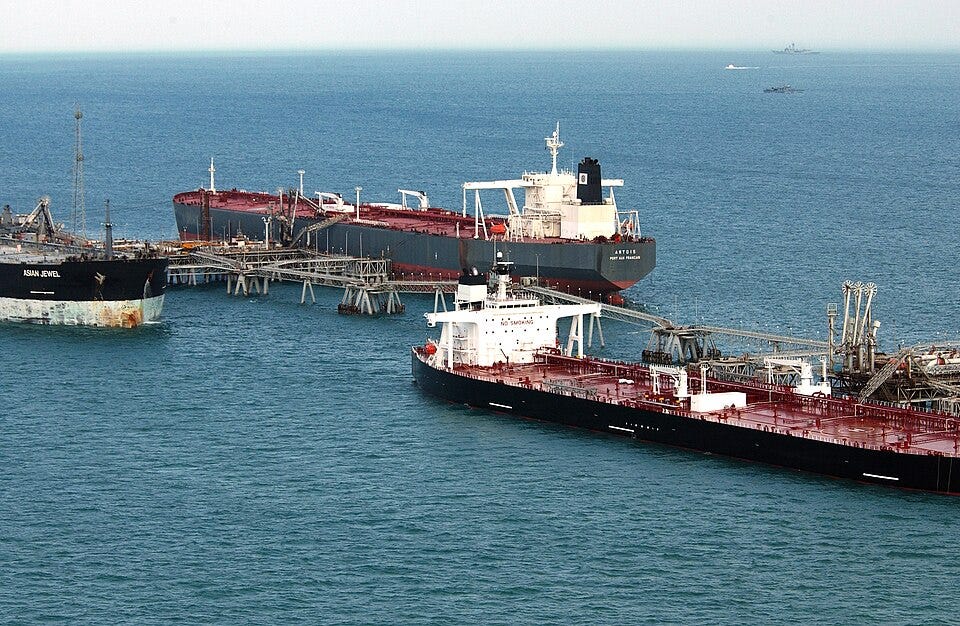
Multiple ship-tracking and energy-monitoring services - including Bloomberg, Kpler, LSEG, and MarineTraffic - confirmed that the Chinese-operated supertanker Yuan Hua Hu, a COSCO Very Large Crude Carrier, transited the Strait on Wednesday morning before temporarily disappearing from tracking systems near Larak Island and later reappearing in the Gulf of Oman. The tanker had been stranded inside the Persian Gulf since early March after loading nearly two million barrels of Iraqi crude at Basra and is now headed toward Zhoushan, China. Reuters and ship-tracking data identified it as the third known Chinese supertanker passage since the war began in February, while Iran’s Fars News Agency reported that at least six Chinese vessels, including bulk carriers, transited in recent days.
.jpg)
This development captures Iran’s strategic logic in its clearest form. Tehran is not reopening the Strait, it is selectively granting access under Iranian-defined rules while presenting the process as an act of sovereign authority. The phrase “Iranian management protocols” is central to this strategy. Iran is effectively implementing a controlled toll-and-access system over the Strait - the same framework Tehran has sought to formalize legislatively - but it is doing so by rewarding China rather than conceding to American demands.
Foreign Minister Abbas Araghchi reinforced this approach during the BRICS Foreign Ministers’ meeting in New Delhi, held simultaneously with Trump’s summit in Beijing. Araghchi stated that ships not involved in war against Iran could pass through the Strait, but only if they coordinated with the Iranian navy. This was not a declaration of reopening; it was the assertion of Iranian administrative authority over one of the world’s most critical waterways.
While in New Delhi, Araghchi also accused Washington of sending “contradictory messages” and said Tehran had “no trust” in the United States. He described the ceasefire as unstable, warned that Iran was prepared to resume fighting if necessary, and insisted there was “no military solution” to the conflict. Most importantly, he articulated what has increasingly become Tehran’s long-war doctrine: “We resist all pressure and sanctions. My country has been the target of severe American sanctions for more than forty years, but those policies did not change ours.”
This statement reflects more than rhetoric. Iran’s leadership believes it has already absorbed the harshest pressure Washington can realistically impose short of full-scale occupation and that economic strain inside the United States will eventually push Washington toward compromise. Iranian Parliament Speaker Mohammad Bagher Ghalibaf highlighted this narrative by pointing to the U.S. Treasury’s recent $25 billion auction of 30-year bonds at a high yield of 5.046%, describing it as evidence that the financial costs of the war are reaching levels not seen since before the 2008 financial crisis. Even Secretary of State Marco Rubio acknowledged during the Beijing summit that the United States is “not immune to global oil prices at some point,” precisely the vulnerability Tehran is attempting to exploit.
Against this backdrop, the Beijing summit produced a mixed outcome for Iran, despite competing public narratives from both Washington and Beijing. Trump claimed that Xi Jinping committed to not sending military equipment to Iran, calling it “a big statement.” According to the White House readout, both governments also agreed that Iran must never obtain a nuclear weapon and that the Strait of Hormuz must remain open to guarantee the free flow of global energy supplies. Trump additionally stated that Xi had expressed interest in purchasing more American oil in order to reduce Chinese dependence on Persian Gulf routes.
Yet Beijing’s own official readout made no mention of Iran whatsoever, referring only to vague discussions about the “Middle East situation.” That omission was itself significant. China is attempting to position itself simultaneously as mediator, energy customer, and geopolitical balancing power without formally aligning itself with either Tehran or Washington.
What China did achieve, and what Iran allowed, was the controlled transit of Chinese oil shipments through the Strait. This arrangement benefits both sides. China secured critical energy access through quiet diplomacy, while Iran demonstrated that it can selectively reward allies and punish adversaries without relinquishing control over the Strait itself. At the same time, the Iranian parliament continues advancing legislation that would formalize tolls and regulatory authority over all vessels using the waterway, even in peacetime. South Korea, whose cargo vessel was reportedly attacked less than two weeks ago in what Seoul believes was likely an Iranian strike, warned that such measures are “effectively equivalent to blocking the waterway.”
American officials were fully aware of these dynamics, but attempted to downplay them. Before the summit, both Rubio and Treasury Secretary Scott Bessent openly urged Beijing to pressure Tehran into reopening the Strait. Yet once in Beijing, Rubio shifted his tone dramatically, insisting: “We are not asking for China’s help. We don’t need their help.”
The reversal appeared partly tactical, aimed at avoiding signaling weakness to Tehran. However, it also revealed a deeper contradiction within Washington’s strategy. The United States wants China to pressure Iran, but without paying the geopolitical price Beijing would likely demand for such cooperation. That price could include concessions on trade or Taiwan policy. During the summit, Xi reportedly warned Trump that mishandling Taiwan could lead to “clashes and even conflicts,” while American officials worried that Beijing might use the Iran crisis as leverage to reduce U.S. arms sales to Taipei.
Bessent later told CNBC that he believed China would work “behind the scenes” to help reopen the Strait, though he added an important qualification: “if anyone can influence Iran’s leadership decisions at all.” That caveat reflects the core reality confronting Washington. Tehran has repeatedly insisted it will only return to meaningful negotiations once it believes the United States is prepared to offer what Iran considers a “fair agreement,” a framework that includes sanctions relief, recognition of Iran’s right to enrich uranium, and acknowledgment of Iranian authority over the Strait. Washington has firmly rejected the last demand, while the first two remain unresolved.
Meanwhile, the Pakistani mediation channel that helped broker the April ceasefire appears increasingly fragile. Araghchi himself described the process as being in “difficulty” - not collapsed, but no longer functioning effectively. Until progress emerges on central disputes, Iran’s strategy remains unchanged: maintain pressure on global energy markets, selectively reward partners such as China through controlled access to the Strait, and wait for economic and political pressures to build inside the United States.
Trump’s upcoming decision on whether to ease sanctions on Chinese companies purchasing Iranian oil may therefore become the most important near-term signal of all. Trump said he would announce his decision “in the next few days.” If sanctions are eased, the move would simultaneously reward Beijing, provide indirect economic relief to Tehran, and reinforce Iran’s belief that strategic patience works. If sanctions remain in place, the dual blockade continues and the ceasefire remains - in Trump’s own words - on “massive life support,” risks of a breakdown from stalemate to a new phase of the war will continue.
For now, the image defining this phase of the conflict is clear: a Chinese supertanker sailing toward Zhoushan through a Strait still controlled by Iran, under protocols defined by Tehran, following a summit that produced no formal agreement - while the Islamic Republic presents the outcome as a strategic success.