

The explosions began sometime after nightfall on Thursday. Residents of Bandar Abbas, Qeshm Island, Sirik, and Minab reported hearing enormous blasts and the sustained crackle of anti-aircraft fire. In Tehran, the state news agency IRNA confirmed that “after two enormous blasts, continuous anti-aircraft fire was heard for several minutes in western Tehran.” By morning, the world was debating whether a ceasefire that had held for four weeks was still alive, and each side was telling a completely different story about what had happened.
The confrontation did not come without warning. Since the broader US-Iran war began on February 28, when Israel and the United States launched strikes against Iran, Tehran had shut down commercial traffic through the Strait of Hormuz, the narrow chokepoint through which roughly 20 percent of the world’s oil and liquefied natural gas normally flows. A ceasefire was declared on April 7 and extended indefinitely by President Donald Trump on April 21 to allow time for negotiations. But the ceasefire had never resolved the fundamental dispute over the Strait itself, and in the weeks that followed, Washington steadily escalated its efforts in a bid to crack it open.
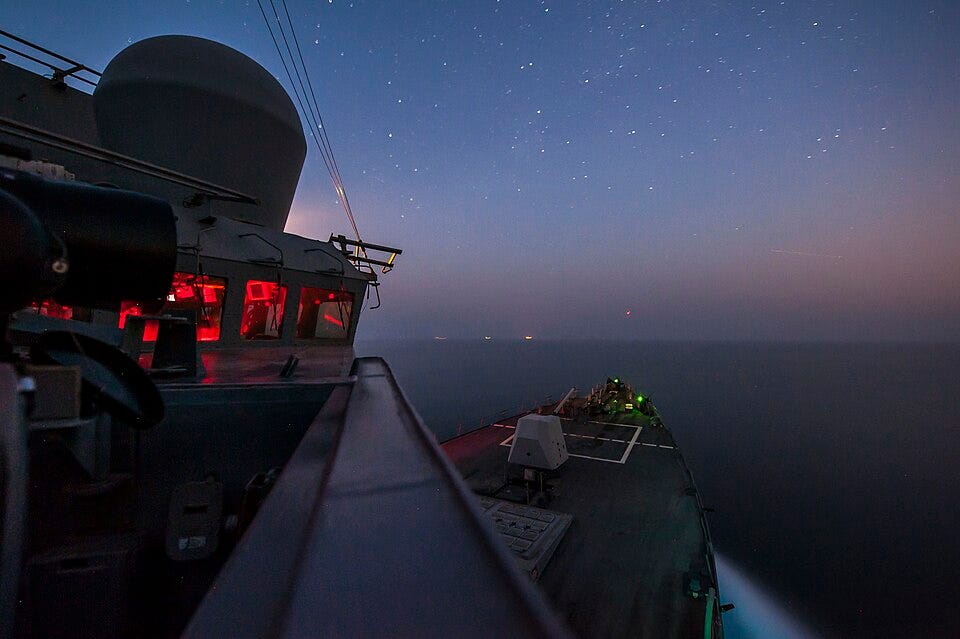
The three American vessels at the center of Thursday’s incident - the USS Truxtun, the USS Rafael Peralta, and the USS Mason - were transiting the Strait of Hormuz outbound toward the Sea of Oman when, according to US Central Command, they came under what it described as an “unprovoked” attack involving missiles, drones, and fast-attack boats. American officials told CBS News the assault was “more intense and sustained” than any previous engagement involving U.S. vessels in this conflict. Iranian fast boats maneuvered close enough to the destroyers that their deck guns opened fire. The Phalanx close-in weapons systems were activated. Apache helicopters engaged with Hellfire missiles and heavy-caliber guns. Support aircraft provided layered air defense from above. CENTCOM said it destroyed the incoming threats and struck Iranian military facilities in response, including missile and drone launch sites, command-and-control nodes, and intelligence and surveillance positions. A Fox News correspondent, citing a senior American official, stated that the US military also struck Iran’s naval base at Bandar Karghan in Minab. CENTCOM stated that none of its three vessels were hit.
_140720-N-EI510-076_(14771746281).jpg)
Iran’s account was categorically different. The Khatam al-Anbiya central military command, which oversees Iran’s war operations, accused the United States of firing first by striking an Iranian oil tanker traveling from Jask toward the Strait, and a second vessel near the UAE port of Fujairah. It further accused American forces, acting “with the cooperation of certain regional countries,” of launching airstrikes against civilian areas along the coasts of Bandar Khmir, Sirik, and Qeshm Island. Iran said its forces responded immediately, striking American military vessels east of the Strait and south of Chabahar, inflicting what it described as “significant damage.” The IRGC Navy went further, claiming a “massive and precise combined operation” using ballistic and cruise anti-ship missiles alongside explosive drones that caused three American warships to sustain serious damage before rapidly withdrawing from the Strait. Iranian state broadcaster IRIB accompanied these statements with video footage purportedly showing missiles being launched toward American ships.
What the satellites could see offered partial corroboration of the chaos, if not its causes. NASA’s VIIRS infrared imagery taken after the exchange detected at least two fires burning in the Strait. The first was located roughly 30 kilometers from Larak Island in the northern Strait, near Iranian coastal waters, consistent with Iran’s claim that one of its tankers had been struck near Jask. The second was burning in the corridor the US Navy had designated for commercial transit during Operation Freedom, and appeared to drift approximately six kilometers over 110 minutes, suggesting a vessel was on fire and moving with the current. Visual confirmation later emerged of at least one, and possibly two or three, vessels burning in the Strait, though ownership could not be immediately established.
Today, the U.S. military reported firing on several “empty” tanker vessels seeking to break the U.S. blockade, adding to the toll of the flaring hostilities.
In the days before the clash, the United States had been running what it called “Project Freedom,” a bid to escort commercial vessels through the Strait by naval force. Satellite imagery confirmed at least two Arleigh Burke-class destroyers operating in the area, alongside reconnaissance aircraft, AWACS planes, and at least six aerial refueling tankers flying over UAE and Saudi airspace. Apache AH-64 attack helicopters had been deployed to Al-Minhad Air Base in the UAE. On May 4, two destroyers had already transited the Strait and, after encountering Iranian resistance, repositioned west of the UAE. Two commercial vessels had attempted passage through a southern corridor near Omani coastal waters. What happened next remains somewhat unclear. Additionally, the UAE came under heavy fire, reportedly from Iran, with strikes on the Fujairah oil port.
What happened next is a muddled picture. Reporting from NBC News asserted that Saudi Arabia and Kuwait had closed their territory for use in Project Freedom, suggesting hesitation with further escalation against Iran. However, the Wall Street Journal contradicted this, saying both countries had kept their airspace and bases open. Regardless, President Trump ordered the operation suspended roughly 48 hours after it began. Yet, subsequent events appear to indicate that if a decision was made to halt the military operations in the Strait of Hormuz, it was later reversed - triggering the latest wave of hostilities playing out on the water.
Also on Monday, May 5, a Chinese-owned and crewed oil products tanker was reportedly struck by an Iranian missile in waters off the UAE coast — with sources variously placing the location near the port of Al-Jeer or near Fujairah, two closely situated but distinct points along the UAE’s eastern coastline. China’s foreign ministry confirmed the incident, with spokesman Lin Jian noting no crew casualties but expressing concern for vessels caught in the conflict. According to Reuters, citing Chinese outlet Caixin, this was the first time a Chinese-flagged vessel had been hit by Iranian fire since the war began. The timing was diplomatically damaging: President Trump is scheduled to travel to Beijing within days for a summit with President Xi Jinping, his first visit to China since 2017. U.S. Ambassador to the United Nations Mike Waltz pointedly highlighted the strike on the Chinese vessel at a press conference, suggesting Iran had attacked one of its few remaining international supporters.
Separately, Iran’s Army announced the seizure of the tanker Ocean Koi - also known as Jin Li - in the Sea of Oman. The 228-meter Panamax-class vessel, flying a Barbados flag, had been sanctioned by the U.S. Treasury in February 2026 for allegedly carrying Iranian oil and gas condensates. Iran said naval commandos and marines boarded it under a Supreme National Security Council directive and a judicial warrant, bringing it to Iran’s southern coast and turning it over to judicial authorities. Tehran accused the vessel of exploiting the regional situation to disrupt Iranian oil exports.
In the hours after the exchange, Trump largely downplayed the exchange while issuing a major threat. In an ABC News interview, he called the episode “a little friendly tap,” asserted all three destroyers had transited the Strait without damage, and insisted the ceasefire remained in effect. In a later post on his social media platform, he claimed Iranian forces had been “completely destroyed,” their fast boats sunk, and their drones “burned in the sky” - falling, in his words, “like a butterfly drifting toward its grave.” He warned Tehran that if it did not “quickly” sign a deal, America would respond “much harder and more aggressively” in the future, and announced that the three destroyers would return to what he called the “steel wall” of the American naval blockade. Speaking to reporters, he also suggested that if Iran did not agree to a deal, that the U.S. would make Iran “glow,” which many interpreted as a threat to use nuclear weapons.
Iran’s Foreign Minister rejected Trump’s framing entirely. Writing on X, Araghchi accused the United States of resorting to “reckless military adventurism” every time a diplomatic solution appeared within reach. “Iranians will never bow to pressure,” he wrote, “but it is diplomacy that always ends up as the victim.”
Araghchi also sharply disputed a CIA assessment - reported by the Washington Post based on four sources with knowledge of a classified intelligence document - suggesting Iran retains approximately 75 percent of its pre-war missile launchers and 70 percent of its missiles. “The correct figure is 120 percent,” Araghchi wrote, without providing evidence. The Washington Post’s reporting added other uncomfortable details for the Trump administration: that Iran is assessed capable of withstanding a naval blockade for 90 days or more, that Tehran has managed to reopen “nearly all” of the underground facilities bombed by Israel and the United States, and that the regime’s ideological hardening means it can absorb pressure far longer than previous Iranian governments might have. One American official quoted in the report was blunt: “You see that governments like these can last years under prolonged sanctions and war, especially when the other side is relying on air power alone.”
At the United Nations, the diplomatic battle over the Strait ran parallel to the military one. The United States, together with Bahrain, Saudi Arabia, the UAE, Kuwait, and Qatar, had been circulating a new Security Council draft resolution demanding Iran immediately halt all attacks and threats against commercial shipping, stop naval minelaying, and disclose the location of mines already placed in the Strait. If passed, the resolution could authorize sanctions against Iran and potentially the use of force if Tehran failed to comply.
Russia’s permanent mission to the UN announced on May 7 that it would not support any resolution using “unbalanced language” or one-sided demands, warning such texts would only deepen tensions and calling on Council members to avoid “artificially inflaming” the situation. Moscow and Beijing have proposed an alternative brief resolution aimed at facilitating a negotiated outcome through political and diplomatic means. A previous US-backed resolution that appeared to open a path to legalizing American military action against Iran was vetoed by Russia and China last month. Iran’s ambassador to the UN, Amir Saeid Iravani, urged member states to “act based on logic, fairness, and principles - not under pressure” - and to reject the new draft entirely. Araghchi separately wrote to the UN Secretary-General and the rotating Security Council president, condemning what he called a “one-sided and provocative” resolution and insisting on the international community’s responsibility not to allow aggressors to weaponize the Council.
Iranian military analysts and IRGC-affiliated outlets, meanwhile, outlined what they described as Iran’s available options going forward. These include the physical blockade of the Strait’s main traffic lane using stationary vessels, and expanded minelaying in both the primary shipping corridor and the alternative route designated by the US and the UK Maritime Trade Operations office in Omani waters near Khasab. The explicit strategic goal would be to leave only an Iran-controlled corridor as a viable passage for commercial ships, reinforcing that any vessel wishing to transit must do so on Iranian terms, while making the American-designated route too dangerous to use.
Whether Thursday’s exchange represents a contained episode or the beginning of a new and more dangerous phase remains deeply uncertain. Both sides claim the other fired first. Both sides claim the other sustained greater damage. Both sides insist they are not seeking further escalation, while simultaneously warning of consequences if provoked again. Trump called it a friendly tap and announced the blockade continues. Araghchi called it an act of aggression and said diplomacy has once again been sacrificed. Somewhere in the waters between Qeshm and the Sea of Oman, three or more vessels, their flags and fates still not fully established, continued to burn.