

The Houthis have made striking battlefield gains along Yemen’s western coast, capturing the strategic port of Mokha and advancing toward positions that could substantially increase their ability to threaten shipping through the southern Red Sea. The offensive has dealt a serious setback to the Saudi-backed Presidential Leadership Council government in Yemen. If consolidated, these gains could also strengthen Iran’s bargaining position by increasing pressure on the maritime routes that Saudi Arabia depends on to bypass disruption in the Strait of Hormuz.
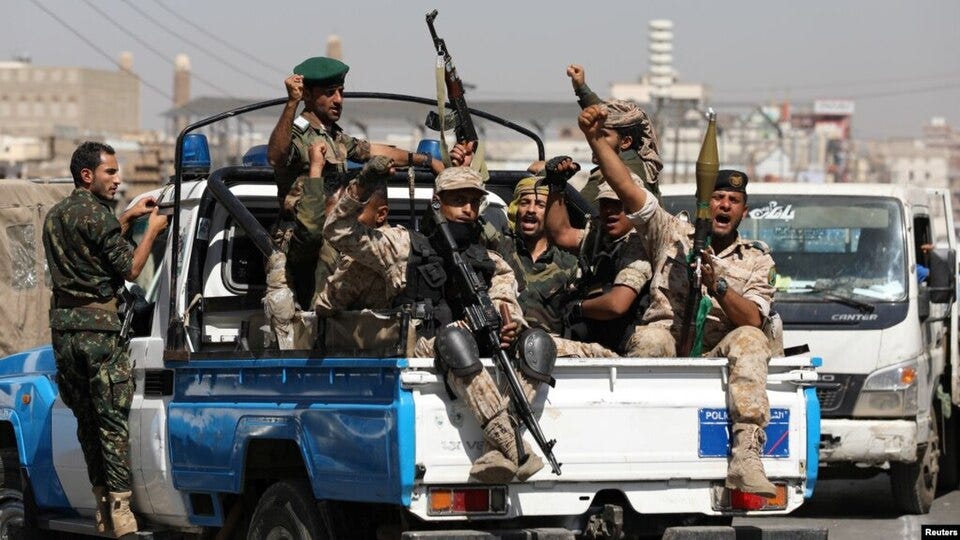

The Associated Press reported the capture of Mokha on September 10, while Reuters cited two Presidential Leadership Council sources saying Houthi forces had reached the Hanish islands, which are positioned just to the north of the Bab el-Mandeb Strait in the center of the Red Sea. Tareq Saleh, a commander aligned with the Presidential Leadership Council, acknowledged withdrawing south of Mokha to regroup. Together, these developments point to a significant reversal along the western coast, although the extent and durability of Houthi control over offshore positions remain unclear.
The advance follows escalating attacks between the Houthis and Saudi Arabia following the Saudi kingdom’s bombing of Sanaa International Airport on July 13, which was intended to disrupt an incoming flight from Iran. Saudi authorities reported that Houthi strikes on September 8 wounded 73 people and set oil installations ablaze. The Saudi-led coalition reported further missile and drone attacks the following day against Abha, Khamis Mushait and Jazan. The fighting has increasingly connected Yemen’s territorial conflict with the security of Saudi energy infrastructure and regional shipping.
Mokha matters because it anchors a strategically important stretch of Yemen’s Red Sea coast north of Bab el-Mandeb. Its capture removes a major Presidential Leadership Council-held position and gives the Houthis a stronger base from which to press south. The Hanish islands lie offshore, farther north than the narrowest section of the strait. An enduring Houthi presence there could broaden the movement’s maritime reach, but reports of forces reaching the islands do not establish that the entire archipelago has been secured.
Farther south, Dhubab and Mayun - also known as Perim Island - are particularly consequential because of their proximity to the passage itself. Control over these locations would have more direct implications for the immediate approaches to Bab el-Mandeb. Available reporting does not establish that both have fallen to the Houthis, making their status important to assessing the offensive’s next stage.
The inland terrain could be equally important to whether the coastal gains endure. The mountainous areas of southwestern Taiz - subject to a longstanding Houthi siege - could make Houthi positions considerably harder to recapture than territory across the coastal lowlands. If secured and fortified, these heights could provide a substantial defensive advantage, complicating counterattacks and helping protect routes supplying coastal forces. Positions overlooking the approaches to Bab el-Mandeb could also improve the ability to monitor and threaten movement toward the strait. The capture of the entire southern Taiz highlands, including al-Turbah, has not been established, but their strategic importance lies in the possibility of turning a rapid advance into a durable foothold.
The distinction between threatening a waterway and fully controlling it remains essential. Possession of Yemen’s shoreline would not automatically give the Houthis uncontested command of an international passage. Yet they would not need complete control to impose substantial costs. Shipping companies and insurers can reduce traffic, reroute vessels or raise charges in response to a credible and persistent risk of attack.
For Saudi Arabia, the kingdom’s primary alternative to the disrupted Strait of Hormuz has become increasingly vulnerable in its own right. The kingdom’s East-West pipeline carries crude across Saudi territory to Yanbu on the Red Sea, allowing exports to bypass the Persian Gulf chokepoint. Southbound shipments from Yanbu toward Asian markets, however, still pass through Bab el-Mandeb. Northbound exports toward Suez follow a different route, so disruption at the strait would not eliminate every Saudi export option. It would nevertheless constrain an important outlet at a time when alternatives are already under pressure.
The economic effects are visible. The Financial Times reported that Saudi oil production fell to approximately 6.2 million barrels a day in August, down 23 percent from July, while crude exports declined to around 3.1 million barrels a day. The report linked the deterioration to Houthi threats against Saudi ports and disruption to shipping on the kingdom’s western coast. These pressures preceded Mokha’s fall; the latest territorial gains could make them more difficult to contain.
Oil prices rose sharply on September 10. Reuters reported Brent reaching $107.08 a barrel and U.S. crude $101.62 during trading, with increases of roughly six percent amid renewed tanker attacks and concerns about further supply losses.
For Iran, the potential strategic gain comes from simultaneous pressure on the Gulf and Red Sea export corridors. Iran’s disruption of the Strait of Hormuz has increased the value of alternative routes. Houthi pressure around Yemen can reduce the reliability of one of the most important alternatives, making it harder for Washington and its partners to sustain the confrontation while containing its economic consequences.
Increasing vulnerability for Saudi exports can tighten global supply and raise fuel prices. Protecting additional shipping routes can increase military demands on the United States and its partners. Continued insecurity can also give regional governments stronger incentives to seek an agreement that restores navigation. If Tehran can help deliver that outcome, its influence could become more valuable at the negotiating table.
A September 10 Reuters investigation, citing Iranian, Yemeni and regional sources, reported that Iranian weapons and Revolutionary Guard guidance assisted the Houthi offensive. Iran denies directing the movement’s operations, and there is both evidence of tight coordination between Tehran and the Houthis and indications that the Houthis remain an independent actor. For example, Iran is believed to have warned the Houthis against occupying Yemen’s capital Sanaa when the country’s ongoing civil war first ignited in 2014. The extent of Tehran’s influence matters: benefiting from an ally’s military pressure is different from being able to guarantee that the pressure will end. Any diplomatic bargain connecting the two conflicts would need to account for the Houthis’ own interests and demands.
Divisions among their opponents could further complicate efforts to reverse the advances. The anti-Houthi camp includes factions with different political objectives and relationships with Saudi Arabia and the United Arab Emirates. Saleh’s forces, originally established with Emirati support, favor a unified Yemen and have maintained Saudi ties. Southern separatists have pursued a different political project. The Associated Press also reported that separatist supporters obstructed the defense minister’s convoy in al-Dhalea, illustrating tensions within the broader government-aligned camp.
The offensive could therefore change the regional conditions under which the Iran–U.S. war is contested and the leverage each side will have should negotiations resume to end it. Holding Mokha, consolidating inland defenses and extending influence toward Bab el-Mandeb could give the Houthis a more enduring ability to threaten Saudi export routes, and give Iran additional bargaining power. That advantage remains conditional. Washington and Riyadh could respond with further escalation that alters the dynamics on the ground, while higher energy prices and prolonged insecurity are likely to deepen civilian hardship. For ordinary Iranians and other regional populations, any gains or losses of leverage will be most consequential if they can be traded in for an agreement that reduces the fighting, eases economic pressure and restores trade.