

The NIAC Capitol Insider is a digest tracking the latest from Congress on Iran-related policy developments, legislation, votes and more. This resource is designed to give our community a clearer, more comprehensive understanding of how Congress is approaching Iran policy by breaking down votes, providing policy analysis, and updating on key congressional actions.
Senate Weighs Adding Iran to Bipartisan Russia Sanctions Bill
The House Approves $95 Billion Spending Package
The House Passes Another War Powers Resolution, and the Senate Falls Short
Hegseth Testifies in Congress for More Iran War Funding
NDAA Advances in the House After Stalling in the Senate
The House of Representatives has now adjourned for August recess and will return in September, while the Senate remains in session. As Congress enters the final stretch before recess, lawmakers spent last week continuing to grapple with the administration’s ongoing, illegal war in Iran – from renewed efforts to assert Congress’s war powers authority to growing disputes over how to fund and oversee the conflict.
With the House advancing additional war funding through the reconciliation process, the Senate blocking movement on the NDAA, and lawmakers on both sides of the aisle raising questions about the administration’s strategy and endgame, debates over Congress’s power of the purse are poised to play a central role in shaping the next phase of the Iran war debate.
Senate Weighs Adding Iran to Bipartisan Russia Sanctions Bill

This week, Senate Republicans are continuing negotiations over whether to add new sanctions on Iran to a bipartisan Russia sanctions bill named after the late Senator Lindsey Graham (R-SC). While the original bill is intended to increase economic pressure on Russia through new sanctions targeting its energy sector, the scope of any Iran-related provisions is not yet known. An initial vote on the measure could come as soon as Tuesday, with final passage later in the week.
Originally developed by the late Sen. Lindsey Graham (R-SC) and Sen. Richard Blumenthal (D-CT), the legislation is now being led by interim Sen. Darline Graham Nordone (R-SC), Graham’s sister and successor, who has been working with Blumenthal on the proposal to include Iran.
The proposal has drawn a mixed response from Senate Democrats. Sen. Richard Blumenthal (D-CT), the lead Democratic sponsor of the Russia sanctions bill, said he would support sanctions on Iran if considered separately but indicated he would prefer to keep the legislation focused on Russia. Other Democrats, including Sen. Mark Warner (D-VA), said they had not yet seen enough details to evaluate the proposal, while Sen. Tim Kaine (D-VA) suggested adding Iran was unlikely to become a deal breaker and could serve as an additional deterrent without putting U.S. troops at greater risk.
Entirely absent from the debate on Capitol Hill thus far is why sanction Iran now, amid a war, particularly when economic pressure has failed to achieve any outcome other than impoverishing ordinary people in Iran and paving the path to war. Moreover, any new sanctions are likely to provoke a sharp response from Iran, potentially undermining diplomatic negotiations to end the war, which will likely entail the relief of sanctions.
Senate Majority Leader John Thune (R-SD) has indicated that negotiations are ongoing as lawmakers work to finalize the package before the Senate departs for August recess. Whether Iran is ultimately included remains unresolved, but the discussions signal that sanctions legislation may become another major avenue through which Congress debates and legislates on Iran.
The House Approves $95 Billion Budget Resolution
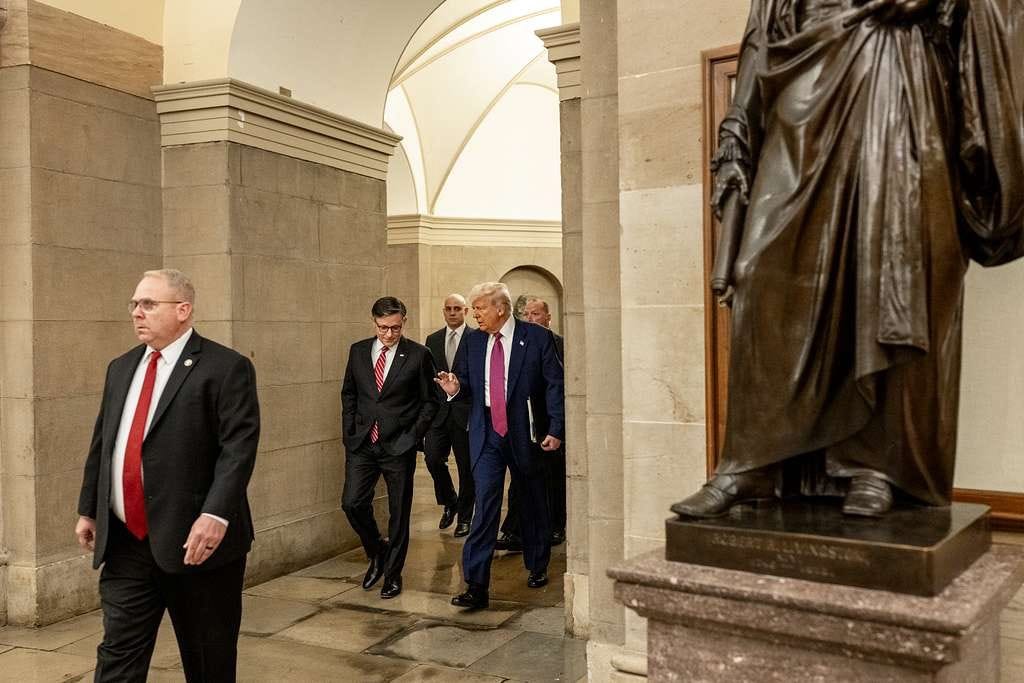
Last week, the House approved a budget resolution that includes approximately $60 billion in additional defense spending related to the Iran war, alongside funding for other national security initiatives and domestic priorities. However, the resolution itself does not provide funding; House committees must still draft the underlying legislation before Congress can consider a final package.
The 216-214 vote serves as the first procedural step of this special legislative maneuver known as “reconciliation.” Several more steps would be needed in order to pass the funding into law.
Reconciliation is a special budget process that allows certain spending and tax-related legislation to pass the Senate with a simple majority of votes, bypassing the usual 60-vote threshold needed to overcome procedural delays in the Senate. By using reconciliation, House Republicans are attempting to advance the package through a divided Congress with fewer obstacles.
For lawmakers opposed to the war, the reconciliation process could become the next major congressional battleground. While recent War Powers votes have focused on the President’s authority to continue military operations without congressional authorization, the upcoming funding debate will test whether Congress is willing to continue financing those operations through the appropriations process. The Senate is not necessarily sold on the reconciliation strategy, though ultimately it may follow the House’s lead and begin its own work on a matching package.
The House Passes Another War Powers Resolution, and the Senate Falls Short
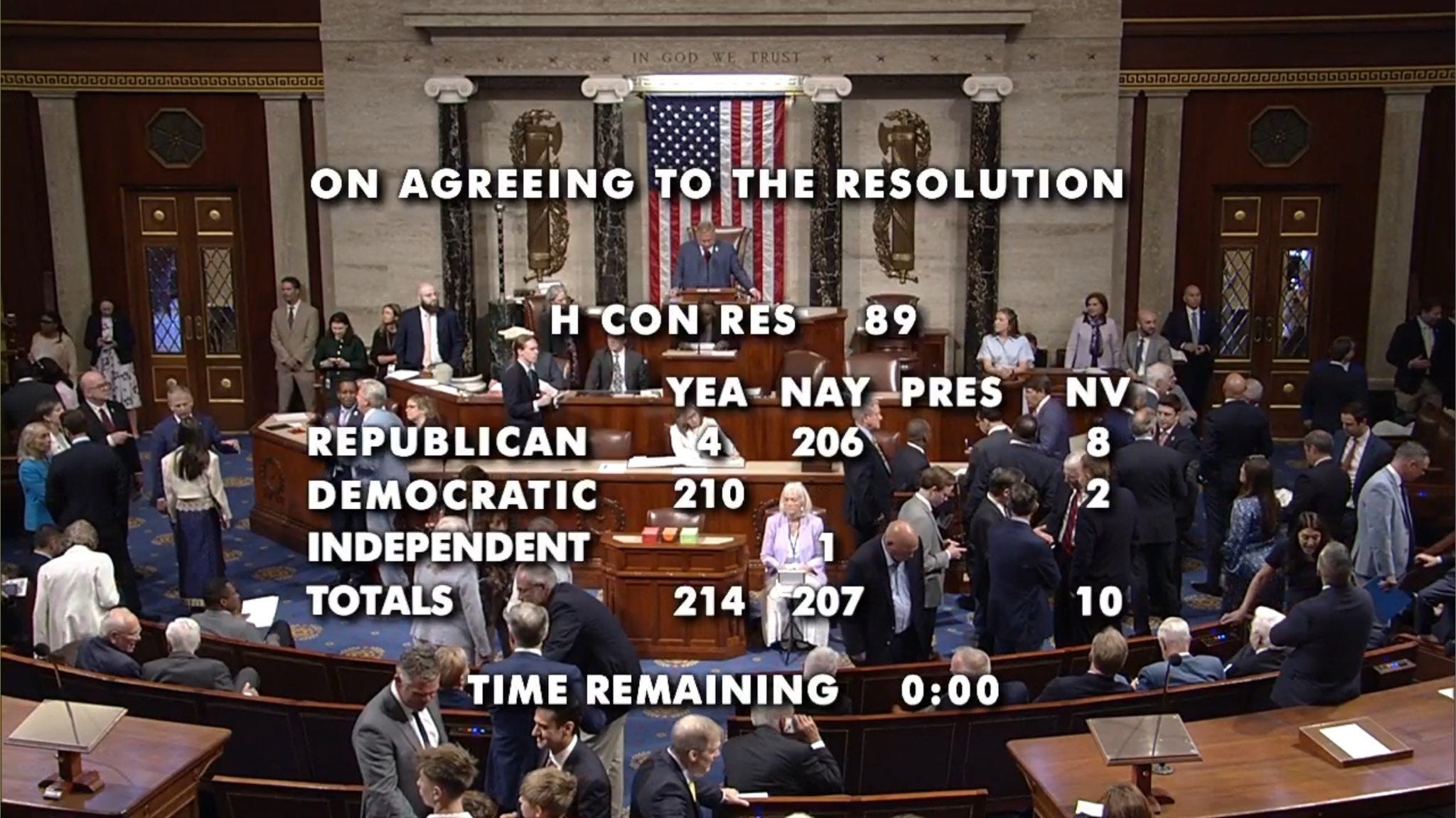
Last week, the House once again moved to assert Congress’s constitutional authority over decisions of war and peace, narrowly passing a War Powers Resolution offered by Rep. Pramila Jayapal (D-WA) directing the administration to end unauthorized U.S. military action against Iran. The 214-208 vote marked the second time in recent weeks that the House has approved a measure seeking to halt the war, with four Republicans voting in favor.
Despite the House’s successful vote, the Senate narrowly rejected its own War Powers Resolution, offered by Senator Chris Van Hollen (D-MD), by a vote of 47-49. Sen. Susan Collins (R-ME) was the only Republican to support the measure. Sens. Lisa Murkowski (R-AK) and Rand Paul (R-KY), who had voted in favor of past war powers resolutions on Iran, were absent, while Sen. Bill Cassidy (R-LA) voted against the resolution after voting in favor on several earlier votes.
The latest votes also come as questions remain unresolved regarding the legal force of H.Con.Res. 86, the bipartisan Iran War Powers Resolution led by Rep. Gregory Meeks (D-NY) that passed both the House and Senate in June. Democrats have continued to argue that the administration is obligated to comply with the resolution and have signaled they are prepared to pursue legal action to clarify its enforceability should the administration continue military operations without congressional authorization. To that end, Rep. Meeks has introduced a resolution directing Speaker of the House Mike Johnson to initiate legal action on behalf of the House to enforce H.Con.Res. 86.
While neither last week’s House vote nor the failed Senate measure is expected to immediately alter U.S. military operations, the repeated votes have continued to increase political pressure on the administration and congressional leadership. The House, in particular, has now twice demonstrated bipartisan support for reasserting Congress’s war powers, with a small but consistent group of Republicans breaking with their party to support efforts to limit unauthorized military action. As the conflict continues, conversations are increasingly turning to Congress’s power of the purse – funding – as the next potential avenue for constraining further military escalation.
Hegseth Testifies in Congress for More Iran War Funding
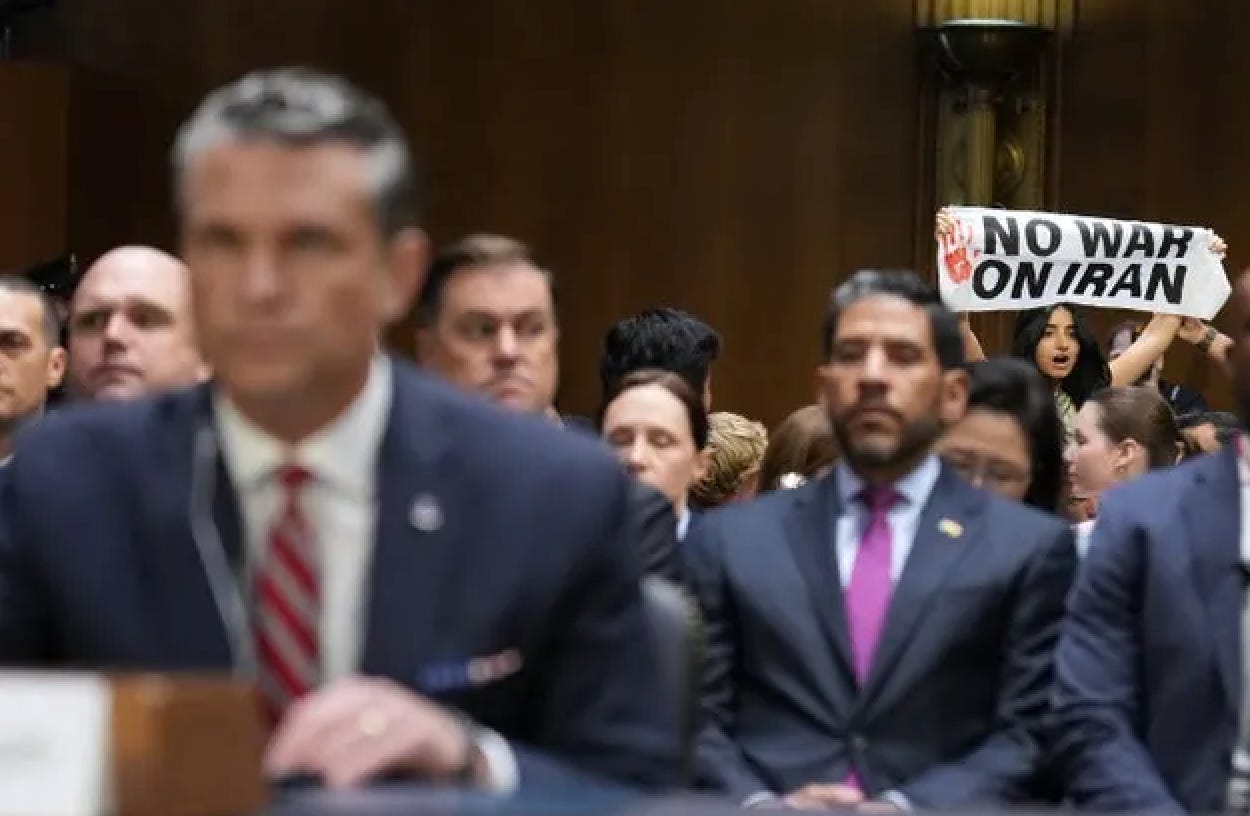
Defense Secretary Pete Hegseth and Chairman of the Joint Chiefs of Staff Gen. Dan Caine appeared before the Senate Armed Services Committee last week to defend the administration’s request for $87.6 billion in additional Pentagon funding, much of which would support ongoing military operations in Iran. The hearing provided lawmakers - and the public - with an opportunity to press senior administration officials on the cost, strategy, and long-term objectives of the conflict.
Lawmakers from both parties questioned whether the administration has a clear plan for ending the war. Sen. Susan Collins (R-ME) said lawmakers needed more information on “the strategy and endgame for the war” as well as the consequences of withholding additional military funding.
Other Republicans raised concerns over the conflict’s duration and consequences. Sen. Jim Justice (R-WV) warned there “has to be an off-ramp,” citing U.S. casualties and mounting civilian deaths in Iran.
Democrats also challenged the administration’s request for additional funding without a clear end strategy. Sen. Dick Durbin (D-IL) pressed Hegseth on the cost of the war, which the Defense Secretary estimated at approximately $37.5 billion to date. Sen. Gary Peters (D-MI) criticized the administration’s lack of a long-term plan, while Sen. Jeff Merkley (D-OR) raised concerns over continued strikes on civilian infrastructure, including desalination plants. Sen. Kirsten Gillibrand (D-NY) criticized the administration’s priorities, arguing that Congress was being asked for “unlimited money for bombs” while Americans struggle with rising costs at home.
The hearing underscored the growing questions over the cost, strategy, and endgame of the conflict. While the House has taken the first step toward advancing additional war funding through the reconciliation process, the future of the package remains uncertain in a Senate context, where lawmakers from both parties are expected to continue pressing the administration for answers on the path forward while also continuing to criticize U.S. conduct throughout the war.
NDAA Advances in the House After Stalling in the Senate
Congress took sharply different approaches to the annual National Defense Authorization Act (NDAA) over the past two weeks, underscoring how the Iran war has become a defining issue in this year’s defense authorization process.
Senate Democrats blocked advancement of the fiscal year 2027 defense bill earlier this month with a 50-46 vote along party lines.Republicans ultimately fell short of the 60 votes needed to bring the $1.14 trillion defense authorization bill to the Senate floor. NIAC Action was among 14 groups including the ACLU, Center for International Policy, J Street and Win Without War urging lawmakers to reject any defense authorization or appropriation amid the Iran war, which came out ahead of the vote.
Democrats argued that Congress should not move forward with the NDAA while the United States remains engaged in an unauthorized war with Iran. Senate Minority Leader Chuck Schumer (D-NY) characterized the bill as effectively giving the administration permission to continue military operations without congressional oversight.
Several Democratic Senators also objected to a provision that would enhance U.S.-Israel defense cooperation, including joint weapons research, production, and military technology integration. Senators including Chris Van Hollen (D-MD), Bernie Sanders (I-VT), Elizabeth Warren (D-MA), Ed Markey (D-MA), Jeff Merkley (D-OR), and Peter Welch (D-VT) urged their colleagues not to advance the NDAA until these issues could be debated and amendments considered.
Sen. Jack Reed (D-RI), the top Democrat on the Senate Armed Services Committee, said both the war and unresolved budget issues influenced his opposition to advancing the bill, while Sen. Tammy Duckworth (D-IL) called for restrictions preventing funds authorized through the NDAA from being used for the Iran war. Sen. Angus King (I-ME) similarly argued that Congress should have a broader debate about the war, its costs, and the administration’s strategy before moving forward.
Republicans criticized the move, arguing that delaying the NDAA risks holding up funding for service members, military readiness, and other defense priorities.
By contrast, the House moved forward with its own version of the NDAA last week, passing a $1.15 trillion defense authorization package by a vote of 216-212 before departing for August recess. The House bill includes military pay increases, investments in defense modernization, and other priorities backed by House Republicans, but advanced largely along party lines as Democrats objected to the administration’s ongoing war with Iran, the bill’s overall cost, and the inclusion of other controversial provisions, including voting-related measures and expanded U.S.-Israel defense cooperation. Six House Democrats, Representatives Henry Cuellar (D-TX), Don Davis (D-NC), Jared Golden (D-ME), Vicente Gonzalez (D-TX), Adam Gray (D-CA) and Marie Gluesenkamp-Perez (D-WA), joined Republicans in advancing the legislation.
This is particularly damaging as it increases the likelihood that Congress will advance the NDAA even amid the Iran war, reducing leverage to end the war. Lawmakers may now try to find a way around Senate opposition to advance the bill.
As the two chambers consider the path forward, the NDAA will remain another key forum for debate over Iran war funding, defense priorities, and Congress’s role in overseeing U.S. military operations.