

The NIAC Capitol Insider is a newly launched digest tracking the latest from Congress on Iran-related policy developments, legislation, votes and more. This resource is designed to give our community a clearer, more comprehensive understanding of how Congress is approaching Iran policy by breaking down votes, providing policy analysis, and updating on key congressional actions. See below for what our very first digest covers:
House War Powers Vote Breakdown
Senate War Powers Vote Breakdown
Senate Joint Resolutions of Disapproval Vote Breakdown
Looking Ahead: Next Senate War Powers Vote
Last week was consequential on the Hill for Iran policy – a one-vote miss on war powers in the House, continued pressure campaigns in the Senate, and the strongest showing yet for efforts to restrict arms sales to Israel.
Iran War Powers Resolution in the House
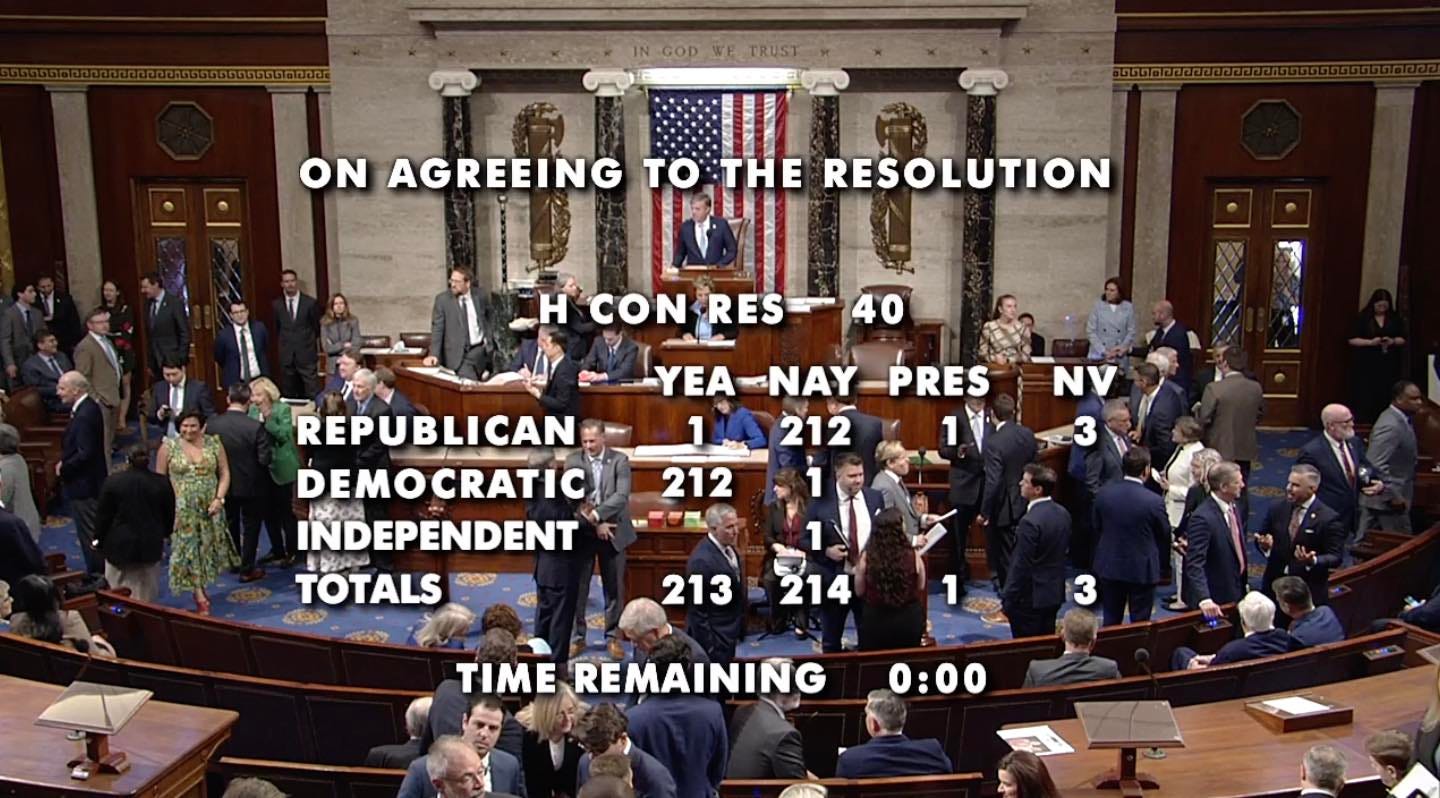
This latest war powers resolution in the House, H.Con.Res. 40, introduced by Reps. Gregory Meeks (D-NY), Adam Smith (D-WA) and Jim Himes (D-CT) received a vote on April 16, 2026, and failed narrowly by a vote of 213 - 214.
Every single House Democrat voted in favor of the resolution with the exception of Rep. Jared Golden (D-ME). Had Rep. Golden voted in favor, the measure would have passed, sending a clear signal to the Trump administration that congressional and public opposition to the war is substantial. It remains unclear whether Golden’s vote was purely substantive or part of a broader, quieter calculation among more hawkish, Israel-aligned Democrats to avoid putting the measure over the top while still allowing the caucus to show overwhelming support. Either way, his vote was decisive.
At the same time, the rest of the Democratic caucus held, including members who haven’t always been reliable yes votes on these issues. Notably, Rep. Juan Vargas (D-CA), Henry Cuellar (D-TX), and Greg Landsman (D-OH), who had voted against the last war powers vote, flipped to support the resolution this week, a signal that even some more moderate or traditionally pro-Israel Democrats are moving, at least on war powers and congressional authority.
On the Republican side, the latest vote reflected a more uneven and ultimately inconclusive shift. Rep. Warren Davidson (R-OH), who had notably come out in support of the last war powers vote after expressing concern for the administration’s aims with the war, voted present for this latest vote. A “present” vote signifies that a Member is physically present in the chamber, but is choosing not to vote.
Additionally, Rep. Nancy Mace (R-SC), one of Congress’ most notorious MAGA Members, has indicated in recent weeks her growing opposition to Trump’s war on Iran, citing concerns for the “clear gap between what’s being said publicly and what we were told behind closed doors.” Last month, she had even told reporters she would “most likely” vote for the House Democrats’ next war powers resolution. However, during last week’s vote in the House, Rep. Mace was notably absent from the chamber. It was reported that Rep. Mace’s father passed away last week on April 14, which many presume to be the reason why she was not present for the vote; a vote which she likely would have supported based on her recent statements.
These developments among some key House Republicans point to softening unease, but not yet the kind of active defections needed to shift the outcome.
Iran War Powers Resolution in the Senate
The Senate is telling a different story than the House – movement, but no breakthrough yet.
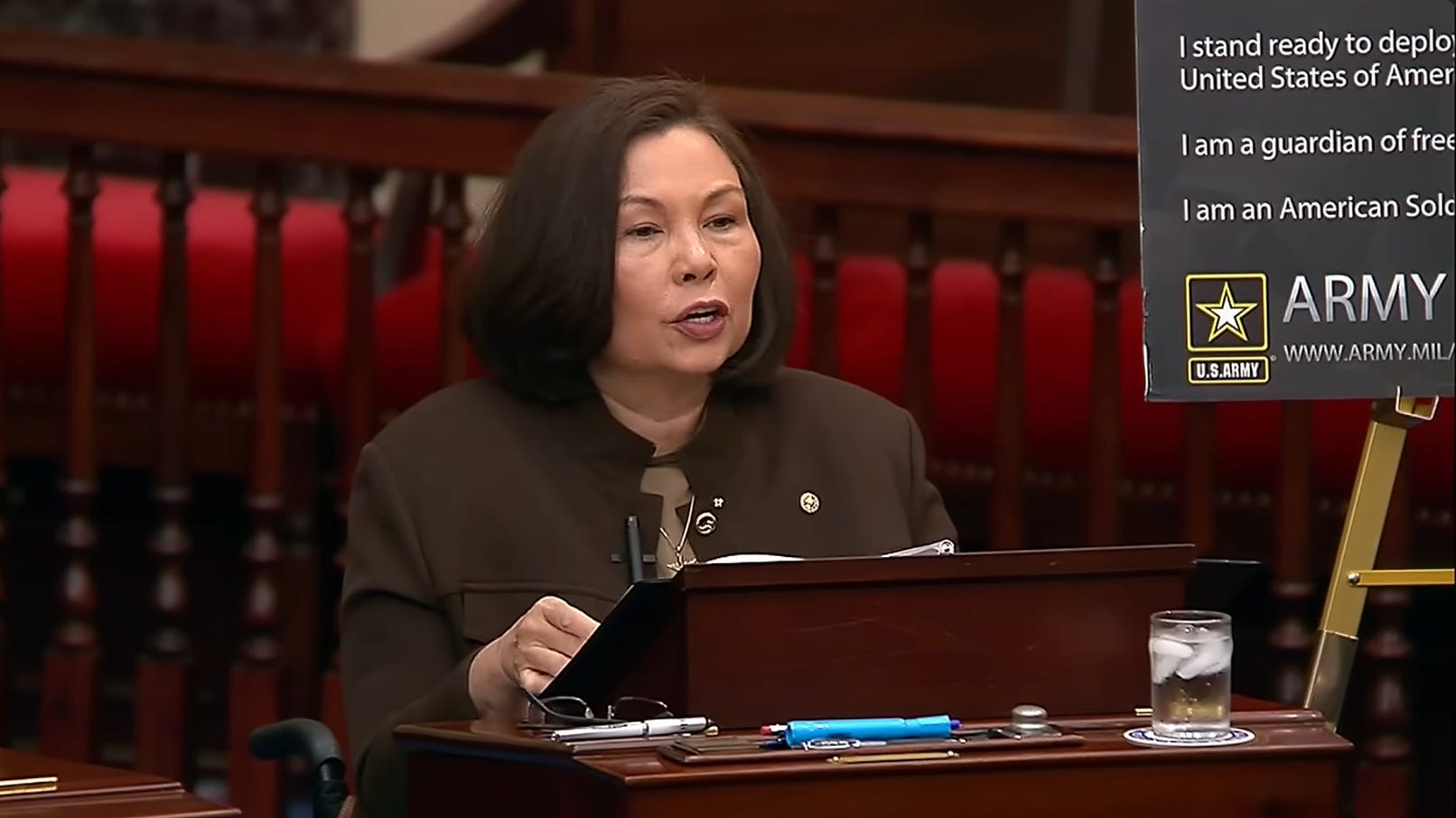
This latest war powers resolution in the Senate, S.J.Res. 123, introduced by Senator Tammy Duckworth (D-IL) received a vote on April 15, 2026, and was rejected in a 47–53 vote. The vote once again failed largely on party lines, with the exceptions of Republican Senator Rand Paul (D-KY) in favor of the resolution and Democrat Senator John Fetterman (D-PA) voting against it. This was the fourth official war powers vote in the Senate since the onset of the war.
Democrats are consistently forcing votes, but Republicans, almost entirely, are holding the line. Senate Democrats have indicated that they intend to continue forcing votes on war powers each week until one can eventually pass. This strategy was reflected by the filing of six new war powers resolutions this week by Senators Jeff Merkley (D-OR), Kirsten Gillibrand (D-NY), Chris Van Hollen (D-MD), Mark Kelly (D-AZ), Raphael Warnock (D-GA), and Andy Kim (D-NJ). The next batch of resolutions require 10 calendar days to ripen before being forced to the floor for votes.
With new resolutions being filed week after week, Democrats are effectively daring Republicans to keep voting against congressional authority as the 60-day War Powers clock runs down on April 29 — a key inflection point. Under the War Powers Resolution of 1973, the President may use military force in emergency situations without Congressional authorization but must either secure that authorization or terminate unauthorized hostilities within 60 days. While most experts agree Operation Epic Fury doesn’t meet the emergency standard to bypass Congress, this has been a central argument for lawmakers opposed to the War Powers Resolution — that the President has a 60 day window.
As that 60-day window closes, it is expected to become an increasingly consequential marker in the debate over the legality and continuation of U.S. involvement in Iran. Looking ahead, Republican lawmakers who argue the President can act for 60 days will either need to come up with a new legal argument for sidelining Congress, vote to end unauthorized military action, or vote to authorize the war. With war power votes failing on such narrow margins, a shift from at least four Republicans would enable future war powers resolutions to pass. As reported in The Hill last week, Senate Republicans are increasingly feeling the pressure of the 60-day mark and whether or not they can realistically, and legally, continue to support Trump’s war without formal Congressional approval.
Senate Effort to Block Arms Transfers to Israel
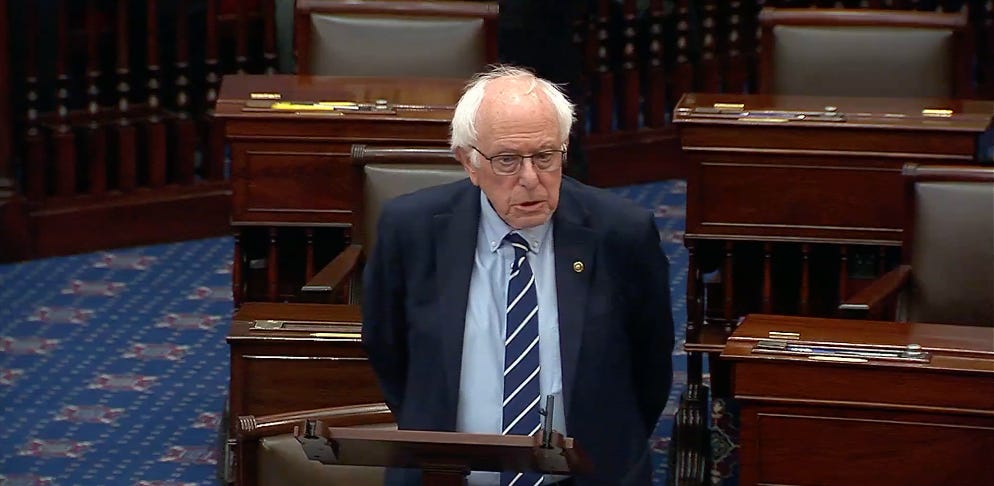
Where the war powers votes in the Senate remain stuck, Senator Bernie Sanders’ (I-VT) Joint Resolutions of Disapproval (JRD) saw their strongest Democratic support yet, signaling a growing willingness within the caucus to challenge arms sales, even if that shift hasn’t yet translated into passage.
A joint resolution of disapproval is a legislative tool used by Congress to overturn or block specific executive actions, including foreign arms sales. Senator Sanders has historically utilized this tool to challenge and force public votes on military aid to Israel, effectively putting Senators on the record for where they stand regarding the unconditional flow of arms to a state known for its gross human rights violations.
These resolutions, S.J.Res. 32 and S.J.Res. 138, led by Sen. Bernie Sanders (I-VT), sought to block approximately $446.8 million in U.S. arms sales to Israel, including bulldozers used in home demolitions and 1,000-pound bombs. The measures represented an effort by Senators to use Congress’s formal disapproval authority to prevent the transfer of offensive weapons amid ongoing war and destruction in Gaza, Lebanon, and Iran.
Both resolutions failed in the Senate on April 15, 2026, with votes of 40–59 and 36–63.
Despite the defeat, the votes underscored a substantial bloc of Democratic senators now willing to formally oppose specific arms transfers, even as the resolutions continue to fall short of passage in the face of unified Republican opposition.
Looking Ahead - Expected Senate Vote this Week on Next War Powers Resolution
The Senate is expected to vote on S.J.Res. 114 this week, the latest Iran War Powers Resolution introduced by Senator Tammy Baldwin (D-WI). As with the previous votes, the measure will serve as a key test of whether enough senators, particularly Republicans, are willing to break with the President and his very unpopular war.
Additionally, Congress is still expecting the Pentagon to present a formal supplemental budget request – estimated at over $200 billion. Notably, as the ceasefire deadline nears, President Trump has already threatened the resumption of bombing should the U.S. and Iran fail to reach an agreement. And after having used at least 45% of its stockpile of Precision Strike Missiles in the war thus far, the administration is likely to pursue billions of additional funding from Congress.
Key Takeaways
In the House, the margin for passing Iran War Powers to end the conflict has now narrowed to a single vote, while in the Senate war powers remain stuck but under continued procedural and political pressure. At the same time, Democratic support for challenging arms sales is slowly but steadily increasing, even as final passage remains out of reach.
As the 60-day War Powers deadline approaches, each vote is becoming more consequential, and the political pressure on both chambers is only set to increase. The fate of ceasefire negotiations with Iran will have a major impact on whether Congress moves from debating Trump's Iran moves to taking major steps toward constraining them.
We will continue tracking key developments in The NIAC Capitol Insider in the weeks ahead.