

The past 48 hours have marked a significant deterioration in the Iran–U.S. de-escalation dynamic, driven primarily by a sequence of moves from Washington that Tehran interpreted as signs of bad faith. Following Iran’s conditional reopening of the Strait of Hormuz on Friday, framed explicitly as a reciprocal gesture tied to the Lebanon ceasefire, President Trump publicly claimed credit for the development while simultaneously reaffirming that the U.S. naval blockade of Iranian ports would remain fully in place until a “100% complete” deal was reached. Iran’s response was swift and unmistakable: the Strait closed again within hours, ship traffic halted, and Iranian naval forces fired on vessels in the waterway — including, according to Trump, a French ship and a British freighter.
President Trump convened a rare Saturday meeting of head national security figures in the White House Situation Room to discuss the current situation with Iran and forthcoming negotiations. Trump’s reaction on Sunday, April 19 crystallized the contradictions now defining this moment. In a Truth Social post, he described Iran’s firing on the ships as “a Total Violation of our Ceasefire Agreement” and returned to bombastic threats to wipe out Iran’s civilian infrastructure, vowing to “knock out every single Power Plant, and every single Bridge, in Iran” if Tehran does not accept what he called a “very fair and reasonable DEAL.” He closed with the declaration: “IT’S TIME FOR THE IRAN KILLING MACHINE TO END.”
The threat to wipe out every power plant and bridge in Iran represents another threat to commit war crimes, which has been a feature of President Trump’s rhetoric amid the conflict with Iran. Significant civilian infrastructure has already been destroyed and severely damaged inside Iran, including schools, hospitals, energy infrastructure and a major bridge. Following through would spike the war’s harsh impact on civilians.
Separate reports indicate that the U.S. is preparing to escalate its blockade by boarding and seizing Iranian vessels. This would include ships carrying oil outside of Middle Eastern waterways, particularly in Asia. The threats seek to underscore that the U.S. has options to escalate and further squeeze Iran.
Yet, embedded in the same Trump post threatening war crimes against civilian infrastructure, was a confirmation that his representatives are traveling to Islamabad the following evening for a second round of negotiations. The threat and the invitation arrived in the same breath, a combination that has come to define Trump’s approach to Iran and that defies Iran’s mantra that it does not negotiate under pressure.
The continuation of the American blockade created an acute political problem inside Iran. Parliamentary Speaker Mohammad Bagher Ghalibaf, who led the Iranian delegation in Islamabad and has emerged as the most public face of the current negotiating effort, found himself under mounting pressure from two directions simultaneously: hardliners who viewed the reopening of the Strait as a concession that received nothing in return, and a broader public demanding transparency after Trump’s contradictory claims flooded Iranian social media. In an unusual move, particularly given the ongoing ceasefire’s fragility and the inherent security risks, Ghalibaf appeared in a lengthy televised interview, speaking directly to the Iranian public for the first time since the Islamabad talks.
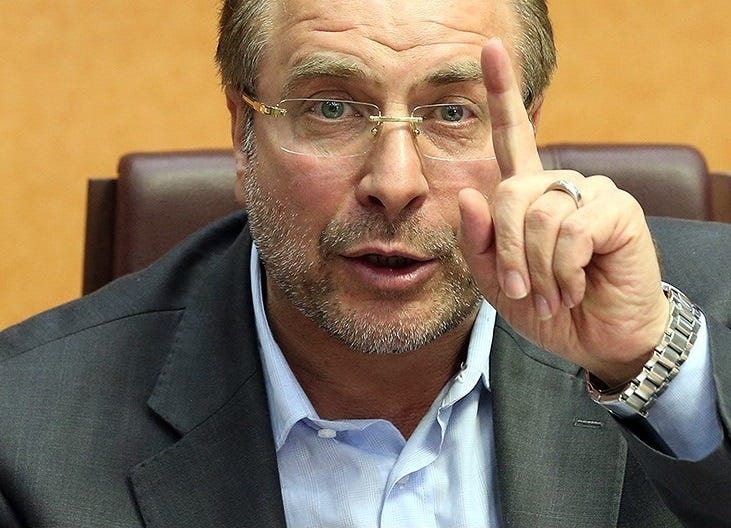

The interview was a carefully structured act of political management. Ghalibaf’s central task was to justify the decision to negotiate at all, to defend the ceasefire as a product of Iranian leverage rather than American pressure, and to neutralize voices calling for either total military victory or complete rejection of talks.
Ghalibaf offered a pointed corrective to triumphalist narratives circulating in Iranian media. He was unusually direct: America is unambiguously stronger than Iran in raw military terms, in equipment, funding, experience, and firepower. “We didn’t destroy them,” he said. “We won the field. That is different.” Iran had succeeded not by matching American power but by outmaneuvering it.
Ghalibaf noted that Iran’s missile and drone systems remained operational despite 39 days of strikes, its forces had downed approximately 180 enemy drones and successfully targeted an F-35. Ghalibaf also asserted that the U.S. had attempted a ground incursion, but been repelled. Referring to the U.S. military operations in early April framed as a successful pilot rescue, Ghalibaf stated “In Isfahan, they faced a debacle worse than the Tabas disaster. They intended to support counter-revolutionary forces through our western and eastern borders. (Trump) even admitted himself that he had supplied them with weapons. Every effort he made failed. He sought to incite internal unrest before and during the war, but was unable to do so. The enemy also decided to launch a ground offensive, but could not carry it out.”
He continued: “The enemy tried to open and seize the Strait of Hormuz, and called upon NATO and the world for support, but no one responded — and he himself could not do it either. So it is clear that we are victorious in this arena, something the enemy itself acknowledges. However, this is a different matter from claiming that we destroyed their army.” The enemy had failed to achieve any of its nine stated objectives, and failure to achieve objectives when you are the aggressor is itself a defeat. This battlefield success, Ghalibaf insisted, does not mean Iran defeated a superpower; it means Iran prevented one from imposing its will. This framing grounded the case for diplomacy in realism rather than bravado, pushing back against those calling for continued fighting on the grounds that total victory was within reach.
His account of the negotiations revealed a more intricate diplomatic sequence than previously understood. According to Ghalibaf, the U.S. opened with a 15-point proposal transmitted through Pakistan’s prime minister and army chief, reviewed by the Supreme National Security Council and relayed to Supreme Leader Khamenei in real time. Iran rejected the American framework and condensed its position into 10 points. Washington countered with 9 points, but Iran held firmly to its 10, and the U.S. ultimately accepted negotiating on Iran’s terms. Ghalibaf also disclosed a significant precondition not previously reported: before entering substantive talks, Iran demanded both a ceasefire in Lebanon and the release of frozen Iranian assets. Only after these conditions were partially met did Tehran agree to send a delegation to Islamabad.
Tehran set one further procedural condition: Trump himself must publicly announce a ceasefire request, so that the historical record would reflect that America sought the truce, not Iran. “This,” Ghalibaf said, “is assertive diplomacy.” Supporting Ghalibaf’s description, Trump’s post announcing the ceasefire ultimately did precede Iran’s own post accepting it.
Perhaps the most politically notable aspect of the interview was Ghalibaf’s candid description of direct, face-to-face talks with the U.S. delegation led by Vice President Vance. While Iran had declined direct engagement in previous rounds of diplomacy before the war, insisting on indirect channels, the Islamabad round moved to direct contact, a significant shift that Ghalibaf did not obscure. He told Vance directly that Iran had “zero trust” in the United States, cited Trump’s threatening tweets as evidence of American bad faith, and warned that the minesweeper incident in the Strait - where Iranian forces came close to firing on a U.S. vessel during the talks themselves - illustrated that Iran remained ready to escalate even at the negotiating table. The talks lasted 21 hours, included both indirect and direct rounds, and ended without a deal, with the main unresolved issues being Iran’s nuclear program and the status of the Strait of Hormuz.
The violation of the ceasefire in Lebanon was the sharpest point of divergence with Washington. Ghalibaf was explicit: the inclusion of Hezbollah in any ceasefire was a non-negotiable Iranian condition from the outset. The Resistance Front entered the fight on Iran’s behalf, and Iran could not accept a ceasefire that left its ally exposed. Pakistan, which mediated the talks, had included Lebanon and Hezbollah in its initial ceasefire announcement.
Heading into consequential negotiations in Islamabad, two parallel and unstable ceasefire arrangements hang in the balance. The Iran–U.S. truce is set to expire April 22. The Israel–Lebanon ceasefire, announced April 16, runs until April 26. Both are under active strain. Israel has declared a security zone inside southern Lebanon and acknowledged losing another soldier since the truce began. Hezbollah has stated it is “on the trigger,” and IRGC commanders have advertised that Iran’s missile and drone launch platforms are being replenished faster than before the war. Iran’s Foreign Minister Araghchi stated that the two sides were “inches away” from a memorandum of understanding before Iran encountered what he described as maximalism and shifting goalposts from the U.S. side.
President Trump has claimed that Iran loses $500 million per day from the closed Strait, while the U.S. “loses nothing.” Yet, this is more likely the result of positioning for tough bargaining than a statement of fact. Iran’s inability to export oil through its primary maritime corridor imposes severe short-term costs, yet the broader disruption to global energy markets, the exposure of U.S. allies in the Gulf, and the reputational cost of a protracted standoff that has now drawn France and Britain into the line of fire underscores the U.S. need to pivot toward a longer-term solution.
What April 19 makes clear is that the window before Tuesday’s ceasefire expiration could be extraordinarily compressed and volatile. The threat to destroy Iranian infrastructure, the confirmation of the next day’s talks, and the firing on European vessels in the Strait are all underscore that there is little room for miscalculation. The fundamental gap has not closed: the U.S. wants a deal that forecloses Iran’s nuclear option and formalizes control of the Strait. Iran wants one that ensures the war will not reignite, codifies its regional role, lifts the blockade, unfreezes its assets, and locks in the ceasefire in Lebanon. But the fact that delegations are still boarding planes for Islamabad, even as Trump promises to end what he calls “the Iran killing machine,” suggests that both sides understand the alternatives well enough to keep talking.